


























































How Long Does Certified Data Analyst Certification Take
Learn how long Certified Data Analyst certification takes including course duration study hours exam preparation time and factors that affect completion speed.

There comes a moment when you start thinking seriously about your career.
Maybe you’re scrolling through job portals.
Maybe a friend just got promoted.
Maybe you’re tired of feeling stuck.
And then you see it — Certified Data Analyst Certification.
It sounds professional. It sounds promising. But the first question that comes to mind is simple:
How long does Certified Data Analyst Certification take?
Is it a quick online course?
Is it a long academic program?
Will it take years?
Let’s walk through this step by step so you know exactly what to expect.
Understanding What Certified Data Analyst Certification Really Means
Before talking about time, it’s important to understand what you are signing up for.
A Certified Data Analyst is someone who can confidently:
- Collect and clean raw data
- Analyze numbers using tools and statistical techniques
- Create reports and dashboards
- Translate data into business insights
- Support decision-making with clear explanations
This is not just about learning software. It’s about learning how to think with data.
A proper Data Analyst Certification program builds both technical skills and analytical thinking. It prepares you for real business problems, not just textbook examples.
So, How Long Does Certified Data Analyst Certification Take?
Here’s the honest answer:
For most learners, it takes 3 to 6 months.
But that timeline depends on a few key factors.
Your Starting Point
If you already know:
- Basic Excel
- Some SQL
- Basic statistics
You may complete it faster.
If you are completely new to data analysis, you might need closer to 6 months.
And that’s perfectly okay. Learning something valuable takes time.
What Influences the Duration?
Let’s break it down in a practical way.
1. Study Mode
Self-Paced Learning
You study when you can. This usually takes 4–6 months if you spend 8–10 hours per week.
Instructor-Led Programs
Fixed schedules. Often completed within 3–5 months.
Bootcamp Style
Intensive programs. Can finish in 8–12 weeks, but require strong daily focus.
2. Practice Time
Analytics cannot be learned by watching videos alone.
You must:
- Work with real datasets
- Write SQL queries
- Build dashboards
- Make mistakes and correct them
The more you practice, the faster you improve.
3. Consistency
Two students can enroll in the same Certified Data Analyst Certification program.
One studies twice a week.
One studies once a month.
Their timelines will be very different.
Consistency matters more than speed.
Eligibility for Certified Data Analyst Certification
Many people hesitate because they think:
“I’m not from a technical background.”
“I studied commerce.”
“I’m from arts.”
Here’s the good news.
Most Certified Data Analyst Certification programs are open to:
- Graduates from any field
- Final-year students
- Working professionals
- Career switchers
- Engineers and IT professionals
You don’t need a computer science degree.
Basic understanding of mathematics and logical reasoning helps, but everything else is taught step by step.
Skills Covered in Certified Data Analyst Certification
Now let’s look at what you will actually learn during these months.
Because the time you invest should give you real skills.
Excel and Data Handling
You begin with Excel because it builds confidence.
You learn:
- Sorting and filtering
- Pivot tables
- Conditional formatting
- Data cleaning techniques
- Charts and visual reports
Many companies still rely on Excel for quick analysis. Strong Excel skills are valuable.
SQL and Database Management
Next comes SQL, which is essential for working with databases.
You learn:
- SELECT statements
- WHERE conditions
- GROUP BY
- JOIN operations
- Subqueries
SQL helps you extract meaningful data from large databases.
Without SQL, a data analyst feels incomplete.
Python for Data Analysis
Python takes your skills to another level.
You learn:
- Pandas for data manipulation
- NumPy for numerical operations
- Data cleaning scripts
- Visualization libraries
- Basic automation
Python allows you to handle large datasets efficiently.
Data Visualization Tools
Data only becomes powerful when people understand it.
You will learn tools like:
- Power BI
- Tableau
You build dashboards that tell clear stories with numbers.
When a manager sees your dashboard and understands the trend instantly, that’s when analytics becomes impactful.
Statistics and Analytical Thinking
A Data Analyst Certification also includes core statistical concepts:
- Mean and median
- Standard deviation
- Probability
- Correlation
- Regression
- Hypothesis testing
These topics help you interpret data correctly instead of guessing.
Business Understanding
Analytics is not just technical work.
You learn:
- KPI measurement
- Business reporting
- Presentation skills
- Decision-support analysis
Because data analysts solve business problems, not math puzzles.
Benefits of Certified Data Analyst Certification
Now let’s talk about why this journey is worth your time.
Career Opportunities
After completing your Certified Data Analyst Certification, you can apply for roles such as:
- Data Analyst
- Business Analyst
- Reporting Analyst
- Analytics Executive
- Junior Data Scientist
Industries hiring include finance, healthcare, retail, technology, and more.
Better Salary Growth
Certified professionals often earn higher salaries than non-certified candidates because employers see validated skills.
Certification builds trust.
Structured Learning
Instead of random tutorials from the internet, a proper Data Analyst Certification gives you:
- Organized curriculum
- Practical assignments
- Real-world case studies
- Capstone projects
You learn step by step, without confusion.
Confidence Boost
Something changes when you earn the title Certified Data Analyst.
You stop doubting your skills.
You speak confidently in interviews.
You apply for better roles.
You start believing you belong in the analytics field.
A Realistic 6-Month Roadmap
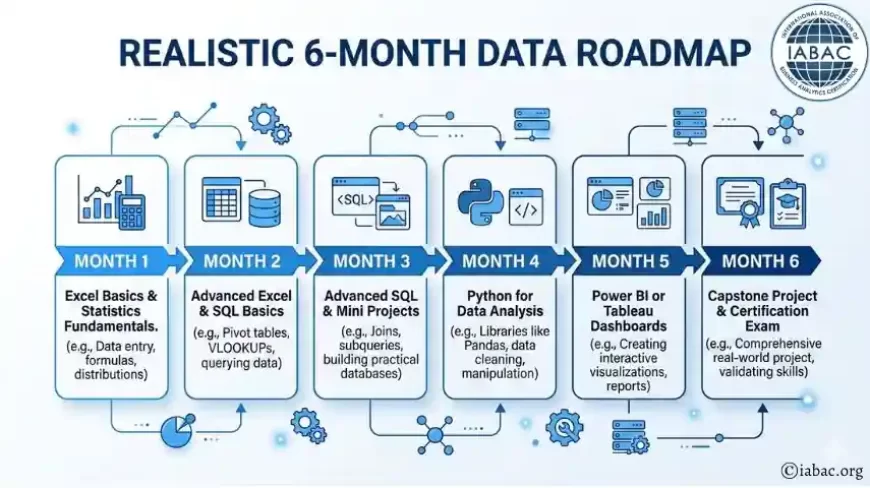
Here’s what a smooth learning journey might look like:
Month 1: Excel basics and statistics fundamentals
Month 2: Advanced Excel and SQL basics
Month 3: Advanced SQL and mini projects
Month 4: Python for data analysis
Month 5: Power BI or Tableau dashboards
Month 6: Capstone project and certification exam
This structure allows you to grow steadily without feeling overwhelmed.
Can You Complete It While Working?
Yes.
Many professionals complete their Certified Data Analyst Certification while working full-time.
By studying:
- 1–2 hours on weekdays
- 3–4 hours on weekends
You can comfortably finish within 4–6 months.
It requires planning, not quitting your job.
Challenges You Might Face
There will be moments when:
- SQL queries return errors
- Python code doesn’t run
- Statistics feels confusing
- Dashboards don’t look right
That’s part of the process.
Every analyst has been there.
What matters is continuing.
The Bigger Picture
Six months may sound long today.
But imagine this:
Six months from now, you could still be thinking about analytics.
Or you could already be a Certified Data Analyst.
Time moves forward whether you act or not.
The difference is what you choose to do during that time.
How Long Does Certified Data Analyst Certification Take?
For most learners:
3 to 6 months of focused and consistent effort.
Not too short to be shallow.
Not too long to feel impossible.
Long enough to build real skills.
Short enough to fit into your life.
If you are serious about building a future in data, the timeline should not scare you.
Because what you gain — skills, confidence, career growth, and recognition — lasts much longer than a few months of study.
And one day, when someone asks you,
“How long did it take to become a Certified Data Analyst?”
You won’t just answer with a number.
You’ll remember the late-night practice sessions, the first successful dashboard, the moment your SQL query finally worked.
And you’ll know it was worth every hour.
Is a Data Analyst Certification Worth It?
Yes, a data analyst certification can be very valuable because it:
- Validates your technical skills
- Improves job opportunities
- Helps you build a professional portfolio
- Makes your resume stand out to recruiters
Many companies prefer candidates who have recognized certifications along with practical skills.
The best certificate for a data analyst depends on your experience level, career goals, and preferred tools. Certifications like the Certified Data Analyst (CDA) are excellent options for building a strong career in data analytics.
If you combine a recognized certification with hands-on projects and strong analytical skills, you can open the door to many high-demand roles in the growing field of data analytics.