

















































Essential Data Engineering Skills
Essential data engineering skills, from databases to cloud platforms, and learn how to manage and analyze data for effective decision-making.


Data is everywhere — in your phone notifications, your streaming recommendations, even the traffic lights that adjust automatically during rush hour. But behind all this magic, there’s a hidden group of professionals making it happen: data engineers.
They’re the unseen heroes who make sure data flows smoothly, accurately, and securely across systems. Without them, the digital economy — powered by AI, analytics, and automation — would grind to a halt.
If you’ve ever dreamed of building the invisible systems that shape the future, learning data engineering might be the smartest career move you can make right now.
The Hidden Engineers Powering Our Digital World
A data scientist is building a machine learning model to predict customer loss.
A marketing analyst wants to understand what drives repeat purchases.
A healthcare system needs to integrate millions of patient records.
None of this would be possible without the foundation built by data engineers — the professionals who design, build, and maintain the pipelines that transport data from chaos to clarity.
They don’t just manage data — they engineer it.
And as the world becomes more data-driven, these roles have exploded in importance. Companies in finance, retail, healthcare, and manufacturing are all racing to build teams that can turn massive amounts of raw data into actionable insight.
That’s where you come in.
Why Data Engineering Has Become a Superpower
In today’s world, data is the new oil, but only if it’s refined. Without systems to clean, structure, and move data efficiently, it’s just noise — useless to decision-makers.
Here’s the reality:
-
90% of global data was created in just the last two years.
-
Over 70% of businesses say poor data quality costs them time and money.
-
Yet, demand for data engineers has grown over 35% year-over-year, and it’s still climbing.
That means there’s not only opportunity — there’s urgency.
If you don’t start building these skills now, you’ll be watching others take the high-value roles in AI, cloud, and analytics that depend on data engineering expertise.
What Exactly Does a Data Engineer Do?
At its core, data engineering is about making data useful.
A data engineer ensures that the right data gets to the right place at the right time — clean, consistent, and ready for analysis.
They:
-
Build pipelines that move data from multiple sources into a central warehouse.
-
Create data architectures that scale with growing business needs.
-
Maintain data quality and integrity, so insights are accurate.
-
Collaborate with data scientists and analysts, making sure they have reliable information.
If data were water, data engineers would be the plumbers, architects, and quality testers — all in one.
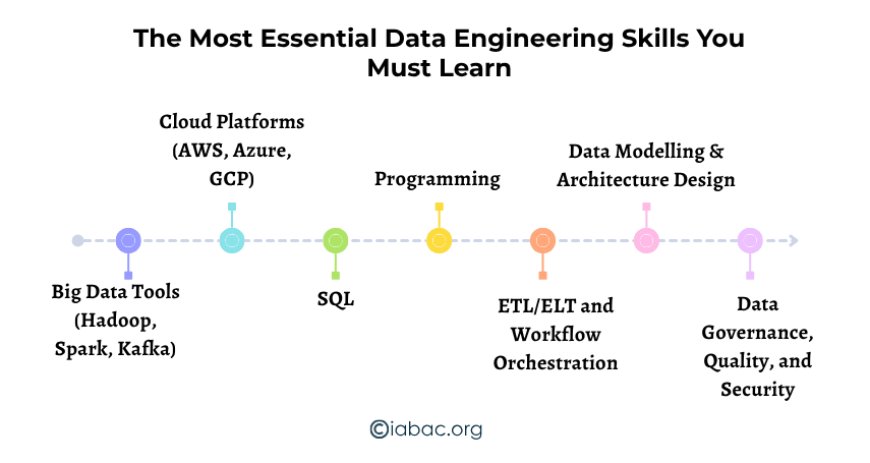
The Most Essential Data Engineering Skills You Must Learn
Let’s break down the must-have technical and analytical skills that define great data engineers.
1. SQL — The Universal Data Language
Every query, every database, every piece of structured data runs on SQL.
It’s the first tool every data engineer learns — the backbone of data extraction and transformation.
Why it matters: Without SQL, you can’t efficiently retrieve or manipulate data. It’s the foundation of every analytics stack.
2. Programming (Python, Java, or Scala)
Python has become the heart of modern data workflows — simple, powerful, and versatile.
Java and Scala, on the other hand, are common in large-scale big data frameworks.
Why it matters: Programming helps automate repetitive tasks, build pipelines, and integrate data across platforms.
3. Data Modelling & Architecture Design
Data doesn’t just live in one place. It flows through systems — from raw logs to polished dashboards.
A solid data model ensures this flow is logical, efficient, and future-proof.
Why it matters: Poor architecture = broken pipelines. Great architecture = scalable success.
4. Big Data Tools (Hadoop, Spark, Kafka)
The modern data engineer must handle massive datasets that can’t fit in a single computer.
Tools like Apache Spark process huge datasets fast, while Kafka streams real-time data.
Why it matters: Companies depend on these systems to process terabytes of data every second — from financial transactions to IoT sensor readings.
5. Cloud Platforms (AWS, Azure, GCP)
The world has moved to the cloud.
AWS, Google Cloud, and Microsoft Azure are now the backbone of most data infrastructures.
Why it matters: Knowing how to deploy, manage, and optimize data pipelines in the cloud makes you invaluable.
6. ETL/ELT and Workflow Orchestration
ETL (Extract, Transform, Load) or its modern variant ELT are the lifelines of data movement.
Tools like Apache Airflow automate these workflows — ensuring data arrives on time and error-free.
Why it matters: Every modern company runs hundreds of pipelines daily — orchestrating them efficiently is what keeps operations alive.
7. Data Governance, Quality, and Security
With stricter data privacy laws (like GDPR), maintaining governance and quality isn’t optional — it’s mandatory.
Why it matters: Clean, compliant, and secure data protects both companies and users — and builds trust.
Soft Skills: The Hidden Edge
Technical skills get you hired. Soft skills make you indispensable.
-
Problem-Solving: Every day, something breaks. Fixing it fast and smartly is what makes great engineers stand out.
-
Collaboration: You’ll work with analysts, scientists, and business teams — communication is key.
-
Curiosity: The best engineers are lifelong learners who explore new tools, frameworks, and data challenges.
-
Attention to Detail: One missing comma in a query can crash a pipeline. Precision matters.
Real-World Example: How Data Engineers Change Everything
Think of a logistics company trying to optimize delivery routes across cities.
Without clean, real-time data — traffic patterns, weather, fuel consumption — they’d waste time, money, and fuel.
A team of data engineers builds a real-time data pipeline connecting GPS trackers, sensors, and databases. The result?
-
Delivery times drop by 25%.
-
Costs decrease.
-
Customer satisfaction skyrockets.
That’s what data engineering really does — it quietly makes everything work better.
Career Opportunities and Growth
The data engineering career path is one of the fastest-growing in tech today.
According to Glassdoor, the average salary for a data engineer is 30–40% higher than traditional IT roles.
And the best part? The demand spans every industry — from fintech to entertainment to public policy.
If you’re passionate about problem-solving, data, and impact, this field offers endless growth.
You can start small — learning SQL and Python — and gradually build expertise in cloud and big data systems. Each skill compounds your value.
How to Get Started (Even If You’re New)
You don’t need to be a tech genius to start. You just need direction and consistency.
Here’s a simple roadmap:
-
Start with SQL. Practice querying sample databases (there are free datasets online).
-
Learn Python. Focus on libraries like Pandas and NumPy for data manipulation.
-
Understand data modelling. Try designing schemas for simple projects.
-
Explore cloud platforms. Use free trials on AWS or GCP to understand basics.
-
Work on projects. Build your own ETL pipeline or clean a public dataset.
-
Show your work. Share your projects on GitHub or LinkedIn — employers love proof of practice.
The Future Belongs to Data Engineers
Artificial Intelligence, IoT, and digital transformation — none of these exist without data engineering at the core.
Every major innovation — from self-driving cars to predictive healthcare — relies on someone who can manage, transform, and deliver data effectively.
The truth? We’re still just scratching the surface. As data doubles every year, data engineering will only grow in demand and prestige.
And if you start now, you’ll be part of the generation that builds the foundation for tomorrow’s intelligent systems.
Your Data Career Starts with One Decision
Maybe you’re a student exploring your first tech role.
Maybe you’re a professional looking to reskill and stay relevant.
Or maybe you’ve always been fascinated by the power of data.
Whatever your path — data engineering is your entry point into the future.
Don’t just watch AI and data science change the world — help build the systems that make it possible.
The opportunities are here, the demand is real, and the time to start is now.