




















































How to Become a Certified AI Expert: Your Complete Step-by-Step Guide
How to become a Certified AI Expert with this step-by-step guide. Eligibility, study plan, exam tips, and career growth explained clearly.


Deciding to pursue the Certified AI Expert certification → is one of the most career-defining decisions an AI professional can make. It is a globally recognized, advanced-level credential that signals to employers — in India and internationally — that you have the knowledge, skills, and verified competence to design, implement, and lead real-world AI systems.
But knowing you want it and knowing how to get there are two different things. This guide walks you through every step of the process — from checking your eligibility to sitting the exam to building your career once you pass. No vague advice. No filler. Just the exact roadmap.
Step 1: Understand What the Certified AI Expert Certification Is
Before committing to a certification, you should know precisely what you are working toward.
The Certified AI Expert is IABAC's advanced AI credential, built on the European Commission's EDISON Data Science Framework. It is designed for professionals who want to go beyond understanding AI — to actively building, evaluating, and deploying AI systems in professional environments.
It is not an entry-level credential. It is not a badge for completing a video course. It is a proctored, scenario-based examination that tests whether you can apply advanced AI and machine learning concepts to solve realistic, complex problems.
The certification requires renewal every 3 years — a deliberate design choice that reflects how rapidly the AI field evolves. This is actually a strength: it tells employers that a certified professional's knowledge is current, not a decade-old credential gathering dust.
If you are not yet sure whether the Expert is the right level for you, or if you are still weighing it against the AI Foundation, our guide on: AI Foundation vs AI Expert certification → will help you decide before you proceed.
Step 2: Check Your Eligibility
Who Is Eligible for the Certified AI Expert Exam?
IABAC does not require a specific degree to sit the Certified AI Expert exam. What matters is demonstrated competency — either through prior learning, professional experience, or completing the Foundation certification.
You are likely ready for the Expert level if you meet most of these criteria:
-
You have at least 1–2 years of experience working with data, software development, analytics, or AI/ML tools in a professional or academic context
-
You are comfortable with Python or another programming language at a functional level
-
You understand fundamental ML concepts — training, validation, overfitting, model evaluation — even if self-taught
-
You have completed the: AI Foundation Certification → (strongly recommended, though not mandatory)
-
You can interpret a confusion matrix, understand what a ROC curve represents, and explain the difference between classification and regression
If you tick fewer than three of the above, spend 4–8 weeks on the Foundation first. The Expert exam will be significantly harder without that foundation — and the Foundation is a valuable credential in its own right, not a detour.
IABAC's eligibility assessment on the certification portal is a practical tool for gauging readiness. Take it honestly.
Step 3: Choose Your Study Path
There are two routes to preparing for the Certified AI Expert exam:
Self-Study vs Authorized Training Partner: Which Is Better?
Self-Study is the right choice if you already have strong AI fundamentals and primarily need to fill in gaps, brush up on specific topics, and practice exam-style questions. IABAC provides a free study guide for the Expert certification — start there. Supplement with the official syllabus, applied projects on public datasets, and peer communities.
IABAC Authorized Training Partners (ATPs) are recommended if you want structured, instructor-led learning with a clear curriculum, accountability, and access to practice exams under simulated conditions. ATPs also have exam-booking relationships with IABAC, which often means discounted retake pricing if needed.
In our experience, candidates who go through an ATP have higher first-attempt pass rates — not because the material is different, but because the structured environment keeps them on track and prevents the most common failure mode: inconsistent, unsystematic preparation.
To find an IABAC Authorized Training Partner → near you or offering online sessions, check the IABAC partner directory. Partners exist across India (Bengaluru, Mumbai, Delhi, Hyderabad, Pune), the UK, UAE, Singapore, and the US.
Step 4: Build Your Study Plan
Preparation time for the Certified AI Expert varies by starting point. Here is a realistic framework:
|
Starting Point |
Estimated Prep Time |
|
Strong ML/data background, recent hands-on experience |
6–8 weeks |
|
IT professional, some ML exposure |
10–14 weeks |
|
AI Foundation certified, non-technical background |
14–20 weeks |
|
Complete beginner (should start with Foundation first) |
Foundation first, then reassess |
How to Build a 12-Week Study Plan
For a candidate with a solid technical base, here is a proven 12-week structure:
Weeks 1–2: Foundations Audit Review the IABAC Expert syllabus against what you already know. Identify your weak areas — these become your priority topics. Do not waste study time on areas where you are already strong.
Weeks 3–5: Core Machine Learning Go deep on advanced ML algorithms — gradient boosting (XGBoost, LightGBM), ensemble methods, regularization, feature selection, and cross-validation strategies. Work through applied examples, not just theory.
Weeks 6–7: Deep Learning Cover CNN architectures for computer vision tasks, RNNs and LSTMs for sequential data, and Transformer architecture fundamentals. Understand attention mechanisms at a conceptual and applied level.
Week 8: NLP and Generative AI Cover text preprocessing, embeddings, sentiment analysis, named entity recognition, and how large language models like GPT-series and open-source alternatives work at an architectural level.
Week 9: MLOps and Deployment Study model versioning, monitoring, A/B testing in production, retraining pipelines, and containerization basics. This area is heavily tested at the Expert level and often under-studied.
Week 10: AI Strategy, Ethics, and Governance Cover responsible AI frameworks, GDPR and India's DPDP Act implications for AI systems, bias detection and mitigation, and enterprise AI adoption strategy. These scenario-based questions appear frequently.
Weeks 11–12: Practice Exams and Review Work through as many practice questions as possible under timed conditions. Simulate the exam environment. Review every wrong answer until you understand the reasoning, not just the correct option.
Step 5: Register for the Exam
Registration for the Certified AI Expert exam is straightforward:
-
Create or log into your account on the IABAC certification portal
-
Select "Certified AI Expert" from the certification catalog
-
Complete the eligibility self-declaration
-
Choose your preferred exam mode — most candidates opt for the online proctored format, which you can take from your own system
-
Select your exam date and time slot (book at least 2 weeks in advance to get your preferred slot)
-
Pay the certification fee and receive your booking confirmation
If you are booking through an IABAC Authorized Training Partner, they will typically handle the registration process on your behalf and may offer bundled pricing for training + exam.
Important: Check your system meets IABAC's technical requirements for online proctoring before exam day — camera, microphone, stable internet connection, and a clean, distraction-free environment are all required.
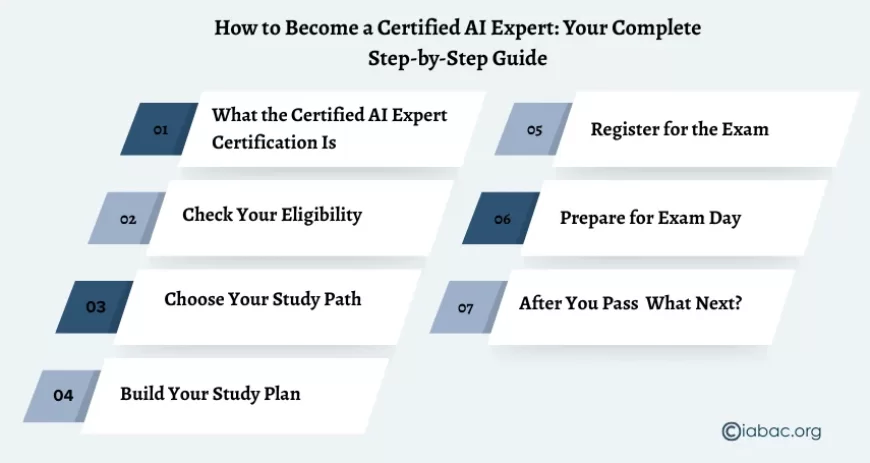
Step 6: Prepare for Exam Day
What to Expect on Exam Day
The Certified AI Expert exam is a proctored online assessment. Here is what the experience looks like:
-
You will be connected to a proctor who monitors you via webcam throughout the session
-
Breaks are generally not permitted once the session begins — plan accordingly
-
The exam includes a mix of multiple-choice questions and scenario-based problem-solving sections
-
Scenario questions present realistic AI implementation challenges and ask you to select the best course of action — these require genuine applied understanding, not memorization
-
Time management is important — flag difficult questions and return to them rather than getting stuck
The most common mistake candidates make on exam day is spending too long on hard questions at the expense of easier ones. Answer what you know confidently first. Return to uncertainty later.
Exam results for the Expert level are typically available within 7 business days after completion.
Step 7: After You Pass — What Next?
Passing the Certified AI Expert exam is a significant achievement. Here is how to make the most of it immediately:
Update your professional profiles. Add the certification to your LinkedIn profile, CV, and any professional portfolios. Use the exact credential name: "IABAC Certified AI Expert." Include the certification ID so employers can verify it.
Engage with the IABAC community. As a certified member, you now have access to IABAC's global network — AI summits, webinars, and professional events. Attend at least one event in your first 3 months. The community is where real career opportunities circulate.
Set your 3-year renewal reminder immediately. The Expert certification requires renewal every 3 years. IABAC's CPD (Continuing Professional Development) program makes this process structured — but you need to accumulate CPD credits over time, not scramble at the deadline. Start earning credits from day one.
Consider a specialization. The Expert certification is your foundation for domain-specific credentials. Depending on your career goals, your next step might be the NLP Expert, Computer Vision Expert, or AI Specialist in Manufacturing certification. These specializations command premium roles and compensation: Explore all IABAC AI certifications →
How to Renew Your Certification Every 3 Years
Renewal ensures your credential stays current in a field that changes faster than almost any other. The renewal process involves:
-
Accumulating the required CPD credits through IABAC-recognized learning activities (courses, conferences, publications, projects)
-
Submitting your CPD log through the IABAC portal before your certification expiry date
-
Paying the renewal fee
The renewal requirement is not a burden — it is a credibility signal. An IABAC Expert certification that has been renewed is more valuable to an employer than one that was earned once and never updated, because it guarantees the holder's knowledge is genuinely current.
Your Roadmap at a Glance
|
Step |
Action |
Timeline |
|
1 |
Understand the certification |
Day 1 |
|
2 |
Complete eligibility assessment |
Day 1–3 |
|
3 |
Choose study path (self-study or ATP) |
Week 1 |
|
4 |
Build and execute study plan |
Weeks 1–12 |
|
5 |
Register for exam |
Week 10 |
|
6 |
Exam day |
Week 12–14 |
|
7 |
Results + credential activation |
7 business days post-exam |
|
8 |
Update profiles, join community |
Immediately after |
|
9 |
Begin CPD tracking for renewal |
Ongoing |
The Path Is Clear — Start Walking It
Becoming a Certified AI Expert is not out of reach. It requires honest self-assessment, structured preparation, and consistent effort over 8–16 weeks. What it gives you in return — verified global credibility, higher earning potential, access to senior AI roles, and a professional network spanning 50+ countries — makes it one of the highest-return career investments available to technology professionals in 2026.
The only decision you need to make today is: am I going to start?
Take the first step: View the Certified AI Expert certification details → and take the eligibility assessment to see exactly where you stand.
Last updated: April 2026. Exam formats, fees, and timelines are subject to change. Always verify current details on the IABAC website before registering.