



















































AI Domains That Are Highest Paying for Your Career (2026)
Explore the most important domains of AI — from Machine Learning to NLP, Computer Vision, and Robotics. With real-world applications and career paths.


Artificial Intelligence is not one single technology, it is a vast ecosystem of interconnected fields, each solving different problems in unique ways.
Whether you are a student, a working professional, or someone exploring an AI career, understanding the domains of Artificial Intelligence helps you find where you fit in, what skills to develop, and which certifications to pursue.
Businesses and professionals are realizing how AI can change things, but the real success lies in understanding its main areas. Whether you're planning to get an Artificial Intelligence Certification, start with the basics in an Artificial Intelligence Foundation course, or move forward with credentials like Certified Machine Learning Associate, it's essential to understand the key domains that drive AI.
The most important parts of AI and why certifications like Certified Artificial Intelligence Expert, Certified Natural Language Processing Expert, and Certified Computer Vision Expert are valuable. These certifications help you build trust and open doors to opportunities across many industries. If you're in a leadership role, an Artificial Intelligence Certified Executive certification can help you lead AI-driven changes in your organization. My goal is to make it simple for you to understand these critical Domains of Artificial Intelligence, so you can make smart choices in your AI journey. Knowing the right areas will set you up for success.
In this guide, we cover all 12 domains of AI, their real-world applications, salary potential, and career paths — updated for 2026
What Are the Domains of Artificial Intelligence?
The domains of Artificial Intelligence refer to the specialized branches or fields that fall under the broader AI umbrella. Each domain focuses on a specific capability — such as learning from data, understanding language, recognizing images, or making autonomous decisions.
Think of AI as a tree: the trunk is AI itself, and each branch (domain) grows in a different direction, solving different real-world problems.
Simple Definition for Students: The domains of AI are the different subject areas within Artificial Intelligence — just like how Science has Physics, Chemistry, and Biology, AI has Machine Learning, NLP, Computer Vision, and more.
The 3 Core Domains of AI (Foundation Level)
Before diving into all 12 domains, it's important to understand the three primary domains of AI that form the foundation:
| Domain | What It Does | Example |
|---|---|---|
| Machine Learning | Learns patterns from data | Netflix recommendations |
| Natural Language Processing | Understands human language | ChatGPT, Google Translate |
| Computer Vision | Interprets images and video | Face unlock, medical scans |
These three domains of AI are the most in-demand in the job market and form the base for most AI certifications.
The Growing Demand for Data Analytics Certifications
The rise of artificial intelligence (AI) is changing how industries work and influencing our daily lives. Here’s a simpler look at how Domains of Artificial IntelligenceI is expanding and its key areas:
- AI Everywhere: AI is common in tech, such as voice assistants (Siri, Alexa) and more advanced systems like self-driving cars and smart cities.
- AI in Different Industries: Sectors like healthcare, finance, retail, and manufacturing quickly use AI to automate tasks, improve decision-making, and offer better customer experiences.
- Data and Computing Power: The increase in data and computing power has made it easier for AI systems to learn and work faster and more accurately.
- Key AI Fields: Major fields like Machine Learning (ML), Natural Language Processing (NLP), Computer Vision, and Robotics are crucial to AI growth.
- AI Certifications in Demand: As Domains of Artificial Intelligence continue to grow, the demand for certifications, including Data Analytics Certification and the Best Data Analytics Certification, is rising. This helps professionals stay competitive in the job market.
The Challenges of Understanding AI Domains
AI offers great potential, but its complexity can be overwhelming. Here's why:
- Many AI Domains: With areas like Machine Learning (ML), Natural Language Processing (NLP), Computer Vision, and Robotics, each needing specific skills, businesses might struggle to choose the right focus to achieve their goals.
- Confusing Terminology: Words like machine learning and deep learning or AI and "automation" are often used interchangeably, confusing their exact meanings.
- Integration Issues: Adding AI to current systems can be tricky. If AI doesn’t align well with business goals, it may result in failed projects or underused technology.
- Lack of Skilled Professionals: There’s a high demand for experts in fields like Certified Computer Vision or Natural Language Processing, but not enough skilled people to meet this demand.
- High Costs: Developing AI needs a lot of computing power, data, and money. Without a clear focus on the right Domains of Artificial Intelligence, costs can quickly add up without delivering the expected results.
12 Important Domains of AI You Should Know in 2026
AI includes several important areas that are crucial for its success. Here are the main domains you should focus on:
1. Machine Learning (ML)
Machine Learning is the most widely used domain of AI. It enables systems to learn from data and improve their performance over time — without being explicitly programmed for every task.
How it works: ML algorithms find patterns in large datasets and use those patterns to make predictions or decisions.
Real-World Applications:
- Email spam filters (Gmail)
- Credit card fraud detection (Banks)
- Product recommendations (Amazon, Flipkart)
- Stock price prediction
Career Scope: ML Engineer, Data Scientist, AI Researcher Avg. Salary in India: ₹8 – ₹25 LPA
2. Deep Learning (DL)
Deep Learning is a subset of Machine Learning that uses artificial neural networks — inspired by the human brain — to process complex data like images, audio, and text.
How it works: Multi-layered neural networks extract high-level features from raw data automatically.
Real-World Applications:
- Voice assistants (Alexa, Siri, Google Assistant)
- Self-driving car perception systems
- Medical image diagnosis (detecting cancer in X-rays)
- Real-time language translation
Career Scope: Deep Learning Engineer, AI Researcher, Computer Vision Engineer Avg. Salary in India: ₹10 – ₹30 LPA
3. Natural Language Processing (NLP)
Natural Language Processing (NLP) is the domain of AI that enables computers to read, understand, and generate human language — both written and spoken.
How it works: NLP combines linguistics and ML to process text/speech data, understand context, and produce meaningful responses.
Real-World Applications:
- Chatbots and virtual assistants
- Google Search autocomplete
- Sentiment analysis for brand monitoring
- Automated content summarization
- Language translation apps
Career Scope: NLP Engineer, Conversational AI Developer, AI Product Manager Avg. Salary in India: ₹9 – ₹28 LPA
4. Computer Vision (CV)
Computer Vision enables machines to interpret and understand visual information from the world — images, videos, and real-time camera feeds.
How it works: CV uses deep learning models (CNNs) to detect, classify, and analyze visual data with human-level accuracy.
Real-World Applications:
- Facial recognition (phones, airports)
- Autonomous vehicles (Tesla, Waymo)
- Quality inspection in manufacturing
- Crop disease detection in agriculture
- Medical imaging (MRI, CT scan analysis)
Career Scope: Computer Vision Engineer, Autonomous Systems Developer, AI Researcher Avg. Salary in India: ₹10 – ₹32 LPA
5. Robotics
Robotics in AI combines mechanical engineering with intelligent software to create machines that can perceive, reason, and act in physical environments.
How it works: AI-powered robots use sensors, computer vision, and decision-making algorithms to operate autonomously.
Real-World Applications:
- Industrial robots in car manufacturing (Tesla, Hyundai)
- Surgical robots (Da Vinci System)
- Warehouse automation (Amazon fulfillment centers)
- Agricultural robots for harvesting
- Bomb disposal and disaster response robots
Career Scope: Robotics Engineer, Automation Specialist, AI Systems Engineer Avg. Salary in India: ₹8 – ₹22 LPA
Read more: [Robotics vs Artificial Intelligence — Key Differences Explained]
6. Reinforcement Learning (RL)
Reinforcement Learning is an AI domain where an agent learns to make decisions by taking actions in an environment and receiving rewards or penalties based on outcomes.
How it works: Like training a dog with treats — the AI keeps doing what gets rewarded and avoids what gets penalized.
Real-World Applications:
- Game-playing AI (AlphaGo beating world chess champions)
- Robot motion planning
- Personalized content recommendations
- Autonomous trading systems
- Self-driving car decision-making
Career Scope: RL Engineer, AI Researcher, Game AI Developer Avg. Salary in India: ₹12 – ₹35 LPA
7. Expert Systems
Expert Systems are AI programs that simulate the decision-making ability of a human expert in a specific domain using a knowledge base and rules.
How it works: They use an "if-then" rule engine combined with domain knowledge to make recommendations.
Real-World Applications:
- Medical diagnosis systems (MYCIN for bacterial infections)
- Tax preparation software (TurboTax)
- Fault diagnosis in engineering systems
- Legal and financial advisory tools
Career Scope: Knowledge Engineer, AI Systems Analyst Avg. Salary in India: ₹6 – ₹18 LPA
8. Data Science & Analytics
Data Science sits at the intersection of AI, statistics, and domain expertise. It involves extracting insights from structured and unstructured data to support business decisions.
How it works: Data Scientists collect, clean, analyze, and visualize data — then build predictive models using ML.
Real-World Applications:
- Business forecasting and sales predictions
- Customer behavior analysis
- Healthcare outcomes prediction
- Supply chain optimization
- Social media analytics
Career Scope: Data Scientist, Data Analyst, Business Intelligence Analyst Avg. Salary in India: ₹6 – ₹25 LPA
Read more: [Is Data Science a Good Career in 2026?]
9. Speech Recognition
Speech Recognition is the AI domain that converts spoken language into text and vice versa. It powers voice interfaces across industries.
How it works: It uses acoustic models, language models, and neural networks to map audio signals to words.
Real-World Applications:
- Voice search (Google, Siri)
- Call center automation and IVR
- Real-time transcription (Zoom, Google Meet)
- Healthcare voice documentation
- Language learning apps (Duolingo)
Career Scope: Speech AI Engineer, Conversational AI Developer Avg. Salary in India: ₹8 – ₹22 LPA
10. Generative AI
Generative AI is one of the newest and fastest-growing domains of AI. It creates new content — text, images, audio, video, and code — that did not previously exist.
How it works: Generative models (like GANs and Transformers) learn the patterns in existing data and use them to generate realistic new outputs.
Real-World Applications:
- Text generation (ChatGPT, Claude, Gemini)
- AI image generation (DALL·E, Midjourney, Stable Diffusion)
- AI music composition
- Synthetic training data generation
- Code generation (GitHub Copilot)
Career Scope: Generative AI Engineer, Prompt Engineer, AI Product Developer Avg. Salary in India: ₹12 – ₹40 LPA (fastest-growing in 2026)
11. Fuzzy Logic
Fuzzy Logic is an AI domain that handles reasoning with imprecise or uncertain data — unlike binary logic (0 or 1), it allows degrees of truth between 0 and 1.
How it works: It mimics human decision-making in situations where information is incomplete or vague.
Real-World Applications:
- Washing machine load sensing
- Air conditioner temperature control
- Anti-lock braking systems (ABS) in cars
- Medical diagnosis under uncertainty
- Stock market prediction models
Career Scope: AI Systems Engineer, Control Systems Developer Avg. Salary in India: ₹5 – ₹15 LPA
12. AI in Cybersecurity
AI in Cybersecurity is an emerging domain where artificial intelligence is used to detect, prevent, and respond to cyber threats in real time.
How it works: AI models analyze network traffic patterns, user behavior, and system logs to identify anomalies and threats.
Real-World Applications:
- Malware and ransomware detection
- Phishing email identification
- Fraud detection in banking
- Network intrusion prevention
- Zero-day vulnerability detection
Career Scope: AI Security Engineer, Threat Intelligence Analyst Avg. Salary in India: ₹10 – ₹30 LPA
All 12 Domains of AI at a Glance
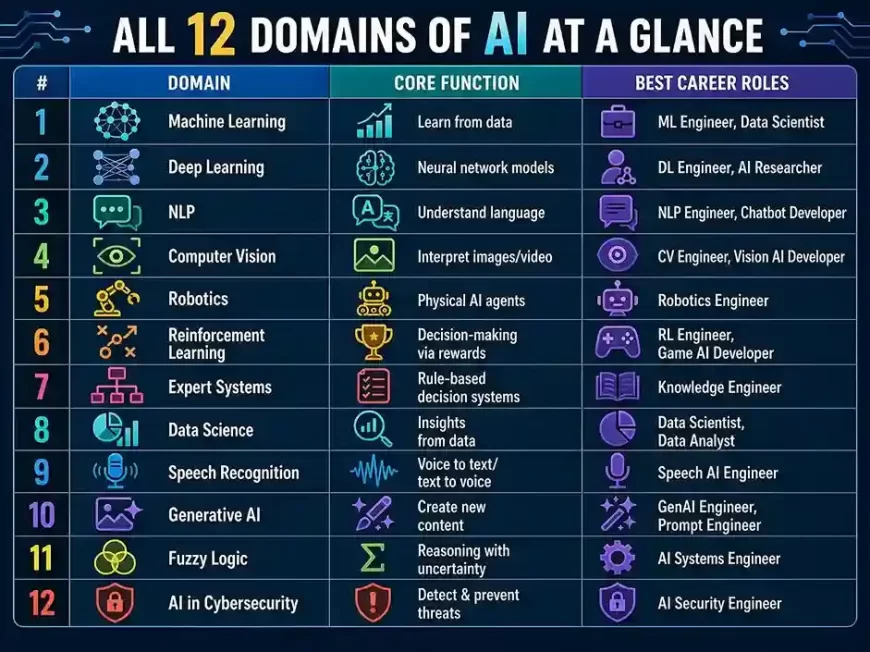
Which Domain of AI Should You Learn First?
The answer depends on your background and goals:
- Complete beginner → Start with Machine Learning + Data Science
- Software developer → Jump into Deep Learning or NLP
- Interested in hardware → Explore Robotics or Computer Vision
- Into creative tools → Learn Generative AI
- Into security → Focus on AI in Cybersecurity
These domains are key for anyone looking to grow in the field of AI.
5 Key Areas in Artificial Intelligence and Top Certifications
Artificial Intelligence (AI) includes several important areas, each driving progress in different fields. Here are the five key areas of AI and the best certifications to help you gain expertise in each:
- Machine Learning (ML)
Machine Learning helps machines learn from data and improve over time. The Certified Artificial Intelligence Expert certification is a great choice for those interested in ML.
Recommended Certification: IABAC’s Certified Artificial Intelligence Expert, a well-recognized certification. - Natural Language Processing (NLP)
NLP enables machines to understand and respond to human language, useful for chatbots and translation tools. The Certified Natural Language Processing Expert certification is ideal for those focusing on this area.
Recommended Certification: Certified Natural Language Processing Expert by IABAC. - Computer Vision
Computer Vision allows machines to process and interpret visual information. This area is important for technologies like facial recognition and self-driving cars. The Certified Computer Vision Expert certification offers deep insights into this field.
Recommended Certification: Certified Computer Vision Expert by IABAC. - Robotics
Robotics involves creating robots that can perform tasks independently. This field impacts many sectors, from manufacturing to healthcare. Various certifications are available to specialize in robotics. - Expert Systems
Expert Systems mimic human decision-making using rules and knowledge bases. They are used in fields like medical diagnosis and finance. Relevant certifications cover AI’s role in developing these systems.
For advanced AI leadership, the Artificial Intelligence Certified Executive certification is a top choice.
How to Get Certified in AI Domains
If you want to formally validate your knowledge in these domains, an AI certification is the fastest path to career growth and higher salaries.
IABAC (International Association of Business Analytics Certifications) offers globally recognized certifications across multiple AI domains:
- ✅ Certified Artificial Intelligence Professional (CAIP)
- ✅ Certified Data Scientist (CDS)
- ✅ Certified Machine Learning Professional (CMLP)
- ✅ Certified NLP Practitioner
- ✅ Certified Data Analyst (CDA)