


















































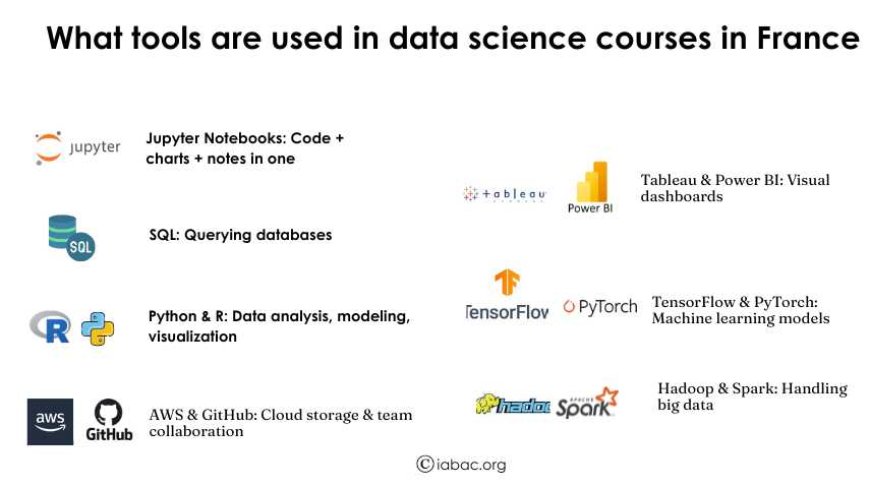
What tools are used in data science courses in France
Learn about the essential tools used in data science courses in France, including software and programming languages crucial for mastering the field.


As someone active in data science, I’ve seen how useful the right training can be—especially through data science courses in France. These courses often come with respected Data Science Certifications that help you build real skills. One of the most helpful programs is the Certified Data Scientist Course. It gives a clear path to learning important tools like Python, R, and SQL. What makes these courses helpful is how they mix practical tasks with theory. You don’t just learn how the tools work—you learn how to use them to solve real problems.
Learning Data Science Tools Step by Step
When I started, I saw how many tools there were and felt a little lost. But as the course moved forward, I learned that each tool had a clear role. Learning when and how to use them helped me understand how they all connect in a real data project.
Key Tools You Will Use
Here are the main tools used in data science courses in France that helped me the most:
- Python and R
- Python was the first language we learned. It’s simple to write and has many helpful libraries like Pandas and scikit-learn for working with data.
- R was great for working with numbers and creating graphs. Tools like ggplot2 made it easy to show results clearly.
- SQL and Jupyter Notebooks
- SQL helped me work with data stored in databases. I used it to pull out only the data I needed.
- Jupyter Notebooks let me write code, show charts, and explain my work—all in one place.
- Hadoop and Spark
- Hadoop taught me how to work with large datasets that don’t fit on one computer.
- Spark helped me process big data faster and was easier to use for both batch and real-time tasks.
- Tableau and Power BI
- These tools helped me turn data into charts and dashboards. It made it easier to explain my findings to others.
- TensorFlow and PyTorch
- These tools are used for machine learning. I used them to build models that can learn from data and make predictions.
- Cloud and Collaboration Tools
- We used cloud tools like AWS and GitHub to share work and store data. Git helped us track changes in our code and work better in teams.
Certifications to Support Learning
During the course, we were also encouraged to take data science certifications. These helped show what we had learned and made our profiles stronger when applying for jobs.
What Tools Are Used in Data Science Certifications and Data Science Courses in France?
Data science is growing fast, and many schools in France now offer courses to help students build the right skills. If you're planning to study in France, it’s helpful to know the main tools used in data science certifications and data science courses in France. Here’s a short and clear guide.
1. Python and R
These are the two main programming languages taught:
- Python is easy to learn and used for things like data analysis and machine learning. Students use libraries such as Pandas, NumPy, and Scikit-learn.
- R is good for working with statistics and charts. It’s often used in research and analysis.
2. Data Visualization Tools
These tools help you turn data into charts and dashboards:
- Tableau is used to create reports and dashboards that are easy to understand and share.
- Power BI is also taught to make visual reports from data.
- Matplotlib and Seaborn are Python tools that help you build custom charts and graphs.
3. Machine Learning Tools
Machine learning is an important part of most data science courses in France:
- Scikit-learn helps with basic machine learning tasks like classification and prediction.
- TensorFlow and Keras are tools for working with deep learning and more advanced models.
4. Big Data Tools
These tools help you work with very large data sets:
- Apache Hadoop is used to process large data across many systems.
- Apache Spark helps with faster data processing and is often included in training.
5. Databases and SQL
Knowing how to work with data in databases is important:
- MySQL and PostgreSQL are used to teach SQL for working with structured data.
- MongoDB is also taught for working with unstructured or flexible data.
6. Cloud Platforms
Many courses in France include cloud tools:
- AWS, Google Cloud, and Azure are used to teach how to store data, run analysis, and build machine learning models in the cloud.
7. Version Control Tools
Students also learn how to work in teams and manage code:
- Git and GitHub are taught to help track changes in code and work on group projects.
Why Choose Data Science Courses in France?
France is home to many good universities and tech companies. It offers a mix of theory and real-world learning in areas like machine learning, big data, artificial intelligence, and statistics. Many programs are taught in English, so international students can also apply.
Types of Data Science Courses in France
You can choose from different types of programs depending on your goals:
1. Bachelor’s Programs
These are for students who are just starting their studies. They usually take three years and teach the basics like programming, databases, math, and statistics.
2. Master’s Programs
These are for students with a background in subjects like computer science, math, or engineering. In two years, you can learn:
- Machine learning
- Data analysis
- Visualization
- Cloud tools
- Work on real company projects
3. Short Courses and Certificates
Short courses or certificates are a good choice if you already work or want to change careers. These focus on deep learning, data tools, or business analytics.
4. Online or Hybrid Options
Some programs let you study online or mix online and in-person classes. These are good for people working or who need more flexible timing.
What You Need to Apply
Requirements can vary by program, but most ask for:
- A background in math, statistics, or computer science
- Good English (some may also need French)
- A motivation letter
- A resume and your academic records
- For master’s courses, a bachelor’s degree in a related subject
Some may also want you to know programming or take exams like GMAT or GRE.
Job Options After Studying
After finishing a data science course in France, you can apply for roles like:
- Data Analyst
- Machine Learning Engineer
- Data Scientist
- Business Intelligence Consultant
- AI Specialist
There are job opportunities in many fields, like banking, healthcare, retail, transport, and tech companies.
Studying data science in France gave me both knowledge and practical experience. The tools I used in the classroom are the same ones used by data professionals today. If you're considering joining data science courses in France, expect a hands-on learning process that helps you build real skills. These tools and data science certifications will prepare you well for your future career in data.