





















































Deep Learning Applications You Use Without Knowing
Deep learning applications power virtual assistants, healthcare, finance, cybersecurity, and recommendations, shaping smarter decisions and digital experiences.


Take a moment and think about how often you interact with technology that feels almost human. You speak to Siri or Alexa and they respond. Netflix seems to know exactly what you want to watch next. Your phone unlocks just by looking at your face, and cars are learning how to drive themselves. It feels like magic — but it isn’t.
Behind all of this is deep learning, quietly learning from massive amounts of data and improving every day. It’s already shaping healthcare, finance, entertainment, cybersecurity, and business decisions, often without us even noticing. And the most exciting part is this: we’re still only at the beginning of what deep learning can do.
Deep Learning and Its Role in Artificial Intelligence
Deep learning is a branch of artificial intelligence that teaches machines to learn by example much like humans do. Instead of following fixed rules, deep learning models learn patterns from data using layered neural networks inspired by the human brain.
To understand where deep learning fits, it helps to see the bigger picture:
-
Artificial Intelligence (AI): The broad goal of making machines intelligent
-
Machine Learning: Systems that learn from data instead of being explicitly programmed
-
Deep Learning: A powerful subset of machine learning that uses deep neural networks to learn complex patterns
Deep learning plays a critical role in modern AI because it can handle:
-
Huge volumes of data
-
Complex tasks like image recognition and language translation
-
Continuous learning and improvement over time
This is why deep learning applications dominate areas where traditional programming simply falls short.
Computer Vision Applications
Computer vision is one of the most visible and impactful deep learning applications. It allows machines to “see” and understand images and videos in ways that are increasingly close to human perception.
Some of the most common computer vision applications include:
-
Facial recognition used in smartphones, airports, and security systems
-
Autonomous vehicles detecting pedestrians, traffic signs, lane markings, and traffic lights
-
Medical imaging where deep learning analyzes X-rays, MRIs, and CT scans for disease detection
In healthcare alone, studies show that deep learning models can match or even exceed human radiologists in detecting certain cancers from medical images. That doesn’t replace doctors, but it gives them a powerful second set of eyes.
Computer vision is also widely used in:
-
Industrial inspection and quality control
-
Surveillance and security monitoring
-
Video enhancement and restoration
-
Robotic vision for automation and manufacturing
Every time a machine accurately recognizes an object in an image, you’re seeing deep learning applications in action.
Natural Language Processing (NLP) Applications
Language is messy, emotional, and full of complexity, and yet deep learning has learned to handle it surprisingly well. That’s where natural language processing (NLP) comes in.
Deep learning applications in NLP power tools we use every day:
-
Virtual assistants like Siri, Alexa, and Google Assistant
-
Speech recognition that converts spoken words into text
-
Text-to-speech (TTS) systems that generate natural-sounding voices
-
Chatbots that answer customer questions instantly
-
Machine translation such as Google Translate
-
Sentiment analysis that detects whether text is positive, negative, or neutral
For example, customer service chatbots now handle millions of conversations daily, reducing wait times and improving user experience. Sentiment analysis helps brands understand how people truly feel about their products by analyzing reviews and social media posts.
The real breakthrough is that NLP systems no longer just process words they understand context, tone, and intent.
Recommendation Systems
Ever noticed how Netflix seems to read your mind? Or how Spotify builds playlists that feel personally curated just for you?
That’s no coincidence. These are deep learning applications at work through recommendation systems.
Recommendation systems analyze user behavior such as:
-
What you click on
-
What you watch, skip, or replay
-
How long you stay engaged
-
Your past preferences
Using this data, deep learning models predict what you’re most likely to enjoy next.
Examples include:
-
Netflix recommending movies and TV shows
-
Amazon suggesting products
-
Spotify curating music playlists
According to industry reports, recommendation systems drive over 80% of the content watched on Netflix. That’s how powerful personalization has become.
Finance and Business Applications
In finance, deep learning applications are less visible but incredibly important.
Banks and financial institutions use deep learning for:
-
Fraud detection in credit card and ATM transactions
-
Anomaly detection to spot unusual activity
-
Algorithmic trading that predicts market trends
-
Risk assessment and credit scoring
-
Business intelligence and decision support systems
Fraud detection systems analyze millions of transactions in real time, identifying suspicious behavior within milliseconds. Without deep learning, this level of speed and accuracy simply wouldn’t be possible.
In business, deep learning supports smarter decisions by turning raw data into actionable insights.
Healthcare and Life Sciences
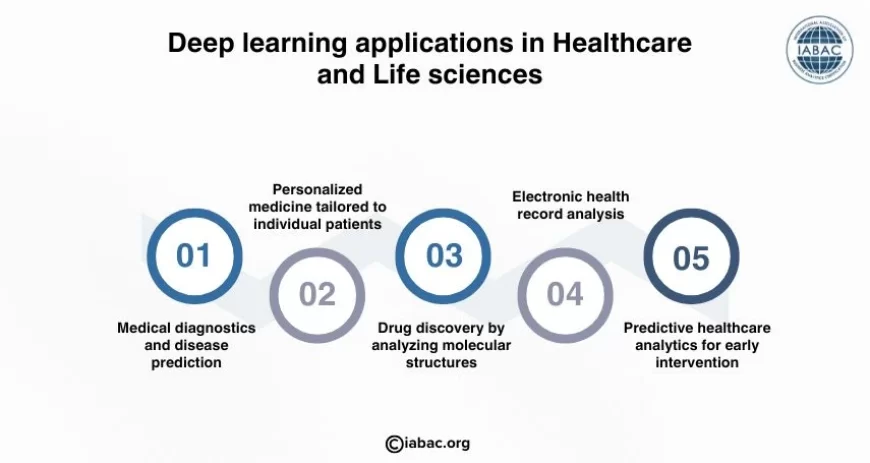
Healthcare may be the most meaningful area where deep learning applications are making a difference.
Some key uses include:
-
Medical diagnostics and disease prediction
-
Personalized medicine tailored to individual patients
-
Drug discovery by analyzing molecular structures
-
Electronic health record (EHR) analysis
-
Predictive healthcare analytics for early intervention
Deep learning models can analyze years of patient data to predict disease risks long before symptoms appear. In drug discovery, AI has reduced research timelines from years to months in some cases.
This doesn’t replace doctors it empowers them.
Entertainment, Media, and Gaming
Deep learning applications have quietly reshaped entertainment.
In media and gaming, deep learning is used for:
-
Content recommendation and personalization
-
Video enhancement and upscaling
-
Generative content creation
-
Game development and design
-
Smarter non-player characters (NPCs)
-
Reinforcement learning for adaptive gameplay
NPCs powered by deep learning can adapt to player behavior, making games feel more realistic and immersive. Streaming platforms use AI to optimize thumbnails, trailers, and even release timing.
Entertainment has become more personal, more dynamic, and more engaging—thanks to deep learning.
Cybersecurity Applications
As cyber threats grow more complex, traditional security methods struggle to keep up. Deep learning applications fill that gap.
They are used to:
-
Detect anomalies in network traffic
-
Identify malware and phishing attempts
-
Monitor user behavior for threats
-
Provide real-time intrusion detection
Unlike rule-based systems, deep learning models adapt as threats evolve, making cybersecurity defenses far more resilient.
Robotics, Automation, and Predictive Maintenance
Deep learning has transformed how machines move, react, and learn in the physical world.
Key applications include:
-
Robotics and autonomous systems
-
Industrial automation and smart manufacturing
-
Motion planning and robotic control
-
Predictive maintenance for machinery
-
Fault detection and failure prediction
Predictive maintenance alone saves industries billions of dollars each year by preventing unexpected equipment failures before they happen.
Edge AI and Internet of Things (IoT)
Not all deep learning happens in massive data centers. Increasingly, it runs on devices themselves.
This is known as Edge AI, where deep learning models operate on:
-
Smartphones
-
Smart cameras
-
Wearable devices
-
IoT sensors
Edge AI enables:
-
Real-time inference
-
Low-latency decision-making
-
Improved privacy and reliability
It powers smart cities, smart homes, and health-monitoring wearables.
How Deep Learning Works
At its core, deep learning works by learning patterns from data.
The process typically involves:
-
Collecting large volumes of data
-
Data preprocessing and feature extraction
-
Training deep neural networks
-
Running inference on new data
-
Continuous improvement through feedback
Reinforcement learning takes this further by allowing systems to learn through trial and error. AlphaGo, for example, learned to defeat world champions by playing millions of games against itself.
Deep Learning Models and Architectures
Different tasks require different deep learning models.
Common architectures include:
-
Convolutional Neural Networks (CNNs) for image processing
-
Recurrent Neural Networks (RNNs) and LSTM for sequences
-
Transformers for NLP and language models
-
Autoencoders for anomaly detection
-
Generative Adversarial Networks (GANs) for generative AI
-
Multimodal learning combining text, image, audio, and video
These models form the backbone of modern deep learning applications.
Infrastructure, Deployment, and MLOps
Behind every successful deep learning application is strong infrastructure.
This includes:
-
Big data pipelines
-
GPUs and cloud computing
-
Model deployment strategies
-
Scalability and monitoring
-
MLOps for maintenance and updates
Performance is measured using metrics like accuracy, precision, recall, and latency ensuring systems remain reliable in real-world conditions.
Explainable AI and Ethical Considerations
As deep learning applications become more powerful, trust becomes essential.
Key concerns include:
-
Explainable AI (XAI) and interpretability
-
Algorithmic bias and fairness
-
Ethical AI development
-
Data privacy and security
-
AI regulations and compliance, such as GDPR
People need to understand why an AI system made a decision, especially in healthcare and finance.
Emerging and Future Deep Learning Applications
The future of deep learning applications is moving fast.
Emerging areas include:
-
Generative AI for text and image generation
-
Multimodal AI systems
-
Self-improving adaptive models
-
Expansion into education, healthcare, and finance
Deep learning applications are transforming how we live and work, powering everything from virtual assistants and recommendation systems to healthcare diagnostics and cybersecurity. As these technologies continue to evolve, deep learning is becoming a must-have skill for anyone looking to stay relevant in the digital age.
If you’re ready to turn this knowledge into a real career advantage, IABAC offers globally recognized certifications in deep learning. Start your journey to build future-ready skills that matter.