















































The Hidden Career Benefits of AI Certification
The hidden career benefits of AI certification from better job opportunities to skill validation, networking, and long-term career growth.

Artificial intelligence is no longer a niche topic reserved for researchers or tech giants. It is changing industries as Different as marketing, healthcare, finance, and retail. From personalized shopping recommendations to predictive analytics, AI has become a core driver of how businesses operate.
With this shift, many professionals are asking: Should I pursue an AI certification?
The immediate answer most people think of is straightforward — better jobs and higher salaries. While those are certainly valid outcomes, they don’t tell the whole story. The real value of an AI certification often lies in less obvious benefits. These “hidden” advantages can reshape the way you learn, work, and grow in your career.
1. More Than a Resume Booster
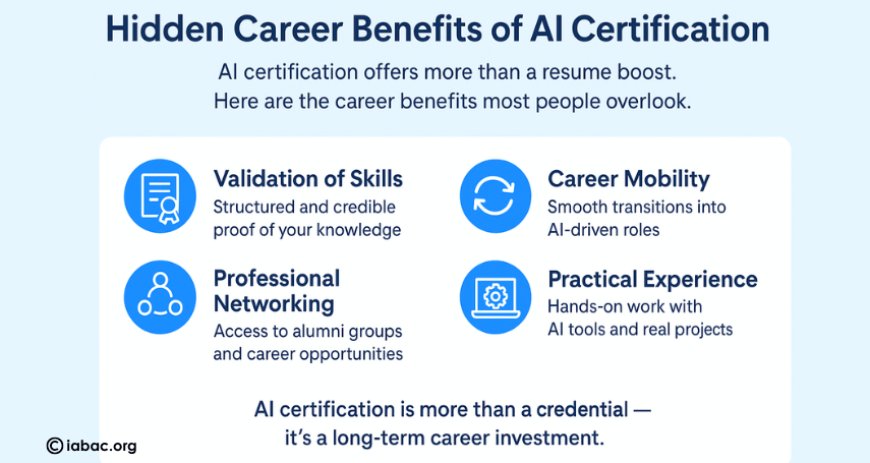
Certification is often seen as just another badge for LinkedIn or an extra line on a CV. But AI certification is more than that. It signals structured, validated expertise.
Anyone can follow a few online tutorials and claim to “know AI.” Employers, however, want proof that a candidate’s skills have been tested in a standardized way. A certification does exactly that — it validates that your knowledge is not just fragmented, but cohesive and applicable.
In a crowded job market, this validation helps distinguish you from candidates who only have surface-level familiarity with AI.
2. A Pathway for Career Transitions
AI certification can also act as a bridge when you’re shifting careers. Professionals today are increasingly moving across industries or into hybrid roles. For example:
-
Marketing professionals use AI certifications to build expertise in customer analytics and predictive modeling.
-
Finance specialists leverage AI to improve fraud detection and risk assessment.
-
Healthcare workers adopt AI knowledge to support diagnostics and patient care systems.
Without certification, such transitions can feel daunting, both for professionals and employers. The certificate demonstrates you’ve invested in building the right skills, reducing the perceived risk of hiring or promoting you into a new role.
3. Building Confidence Through Structure
AI can appear overwhelming, especially to those without a technical background. Concepts like neural networks or machine learning algorithms may seem inaccessible.
Certification programs help by offering structured learning. They start with foundational knowledge, gradually introduce complexity, and include checkpoints to reinforce learning. This methodical approach builds confidence.
By the end of a certification program, you don’t just recognize AI terminology — you understand how to apply it in real-world scenarios. That confidence often translates into a stronger presence in meetings, project discussions, and decision-making.
4. Access to Professional Networks
One of the most overlooked benefits of AI certification is community. Many programs include access to alumni groups, online forums, or peer networks.
At first, these communities may seem like an extra feature. But in practice, they become powerful career resources. Through them, you can:
-
Learn directly from peers who are applying AI in different industries.
-
Access mentorship from experienced professionals.
-
Discover opportunities such as job referrals, freelance projects, or collaborations.
In many cases, these networks create as much career value as the certificate itself.
5. Hands-On Experience With Tools
Theory alone isn’t enough in AI. Employers want professionals who can move from concepts to practice.
Most certification programs include applied projects. You might train a machine learning model, build a chatbot, or experiment with tools like TensorFlow, PyTorch, or cloud-based AI platforms.
This hands-on experience is one of the hidden strengths of certification. It prepares you for real workplace challenges, ensuring that your knowledge isn’t just academic but practical.
6. A Competitive Edge in Hybrid Roles
As AI becomes integrated across industries, “hybrid” roles are becoming common. Titles like AI Marketing Specialist or AI Business Analyst reflect a blend of domain expertise and technical literacy.
An AI certification gives you a competitive edge in these roles. For example, a certified marketer stands out not just for campaign strategy, but for their ability to leverage AI tools for personalization and analytics.
This unique combination can set you apart in industries where demand is high but supply of skilled professionals is limited.
7. Employer Perception: Signaling Adaptability
Employers see AI certification as more than proof of knowledge. To them, it signals adaptability and a willingness to learn.
In fast-changing industries, adaptability is often just as important as technical skills. Certification demonstrates that you are proactive in keeping up with change — a trait employers look for when making hiring or promotion decisions.
This perception can make a difference not only in landing jobs but also in climbing within your current organization.
8. Personal Growth Beyond the Certificate
Certification isn’t only about professional milestones. It can also bring personal growth.
-
You learn to think in a more data-driven way.
-
You become comfortable engaging with technical teams.
-
You develop problem-solving skills that apply across domains.
This shift in mindset often makes certified professionals more confident contributors, not just in AI-specific contexts but in broader organizational discussions.
9. Long-Term Career Resilience
Job roles are evolving faster than ever. Skills relevant today may need updating in just a few years. AI certification equips you with resilience by preparing you for changes in the job market.
Even if your role doesn’t involve AI today, it likely will in the near future. Certification ensures you’re ready before the change happens, instead of scrambling to adapt later.
This readiness positions you not just for survival but for leadership as industries transform.
10. Bridging the Gap Between Tech and Business
Organizations often struggle with a communication gap between technical teams and business leaders. Technical staff may focus on algorithms, while business teams look at outcomes. Few professionals can bridge the two. Organizations adopting AI often seek expert guidance through AI consulting to align technical capabilities with real business outcomes.
AI-certified professionals often fill this gap. With a balanced understanding of both sides, you can translate AI capabilities into business value.
For example:
-
Explaining how predictive models reduce costs.
-
Demonstrating how AI-driven recommendations increase engagement.
-
Highlighting where automation saves time for teams.
This “translator” role is increasingly valuable in companies navigating AI adoption.
11. Enhancing Professional Credibility
Finally, AI certification enhances your professional credibility. Whether you’re sharing insights online, contributing to panels, or guiding teams internally, a certification reinforces your authority.
Colleagues and employers are more likely to trust your input when it’s backed by recognized training. Over time, this credibility can open doors to thought leadership, consulting, or advisory roles.
AI certification is often associated with obvious outcomes like better jobs or higher pay. While those are important, the hidden career benefits are just as impactful — structured learning, networking, confidence, practical experience, adaptability, and long-term resilience.
In a world where AI is shaping industries at an accelerating pace, certification is more than a credential. It’s a signal of readiness, adaptability, and forward-thinking.
If you’re considering AI certification, don’t see it only as a resume booster. See it as an investment in long-term career growth, personal development, and future relevance. The hidden benefits may turn out to be the ones that matter most.