






















































What Is Data Science Course
Learn what a data science course is, its key topics, and how it helps in understanding data, tools, and techniques for better decision-making skills.


A Data Science course is designed to help you understand the basics of working with data. It teaches you key skills like analyzing data, using machine learning and creating visualizations. This course is perfect for beginners or anyone looking to get a solid grasp of the tools and techniques used to solve problems with data. With my experience, I’ll help you build knowledge and the confidence to apply what you learn in real-world situations. Whether you're new to the field or looking to sharpen your skills, this course will guide you through the essentials of Data Science.
What Is a Data Science Course
A data science course is a planned program that teaches you the skills, tools, and methods needed to work with data. It usually includes topics like data handling, analysis, visualization, and machine learning. These courses can be for beginners or advanced learners, depending on what they cover and who they are for.
A data science course is a structured learning program designed to teach you the basics, techniques, and tools used in data science. Data science is a field that combines statistics, math, computer science, and knowledge about specific areas to get insights from data. A data science course usually covers the whole data process, from collecting and cleaning data to analyzing and visualizing it, and finally, using machine learning models and sharing results.
The main aim of a data science course is to give students the knowledge and abilities to analyze large datasets, make decisions based on data, and create models that can predict future trends. Courses from well-known organizations like IABAC offer training and certification that meet industry needs, helping learners prepare for jobs in the field.
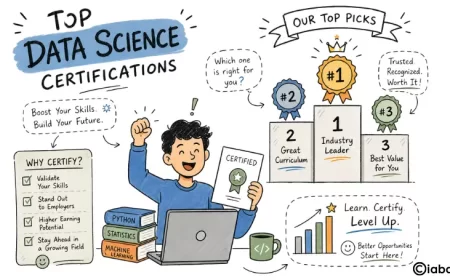
Why Take a Data Science Course?
Data science is becoming more important in many industries, including healthcare, finance, marketing, and technology. Taking a data science course can help you in several ways:
- Career Opportunities
Data science is one of the most sought-after jobs, offering high salaries and various roles such as Data Scientist, Data Analyst, and Machine Learning Engineer. - Skill Development
A course gives you hands-on experience with tools like Python, R, SQL, Tableau, and libraries for machine learning and data visualization. - Structured Learning
For beginners, learning the complex ideas of data science can be hard. A course breaks it down into easy-to-understand parts and provides a clear learning path. - Certification
Recognized certifications, like those from IABAC, improve your resume and show your skills to potential employers.
How to Choose the Right Data Science Course?
If you're new to data science, it's important to pick a course that matches your level and career goals. Here are some tips:

- Check the Curriculum: Make sure the course covers all the basics, such as Python programming, statistics, and machine learning.
- Industry Recognition: Look for courses that offer certifications recognized by top organizations. For example, IABAC-certified courses are known worldwide and meet industry standards.
- Hands-on Learning: Practical projects and real-life case studies are important for understanding how to apply what you’ve learned.
- Mentorship and Support: Choose programs that provide access to mentors, discussion forums, and career advice.
- Flexibility: Consider courses that offer flexible schedules, especially if you are working while studying.
Key Benefits of an IABAC-Certified Data Science Course
- Global Recognition
IABAC certifications are recognized internationally, adding value to your professional profile. - Comprehensive Syllabus
IABAC ensures that its curriculum matches the latest trends in the industry. - Practical Focus
These courses emphasize hands-on projects, helping you apply what you learn to real-world situations. - Pathway to a Career in Data Science
The certification helps you move into various data science job roles.
What Does a Data Science Course Cover?
Data is often called the new oil. From businesses to healthcare, finance to social media, data helps make decisions, create new ideas, and find solutions. With the growth of big data, machine learning, and artificial intelligence, more people are looking to learn data science. Many are taking data science courses to gain the skills needed for these jobs.
But what exactly is a data science course? What will you learn, and how will it help you become a skilled data scientist? In this blog, we'll look at the main parts of a typical data science course, the skills it teaches, and what you can expect to gain from it.
Key Components of a Data Science Course
A complete data science course includes several key parts. Here are the main topics and skills that are usually covered:
1. Introduction to Data Science
The first part of a data science course is usually an overview of what data science is, its history, its real-world uses, and why it’s important today. This section might include basic ideas like data collection, data cleaning, exploring data, and data visualization. Students will also learn about the tools and technologies commonly used in the field, such as Python and R.
2. Mathematics and Statistics for Data Science
A strong foundation in math and statistics is important for any data scientist. In this part of the course, you will learn key ideas in probability, statistics, and linear algebra, which are essential for understanding data patterns, testing ideas, regression analysis, and more. Some of the main areas include:
- Probability: Ideas like conditional probability, Bayes’ theorem, and different probability distributions (e.g., normal, binomial, Poisson).
- Statistics: Descriptive statistics, inferential statistics, statistical tests (t-tests, chi-square tests), p-values, confidence intervals.
- Linear Algebra: Vectors, matrices, eigenvalues, and eigenvectors, which are important for understanding machine learning algorithms.
- Calculus: Some data science courses also cover basic calculus, especially derivatives and integrals, which are used in optimization techniques for machine learning.
3. Programming for Data Science
Programming is a key skill for data science. While different languages can be used, most data science courses focus on Python because it is popular and has many libraries for data manipulation, analysis, and visualization. In this section of the course, you will:
- Learn Python syntax, data types, control structures, functions, and object-oriented programming concepts.
- Understand how to use Python libraries like NumPy, pandas, and SciPy for data manipulation, cleaning, and analysis.
- Explore libraries like Matplotlib, Seaborn, and Plotly for creating data visualizations and presenting findings clearly.
Some courses may also introduce R programming, which is another popular language for data analysis, especially in academia and research.
4. Data Collection and Preprocessing
Before analyzing data, it must be collected and cleaned. This part of the course teaches methods for gathering, organizing, and preparing data. You will learn how to:
- Import data from different sources, including CSV files, databases, APIs, and web scraping.
- Clean and preprocess data by handling missing values, outliers, and noisy data.
- Transform and normalize data to ensure it is in a format that can be used for analysis.
- Perform feature engineering to create new variables that can improve the performance of machine learning models.
5. Exploratory Data Analysis (EDA)
Exploratory Data Analysis (EDA) is the process of examining data sets to summarize their main features and find patterns, trends, and relationships. During this part of the course, you will learn how to:
- Use statistical techniques and visualizations to look at the structure of the data.
- Apply correlation and covariance to study the relationships between variables.
- Identify anomalies, trends, and outliers that could affect data modeling.
- Use methods like dimensionality reduction (e.g., PCA) to simplify large datasets for better analysis.
6. Machine Learning Algorithms
Machine learning is a key part of data science, and it is often the most exciting part of a data science course. In this section, you will learn how to use machine learning algorithms, which allow computers to make predictions or decisions without being explicitly programmed. Topics include:
- Supervised Learning: Techniques like linear regression, logistic regression, decision trees, random forests, and support vector machines.
- Unsupervised Learning: Clustering algorithms like k-means and hierarchical clustering, as well as dimensionality reduction methods.
- Neural Networks and Deep Learning: Basics of neural networks, backpropagation, and frameworks like TensorFlow and Keras.
- Model Evaluation and Tuning: Techniques like cross-validation, grid search, and model evaluation metrics (accuracy, precision, recall, F1 score).
7. Data Visualization and Communication
Being able to present data in an easy-to-understand and meaningful way is essential for any data scientist. This part of the course will focus on methods to visualize data effectively. You will learn how to:
- Create visualizations such as histograms, bar charts, scatter plots, heatmaps, and box plots to show patterns and trends.
- Use advanced tools like Tableau or Power BI to build interactive dashboards and reports.
- Create clear stories that help others make data-driven decisions.
8. Big Data and Cloud Computing
As data continues to grow, handling large datasets becomes more important. Some data science courses cover topics related to big data, including:
- Distributed Computing: Using frameworks like Hadoop and Spark to process large datasets across multiple machines.
- Cloud Computing: Learning how to use cloud platforms such as AWS, Google Cloud, and Microsoft Azure for storage, computation, and deployment of data science models.
- Databases: Understanding SQL for querying relational databases and NoSQL for working with unstructured data.
A data science course is the first step toward a successful career in data science. By offering a clear learning path, relevant tools, and practical experience, these courses help learners handle real-world data challenges confidently.