

























































Intelligence in AI Technology
Learn how intelligence in AI technology works, its uses, and how it helps in daily life with smarter systems and better decision-making.

Artificial intelligence is changing the world in ways we once only dreamed of. Intelligence in AI is about more than just programming—it’s about machines learning to think, adapt, and solve problems, often better and faster than humans. This ability reshapes industries like healthcare and finance, making them more efficient and accurate. With years of experience, I’ve seen how this technology has improved medical diagnoses, streamlined financial systems, and solved problems once thought impossible. Intelligence in AI isn’t just about machines doing tasks—it’s about creating solutions that truly make a difference in our lives.
What is Artificial Intelligence
AI means creating computer systems that can do tasks that normally need human intelligence, like understanding speech, recognizing images, or solving problems. The intelligence in AI comes from its ability to learn from data, spot patterns, and improve over time. Certifications like Certified Machine Learning Associate help teach these skills.
How Does Intelligence in AI Work
AI's intelligence is built on three key ideas:
- Learning: AI uses algorithms to study and understand data. Programs like Certified Artificial Intelligence Expert teach how machines learn through methods like supervised, unsupervised, or reinforcement learning.
- Reasoning: AI applies logic to make smart decisions. Certifications like Certified Natural Language Processing Expert focus on how machines understand and respond to human language.
- Adaptation: AI systems can adjust to new data or situations. For example, courses like Certified Computer Vision Expert show how machines adapt to visual inputs.
Types of Intelligence in AI
AI intelligence can be classified based on its scope and ability:
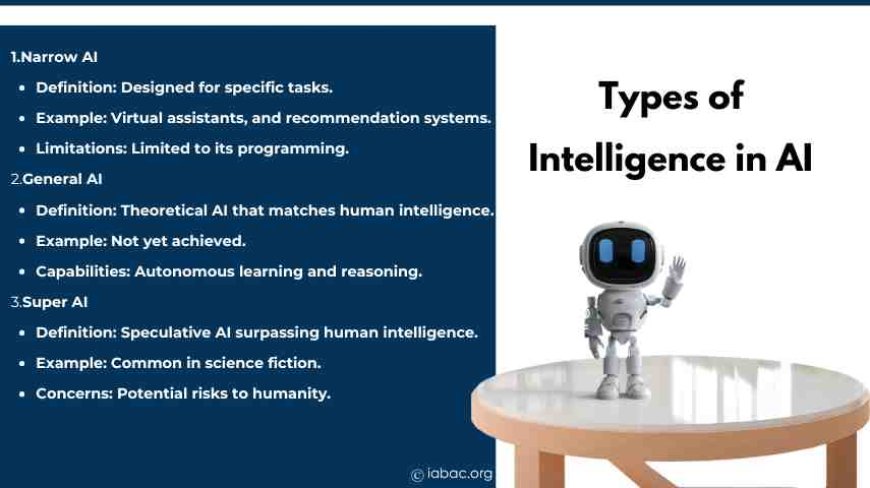
- Narrow AI
- Definition: This type of AI is designed to do one specific job.
- Example: Virtual assistants, recommendation systems, and facial recognition software.
- Limitations: It can only do the task it’s programmed for and cannot perform tasks outside of that.
- General AI
- Definition: This is a theoretical AI that could perform any intellectual task that a human can.
- Example: General AI is still a concept and has not yet been achieved.
- Capabilities: It would involve autonomous learning, reasoning, and transferring knowledge across different tasks.
- Super AI
- Definition: A speculative future form of AI that would surpass human abilities in every area.
- Example: Seen often in science fiction, this kind of AI could be better than humans at creativity, emotional intelligence, and problem-solving.
- Ethical Concerns: There are concerns about how to control this AI and whether it could pose a risk to humanity.
How AI Mimics Human Intelligence
AI models like neural networks work in a way similar to the human brain, processing information and making decisions. Advanced certifications, such as Certified Artificial Intelligence Expert, train people to design and improve these systems for tasks like language translation or predicting trends.
Defining Intelligence in AI
Intelligence in AI refers to the ability of machines to mimic human thinking and decision-making. It allows machines to:
- Learn: Improve over time based on experience, without needing to be directly programmed.
- Reason: Make decisions and draw conclusions from available information.
- Perceive: Recognize patterns and objects in the real world, such as identifying people, sounds, or images.
- Plan: Predict future actions and make decisions based on goals.
- Solve Problems: Find solutions to challenging problems.
These abilities come from the use of algorithms, data, and powerful computers, enabling AI systems to do tasks that traditionally required human skills.
Key Components of Intelligence in AI
- Machine Learning (ML): Machine learning is the foundation of AI’s intelligence. It allows machines to learn from data, recognize patterns, and improve their abilities over time. Common techniques include supervised, unsupervised, and reinforcement learning.
- Natural Language Processing (NLP): NLP helps machines understand, interpret, and respond to human language. This is what powers chatbots, translation services, and voice assistants like Siri or Alexa.
- Computer Vision: Computer vision is the ability of machines to interpret and understand visual information from the world. It allows AI to recognize images, videos, and real-time visual data for making decisions.
- Reasoning and Logic: AI systems use reasoning to understand problems, make decisions, and see connections between things. For example, expert systems use logical rules to provide solutions in specific areas, like medicine or law.
- Memory and Context Awareness Some AI systems can remember information and use context to improve their interactions. For instance, AI in customer service can remember past conversations to offer a more personalized experience.
Types of AI Systems
There are three types of AI systems. Narrow AI (Weak AI) focuses on specific tasks, like chatbots and recommendation engines, and is covered in foundational courses. General AI (Strong AI) is a hypothetical system capable of performing any task a human can, often explored in advanced certifications. Superintelligent AI refers to AI surpassing human intelligence, which remains a topic of ongoing research.
There are three types of AI:
- Narrow AI (Weak AI): These systems handle specific tasks like chatbots or recommendation engines. Courses like Artificial Intelligence Foundation focus on this type of AI.
- General AI (Strong AI): Hypothetical systems that could perform any task a human can do. These concepts are introduced in advanced certifications like the Artificial Intelligence Certified Executive program.
- Superintelligent AI: AI smarter than humans, is still a subject of research.
Why AI Certifications Are Important
AI certifications are valuable for beginners and professionals because they offer:
- Practical Knowledge: Programs like the Artificial Intelligence Foundation teach the basics of AI.
- Recognition: Certifications such as Certified Artificial Intelligence Expert are trusted by companies around the world.
- Career Opportunities: Specialized certifications, like Certified Natural Language Processing Expert, help you qualify for in-demand AI jobs.
Applications of Intelligence in AI
AI’s intelligence is already making a big impact in many areas:
- Healthcare AI can help doctors diagnose diseases, recommend treatments, and predict patient outcomes. It analyzes medical data and images to provide better care.
- Finance AI is used to spot fraudulent activity, predict market trends, and automate financial processes.
- Transportation AI is key to self-driving cars, helping them make decisions based on real-time data from sensors and cameras.
- Customer Service Chatbots and virtual assistants use AI to understand customer queries and provide instant responses.
- Manufacturing Intelligent robots can optimize production lines and predict when equipment needs maintenance, reducing downtime.
- Education AI helps create personalized learning experiences by adjusting to each student’s needs.
Challenges and Ethical Considerations
While AI has many benefits, there are some challenges and concerns:
- Bias in Algorithms: AI systems can sometimes reflect biases from the data they are trained on, leading to unfair outcomes.
- Lack of Explainability: Some AI models, like deep learning, are complex and hard to understand, making it difficult to explain how decisions are made.
- Ethical Concerns: With AI being used in many areas, there are important questions about privacy, job displacement, and who is responsible for decisions made by AI.
Developing ethical guidelines and transparent AI systems will be crucial in addressing these challenges.
The Future of Intelligence in AI
AI has a bright future, with growing areas like language processing and computer vision leading the way. Professionals with certifications like Certified Machine Learning Associate and Certified Computer Vision Expert are helping shape this progress.
Intelligence in AI is about machines being able to perform tasks that require human-like thinking and problem-solving. From learning and reasoning to seeing and making decisions, AI is transforming technology and our daily lives. As AI continues to grow, its uses will expand, making it an important part of the future. Understanding how AI works and its limitations is key to using it responsibly and ensuring it benefits society.