
























































Which Industries Offer Data Analytics Positions?
Data analytics roles exist across industries like finance, healthcare, retail, IT, marketing, and manufacturing, driving insights, efficiency, and growth.

Data is everywhere. Every click, every purchase, every online search creates data. Companies are not just collecting this data—they are using it to make better decisions, improve customer experience, and grow faster. Because of this, Data Analytics Positions are growing quickly across the world, and the demand is not slowing down.
If you are thinking about building a career in this field, you might be wondering: Which industries actually offer data analytics jobs? What skills do I need? And how do certifications help? Let’s break everything down in a simple and clear way.
Data analytics is not limited to tech companies anymore. It is now a key part of almost every industry. From healthcare to finance, from retail to sports, data plays an important role in daily decisions.
Let’s start by understanding where the opportunities are.
Industries That Offer Data Analytics Positions
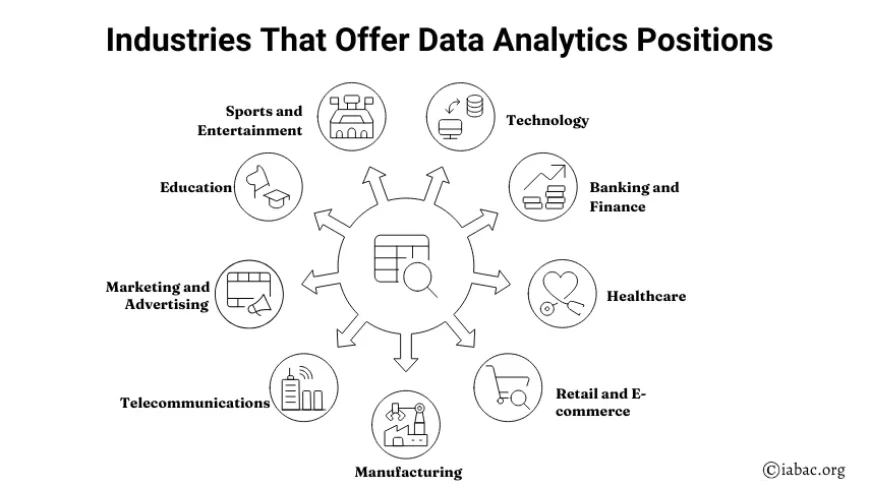
1. Technology Industry
The technology sector is one of the biggest employers for data professionals. Companies use data to improve software, understand users, and build better products.
In this space, data analysts work with large datasets, track user behavior, and support product teams. This industry also offers some of the highest salaries. In major tech hubs, experienced professionals can earn more than ₹14 lakhs per year.
2. Banking and Finance
Banks and financial companies depend heavily on data. They use it to detect fraud, manage risks, and understand customer spending habits.
Data analysts in this field work with transaction data, customer profiles, and financial reports. They also help companies make better investment decisions.
3. Healthcare
Healthcare is becoming more data-driven every day. Hospitals and research centers use data to improve patient care and manage operations.
For example, data can help doctors predict diseases, track treatment results, and reduce costs. Data analytics professionals play a key role in making this possible.
4. Retail and E-commerce
Retail companies use data to understand what customers want. They track buying behavior, product trends, and seasonal demand.
If you’ve ever seen product recommendations online that feel “too accurate,” that’s data analytics at work. Analysts help businesses decide pricing, promotions, and inventory planning.
5. Manufacturing
Manufacturing companies use data to improve production and reduce waste.
Data analytics helps in predicting machine failures, improving quality, and managing supply chains. This leads to faster production and lower costs.
6. Telecommunications
Telecom companies handle massive amounts of data every day. They use analytics to improve network performance, reduce customer churn, and offer better services.
Data analysts help in understanding usage patterns and improving customer experience.
7. Marketing and Advertising
Marketing today is driven by data. Companies track campaign performance, customer engagement, and return on investment.
Data analysts help teams understand what works and what doesn’t. This leads to better marketing decisions and higher profits.
8. Education
Educational institutions are also using data analytics. They analyze student performance, course effectiveness, and learning patterns.
This helps improve teaching methods and student outcomes.
9. Sports and Entertainment
Yes, even sports teams use data analytics. They study player performance, match statistics, and fan engagement.
In entertainment, streaming platforms use data to recommend content and understand viewer preferences.
Common Job Roles in Data Analytics
There are different roles under the umbrella of Data Analytics Positions, and each has its own focus.
- A data analyst works on understanding data and creating reports or dashboards. They often use tools like Excel, Power BI, and Tableau.
- A business analyst connects business needs with data insights. They help companies make decisions based on data.
- A data engineer focuses on building systems to collect and process data. They work with data pipelines and infrastructure.
- An online data analyst works remotely, often evaluating search results and improving content quality.
Each role has its own path, but they all require a strong understanding of data.
Skills Required for Data Analytics
To succeed in this field, you need a mix of technical and analytical skills.
Technical Skills
SQL is one of the most important skills. It is used to manage and query databases.
Python and R are widely used for data analysis and automation.
Visualization tools like Power BI and Tableau help in presenting data clearly.
Data Handling Skills
You should understand how to collect, clean, and organize data.
ETL (Extract, Transform, Load) is a common process used to prepare data for analysis.
Data modeling helps in structuring data for better use.
Analytical Skills
You need to think logically and understand patterns.
Statistical analysis helps in making predictions.
Exploratory Data Analysis (EDA) helps in understanding data before making decisions.
Tools You Should Know
Excel is still very important, especially advanced functions.
Google Sheets is widely used for collaboration.
Other tools like Alteryx and CRM systems are also helpful depending on the role.
Salary Outlook in Data Analytics
Salaries in data analytics depend on skills, experience, and location.
Entry-level roles may start around ₹5–6 lakhs per year.
Mid-level professionals can earn around ₹10–15 lakhs per year.
Top professionals can go beyond ₹14 lakhs and even higher in global markets.
The demand is high, and companies are willing to pay well for skilled professionals.
Where to Find Data Analytics Jobs
There are many platforms where you can find opportunities.
Job portals list thousands of openings in data analytics. Some platforms have over 30,000 active listings.
Freelance platforms offer remote work opportunities.
Startup-focused platforms provide roles in fast-growing companies.
The good news is that remote work is becoming more common, so you can work for global companies from anywhere.
Why Data Analytics Certifications Matter
Now, here comes an important question: Do you really need certifications?
The short answer is yes. Data Analytics Certifications help you stand out in a competitive market.
They show that you have the required skills and knowledge. They also help you learn in a structured way.
Many employers prefer candidates who have certifications because it reduces their training effort.
Why Is an Accredited Body Important for Certifications
Not all certifications are equal. This is where an accredited body becomes important.
An accredited body ensures that the certification meets quality standards. It checks whether the course content is relevant and up to date.
Without accreditation, a certification may not be trusted by employers.
An accredited certification gives you credibility and improves your chances of getting hired.
How Does an Accredited Body Approve Certification Programs
Accredited bodies follow a detailed process before approving any certification.
They review the course content to make sure it covers important topics.
They check whether the training methods are effective.
They evaluate the assessment process to ensure it measures real skills.
They also review the trainers and their expertise.
Only after passing these checks does a certification get approved.
What Is the Role of an Accredited Body in Education
An accredited body plays a key role in maintaining education standards.
It ensures that learners receive quality training.
It helps build trust between learners and employers.
It also encourages continuous improvement in certification programs.
In simple words, it acts as a quality checker for education.
How IABAC Supports Your Career
When it comes to Data Analytics Certifications, IABAC (International Association of Business Analytics Certifications) focuses on industry-relevant learning.
The programs are designed to match real-world requirements.
They cover important tools, techniques, and concepts used in the industry.
They also help learners build practical skills through projects and case studies.
You can explore more about these certifications on the IABAC website (www.iabac.org) and find a program that fits your career goals.
A Small Reality Check
Many people think learning data analytics means sitting with complex formulas all day.
In reality, it’s more about solving problems. Yes, sometimes you will spend hours trying to figure out why your code is not working… only to realize you missed a small comma. It happens to everyone.
But the good part? That moment when everything works feels amazing.
Data analytics is not just a career option anymore—it is a skill that is becoming essential across industries. From technology to healthcare, from finance to sports, Data Analytics Positions are everywhere. With the right skills, tools, and Data Analytics Certifications, you can build a strong and rewarding career.Focus on learning step by step. Build your skills. Work on real projects. And choose certifications that are recognized by an accredited body. The journey may feel challenging at times, but every small step brings you closer to your goal. And one day, you won’t just be analyzing data—you’ll be making decisions that actually matter.