





















































Who Is the Father of Artificial Intelligence? Explained
Who is the Father of Artificial Intelligence? Read about Alan Turing, the origin of AI, its history, key ideas, and why his work still shapes AI careers.

Artificial intelligence, commonly known as AI, often feels like a recent innovation. It appears in voice assistants, recommendation systems, smart cameras, and language tools. Because these technologies feel new, many people assume artificial intelligence itself is a modern invention. In reality, the basic ideas behind AI were developed decades ago by one remarkable thinker.
This leads to a question that appears frequently in classrooms, competitive exams, interviews, and online discussions: Who is the father of artificial intelligence?
Understanding the answer is not just about memorising a name. It helps learners understand how intelligent machines were first imagined, why modern AI works the way it does, and how logical thinking shaped today’s technologies. This knowledge builds clarity for students, confidence for professionals, and direction for anyone planning a future in artificial intelligence.
Understanding Artificial Intelligence
Before answering who is the father of artificial intelligence, it is important to understand what artificial intelligence actually means.
Artificial intelligence refers to the ability of machines or computer systems to perform tasks that normally require human thinking. These tasks include learning from experience, solving problems, understanding language, recognising patterns, and making decisions based on data.
AI does not mean machines have emotions or awareness. Instead, AI systems follow logic, rules, and mathematical models designed by humans.
What Artificial Intelligence Can Do
Artificial intelligence systems are designed to:
-
Learn from data
-
Identify patterns and trends
-
Make predictions
-
Respond to human input
-
Improve performance over time
These abilities come from structured thinking and logical models, not from human feelings.
Everyday Examples of Artificial Intelligence
AI is already part of daily life, often without people noticing it.
Some common examples include:
-
Search engines suggest relevant results
-
Email platforms filtering unwanted messages
-
Navigation apps choose faster routes
-
Video platforms recommending content
-
Translation tools converting one language into another
All of these applications are based on ideas that were first imagined long before modern computers became powerful.
Why People Ask: Who Is the Father of Artificial Intelligence?
The question of who is the father of artificial intelligence is one of the most commonly asked questions related to AI history. It appears in:
-
School and university exams
-
Technical and non-technical interviews
-
Certification tests
-
Introductory AI courses
People ask this question for several reasons:
-
To understand where AI truly began
-
To avoid confusion caused by many contributors
-
To build strong foundational knowledge
-
To connect modern AI tools to their origins
While many scientists helped shape artificial intelligence, one individual laid the intellectual groundwork that made everything else possible.
The Clear Answer: Alan Turing
The person most widely recognised as the Father of Artificial Intelligence is Alan Turing.
Alan Turing was a British mathematician, logician, and computer scientist. His work created the foundation for both modern computing and artificial intelligence. Long before AI became a field of study, Turing was already asking questions that defined what intelligent machines could be.
Who Was Alan Turing?
Alan Turing was born in 1912 in England. From a young age, he showed exceptional ability in mathematics and logical reasoning. He studied at leading universities and focused on problems that required deep analytical thinking.
During World War II, Turing played a critical role in code-breaking, but his influence on artificial intelligence came from his theoretical work, not wartime activity alone.
His ideas were far ahead of his time and shaped how scientists thought about machines and intelligence.
The Big Question That Changed Everything
In 1950, Alan Turing published a paper that asked a bold and simple question:
“Can machines think?”
At that time, computers were large machines designed mainly for calculations. The idea that a machine could imitate human thinking was considered unrealistic by many.
Turing believed that if human thinking followed logical steps, then a machine could also follow similar steps using rules and symbols.
This single question became the starting point for artificial intelligence as a concept.
The Turing Test: Measuring Machine Intelligence
One of Alan Turing’s most influential ideas is the Turing Test.
How the Turing Test Works
-
A human judge communicates through text
-
There are two hidden participants
-
One participant is a human
-
The other participant is a machine
-
If the judge cannot reliably tell which is which, the machine demonstrates intelligent behaviour
The test does not measure emotions or consciousness. Instead, it focuses on whether a machine can imitate human responses convincingly.
Even today, debates about AI intelligence often refer back to the Turing Test.
The Turing Machine: Foundation of Computing
Another major contribution by Alan Turing is the Turing Machine.
The Turing Machine is a theoretical model that shows how a machine can process information using simple rules.
It proved that:
-
Any logical task can be broken into basic steps
-
Machines can follow instructions to solve problems
-
Complex operations can come from simple actions
Modern computers still follow this principle, which is why Turing is also considered a founder of computer science.
Why Alan Turing Earned the Title “Father of Artificial Intelligence”
Many researchers contributed to artificial intelligence, but Alan Turing is given this title for specific reasons.
He:
-
Defined what machine intelligence could mean
-
Introduced a method to test intelligence
-
Created the theoretical basis for computing
-
Inspired future AI research
Because of this, when people ask who is the father of artificial intelligence, Alan Turing remains the most accurate answer.
Father of AI vs Founders and Pioneers of AI
A common source of confusion is the difference between:
-
The Father of Artificial Intelligence
-
Founders or pioneers of AI
Alan Turing is called the father because he laid the intellectual foundation. Others built upon that foundation later.
Key Difference Explained
-
Father of AI: Introduced the core idea of thinking machines
-
AI pioneers: Developed systems, programs, and research fields
This distinction helps clarify why multiple names appear in AI history, but only one holds the central title.
Other Thinkers Who Shaped Artificial Intelligence
Artificial intelligence did not grow from one person alone. Several researchers expanded Turing’s ideas.
Notable contributors include:
-
John McCarthy, who coined the term “Artificial Intelligence”
-
Marvin Minsky, who worked on early AI models
-
Herbert Simon, who studied problem-solving systems
These thinkers helped turn theory into practice, but they worked on ideas that already existed because of Turing’s early work.
The Formal Birth of Artificial Intelligence as a Field
While Alan Turing laid the groundwork, artificial intelligence became a formal academic field in the mid-1950s.
In 1956, researchers gathered to discuss creating machines that could simulate human intelligence. This moment marked the official beginning of AI as a discipline.
However, the ideas discussed during this period were deeply influenced by Turing’s earlier theories.
Artificial Intelligence vs Computer Science
Many learners confuse artificial intelligence with computer science or programming.
Here is a simple distinction:
-
Computer Science: Study of computation, algorithms, and systems
-
Programming: Writing instructions for computers
-
Artificial Intelligence: Creating systems that imitate intelligent behavior
AI is a specialised area within computer science, built on logic, mathematics, and data.
How Alan Turing’s Ideas Shape Modern AI
Although today’s artificial intelligence systems appear highly advanced, their basic principles come from ideas first introduced by Alan Turing. His work showed that machines could process information using logic, rules, and structured steps, which remains true even now.
Examples of His Influence Today
-
Machine learning models use mathematical logic to analyse data and make predictions, following structured processes similar to those Turing described.
-
Language systems are designed to imitate human conversation by recognising patterns in words and sentences, reflecting Turing’s idea of machines responding intelligently.
-
Decision-making systems rely on rules, probabilities, and calculations to choose outcomes, rather than emotions or intuition.
-
Automated testing systems check whether machines behave intelligently, similar to how the Turing Test evaluates machine responses.
Even large-scale cloud-based AI services used by companies like Google and Microsoft are built on computational models that trace back to early theoretical ideas introduced by Turing.
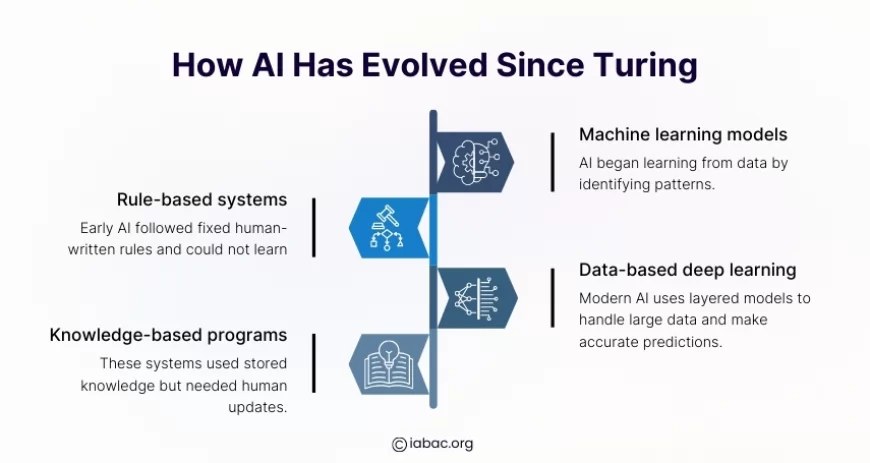
After Alan Turing introduced the idea that machines could imitate human thinking, artificial intelligence began to grow step by step. It did not advance all at once. Instead, it developed through several important stages over time.
-
Rule-based systems: Early AI systems followed fixed rules created by humans. These systems worked only when clear instructions were provided and could not learn on their own.
-
Knowledge-based programs: Later, systems were designed to store information and use it to make decisions. They relied on expert knowledge but still required human input to update their understanding.
-
Machine learning models: AI then moved toward learning from data. Instead of following only rules, machines started improving their performance by finding patterns in large sets of information.
-
Data-based deep learning: Modern AI uses layered models that process huge amounts of data. These systems can recognise images, understand language, and make predictions with higher accuracy.
Each stage builds on Turing’s original idea that machines can simulate certain aspects of human thinking using logic and data.
Why This Knowledge Matters for Students
Understanding who is the father of artificial intelligence helps students:
-
Build strong fundamentals
-
Understand exam concepts clearly
-
Connect theory with applications
-
Avoid misinformation
Students with strong foundations learn advanced AI concepts more easily.
Why Professionals Benefit From AI History
For professionals, AI history provides more than facts.
It helps them:
-
Understand system limitations
-
Communicate with technical teams
-
Make better technology decisions
-
Plan long-term career growth
Strong foundational knowledge builds credibility in AI-related roles.
Ethical Thinking and Alan Turing’s Vision
Alan Turing did not focus only on making machines intelligent. He also thought about how humans should guide and control such machines. His ideas encouraged people to consider responsibility with innovation.
He raised important discussions about:
-
Human control over machines, ensuring that people remain responsible for decisions made by intelligent systems.
-
Limits of automation, recognising that not every task should be left entirely to machines.
-
The difference between imitation and understanding reminds us that machines may copy human behaviour without truly thinking or feeling.
These discussions continue to be relevant today, especially as artificial intelligence systems become more powerful and widely used.
Learning Artificial Intelligence With the Right Foundation
Many learners focus only on tools and coding. However, understanding theory creates stronger professionals.
A balanced AI learning path includes:
-
History of artificial intelligence
-
Logical reasoning
-
Practical application
-
Ethical awareness
Professional AI certifications support structured learning that connects foundational knowledge with real-world AI skills.
Common Misunderstandings About the Father of AI
Many learners feel confused when they first study the history of artificial intelligence. This confusion often happens because modern AI tools and robots receive more attention than the original ideas behind them.
Clearing the Confusion
-
The Father of Artificial Intelligence is not the person who invented robots or modern machines.
-
The title is not based on who created the latest AI software or applications.
-
Instead, it is based on who introduced the intellectual foundation that made intelligent machines possible.
Understanding this difference helps learners develop a clear and accurate view of how artificial intelligence truly began.
Key Takeaways
-
Alan Turing is known as the Father of Artificial Intelligence
-
He asked whether machines could think
-
The Turing Test remains influential
-
Modern AI still follows his logic-based ideas
-
Understanding AI history strengthens learning and careers
The question of who is the father of artificial intelligence is more than a historical fact. It represents the beginning of an idea that changed technology forever. Alan Turing’s work shows that powerful innovations begin with simple questions and logical thinking. For learners and professionals alike, understanding this origin builds clarity, confidence, and respect for artificial intelligence as a field. If you want to build a future in artificial intelligence, start with strong foundations and structured learning. Start your journey today by exploring certification programmes that focus on AI fundamentals, practical skills, and long-term career growth.