

















































Why Some Python Data Science Courses May No Longer Be Enough
Some Python data science courses may no longer be enough as employers expect broader AI, machine learning, and project-based skills.

There was a time when joining one of the many Python Data Science Courses felt like getting a golden ticket. Open a laptop, learn a few lines of Python, build a chart, train a simple model, and suddenly it looked like the future was waiting with a high salary and a shiny job title.
Many people still remember those early lessons:
Print ("Hello Data Science")
That one line felt magical.
Then came the next lesson:
import pandas as pd
And just like that, thousands of learners believed they were only a few weeks away from becoming a data scientist.
But today, many learners are finding something difficult. They finish a course, receive a certificate, update their resume, and then open a job description. Suddenly the job description looks like it was written in another language.
The company asks for Python, SQL, machine learning, cloud tools, data storytelling, business knowledge, deep learning, deployment, dashboards, APIs, and sometimes even communication skills. One learner joked that the company seemed to want “a data scientist, a software engineer, a business analyst, and a magician in one person.”
Sadly, that joke is not far from reality.
The truth is simple. Some older Python Data Science Courses are no longer enough because the world of data science has changed. Learning only basic Python is like learning how to hold a cricket bat and expecting to play in the World Cup the next day.
This article explains why that is happening, what modern employers want, and what learners should do now.
The Old Style of Python Data Science Courses
For many years, most Python Data Science Courses followed the same path:
- Learn Python basics
- Learn NumPy and Pandas
- Create charts with Matplotlib
- Train a few machine learning models
- Finish a small project
- Receive a certificate
That worked well in the past because companies were still building their first data teams.
Back then, even simple skills had great value.
A learner who knew how to:
- Read a CSV file
- Clean missing values
- Build a linear regression model
- Create a simple chart
could already stand out.
But now things are different.
Companies are collecting huge amounts of data every second. Online shopping websites, banks, hospitals, factories, mobile apps, and sports teams all use data. They need people who can do more than just write a few Python commands.
Today, many Data Science Courses still teach only the old path. They spend hours explaining loops, variables, and tiny sample datasets that have only 50 rows.
Then the learner joins a real company and sees a file with 50 million rows.
At that moment, even the strongest coffee may not help.
Why Basic Python Alone Is Not Enough
Python is still one of the most important skills in data science. That has not changed.
The problem is not Python.
The problem is learning only Python.
Imagine someone wants to become a chef. Learning how to use a knife is important. But if the person only learns how to cut onions and never learns cooking, timing, taste, or presentation, becoming a great chef will be difficult.
Python is the knife.
Data science is the full kitchen.
Modern employers want people who understand:
- Python
- SQL
- Statistics
- Machine Learning
- Data Cleaning
- Cloud Platforms
- Business Thinking
- Communication
- Real Projects
- AI Tools
A person who only knows Python often struggles because real jobs need a combination of skills.
For example, a company may ask:
- Can you find the reason sales dropped last month?
- Can you explain the answer to non-technical managers?
- Can you build a prediction model?
- Can you put that model into a website or app?
- Can you make sure the system still works after six months?
A basic course usually does not prepare learners for these questions.
The New Skills Employers Want For Data Science
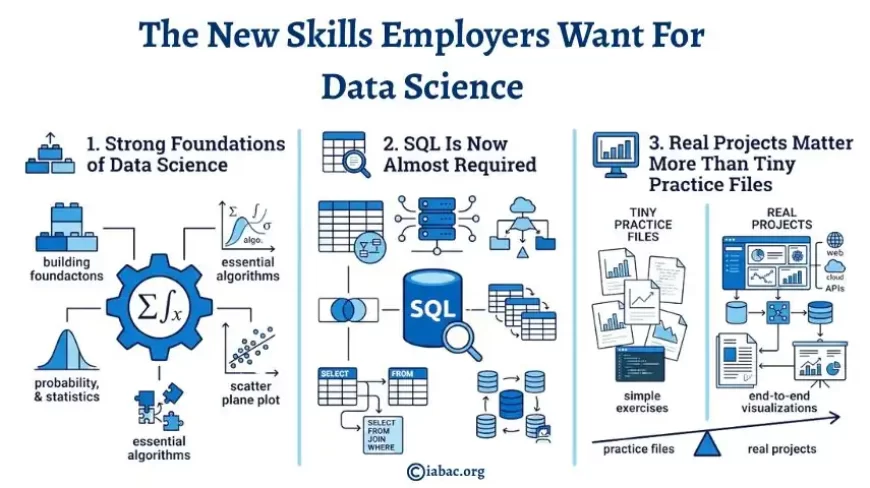
The modern data science job market has changed quickly.
A few years ago, many employers looked only for coding knowledge.
Now they look for problem solvers.
Below are the most common skills companies expect today.
1. Strong Foundations of Data Science
Many learners rush straight into machine learning without learning the foundations of data science.
That is like trying to build the roof of a house before building the walls.
The foundations of data science include:
- Statistics
- Probability
- Data Cleaning
- Data Collection
- Data Ethics
- Business Understanding
For example, if a model predicts that a customer will leave a company, the learner should know:
- Why the model made that prediction
- Whether the data is fair
- Whether the result makes business sense
Without these basics, even a powerful model can give weak results.
Example: Why Statistics Matters
Imagine 1000 customers visit a website.
- 100 click on an advertisement
- 900 do not click
The click rate is:
[Click\ Rate = \frac{100}{1000} \times 100 = 10%]
Now imagine a model predicts that 95 people will click.
That sounds good. But if the learner does not understand statistics, they may not know whether the model is truly useful or just guessing.
2. SQL Is Now Almost Required
Many Python Data Science Courses forget one important truth.
Most company data does not sit neatly inside a Python notebook waiting politely to be used.
Most data lives inside databases.
That means SQL is necessary.
A learner who knows Python but not SQL may feel like a person who bought a beautiful fishing rod but forgot there is no boat.
Common SQL tasks include:
- Finding sales numbers
- Joining tables
- Removing duplicate data
- Grouping information
- Filtering by date or region
Example:
SELECT region, SUM(sales)
FROM company_data
GROUP BY region;
That one line can answer a business question in seconds.
3. Real Projects Matter More Than Tiny Practice Files
Many old courses use small sample datasets.
For example:
- Iris flower dataset
- Titanic dataset
- Small housing dataset
These are useful for learning basics, but real work is much harder.
Real projects often include:
- Missing data
- Wrong data
- Large files
- Strange customer behavior
- Business pressure
- Tight deadlines
A good learner should work on projects such as:
- Predicting customer churn
- Detecting fraud
- Forecasting product sales
- Finding hospital readmission risk
- Building recommendation systems
This is where modern Data Science Courses become more valuable.
Why Data Science for Developers Is Becoming Important
The line between software development and data science is becoming smaller.
Many companies now want data science for developers.
That means they want people who can:
- Build a model
- Write clean code
- Connect the model to an app
- Deploy the model online
- Keep it running
In the past, a data scientist could build a model and hand it to another team.
Today, many companies expect one person to do more.
For example:
A learner builds a movie recommendation model.
The company does not only ask: “Can the model work?”
The company also asks: “Can customers use it inside our app by next week?”
That is why topics such as:
- APIs
- Flask
- FastAPI
- Docker
- Git
- Cloud services
are becoming more important.
Without these skills, a learner may know the answer but may not know how to use it in the real world.
Machine Learning Expert Skills Are Now in Demand
Basic machine learning is no longer enough for many roles.
Companies now want a machine learning expert who understands:
- Advanced models
- Model tuning
- Deep learning
- NLP
- Computer Vision
- Model deployment
- Model monitoring
For example, an online store may want a system that predicts what a customer will buy next.
A basic course may teach only linear regression.
But the company may need:
- Random Forest
- XGBoost
- Neural Networks
- Recommendation Systems
A Simple Comparison
|
Skill Level |
What the Learner Can Do |
|
Beginner |
Build a small prediction model |
|
Intermediate |
Clean data and compare different models |
|
Machine Learning Expert |
Build, improve, deploy, and maintain advanced systems |
This is one reason why some older Python Data Science Courses no longer match what employers need.
The Rise of the Certified Data Scientist
Many learners today are looking for more than a course certificate.
They want proof that they are ready for real work.
This is why the certified data scientist path is becoming more popular.
A strong certification usually includes:
- Practical projects
- Business case studies
- Modern tools
- Assessments
- Real-world skills
Employers often trust candidates more when they see that the learner has completed serious training.
A certificate alone is not magic.
No certificate can suddenly make someone an expert overnight.
But a good certification can help learners:
- Build confidence
- Show their knowledge
- Improve their resume
- Prepare for interviews
For learners looking for global programs, the IABAC website at iabac certifications includes certification options that cover more than basic Python. Many of these programs include business understanding, machine learning, real projects, and job-focused skills.
Data Scientist in Finance and Other Special Roles
Another reason old-style courses are becoming weaker is that companies now want specialists.
In the past, “data scientist” was enough.
Now companies look for:
- Data scientist in finance
- Data scientist in healthcare
- Data scientist in marketing
- Data scientist in supply chain
- Data scientist in banking
Each field has different needs.
For example, a data scientist in finance may need to know:
- Risk prediction
- Fraud detection
- Credit scoring
- Stock market data
- Financial regulations
A general Python course may not teach these topics.
Example: Fraud Detection
Suppose a bank processes 1,000,000 transactions every day.
Only 500 of those are fraudulent.
The fraud rate is: [Fraud\ Rate = \frac{500}{1,000,000} \times 100 = 0.05%]
This means fraud cases are rare.
A learner who only knows basic machine learning may struggle because the data is highly unbalanced.
A finance-focused data science course teaches how to solve this problem.
A Small Chart That Explains the Change
Below is a simple comparison of what companies wanted before and what they want now.
|
Year |
Main Skill Needed |
|
2018 |
Basic Python and simple machine learning |
|
2020 |
Python + SQL + Projects |
|
2023 |
Python + Machine Learning + Cloud + Business Skills |
|
2026 |
Full data science skills, deployment, communication, and domain knowledge |
Another way to look at it:
Old Course:
Python -> Model -> Certificate
Modern Career:
Python -> SQL -> Statistics -> Machine Learning -> Business Understanding -> Deployment -> Portfolio -> Job
That extra path may look longer.
But it also creates stronger professionals.
How Learners Can Stay Ready
The good news is that learners are not late.
The data science field is still growing around the world. Companies continue to need skilled people.
But learners need to choose better Data Science Courses.
Before joining a course, ask these questions:
- Does the course include SQL?
- Does it teach real-world projects?
- Does it include statistics?
- Does it explain cloud tools?
- Does it cover model deployment?
- Does it include communication and business skills?
- Does it prepare learners for actual jobs?
If the answer is “no” to most of these questions, the course may not be enough.
A learner should also build a personal portfolio.
For example:
- Upload projects to GitHub
- Write short project explanations
- Create LinkedIn posts
- Build a small website
One good project often speaks louder than ten certificates.
The Future of Python Data Science Courses
Python will continue to stay important.
There is no sign that Python is disappearing.
In fact, Python may become even more important because of AI, automation, and machine learning.
But future Python Data Science Courses will need to teach more than coding.
The strongest courses will include:
- Python
- SQL
- Statistics
- AI
- Business Skills
- Communication
- Real Projects
- Deployment
- Industry Knowledge
A learner who studies all these areas will have a much better chance of success.
And perhaps most importantly, learners should not lose hope.
Many people feel worried when they realize their old course did not teach enough. That feeling is normal.
The good news is that learning does not stop.
Every expert once looked at a confusing dataset and thought:
“What is this?
Why are there 72 columns, 14 missing values, and one column named final_final_latest_REAL.xlsx?”
That moment happens to everyone.
The difference is that successful learners keep going.
They ask questions.
They improve their skills.
They build projects.
They keep learning.
And one day, they look back and smile at the first tiny Python program they wrote.
print("Hello Data Science")
Because that small beginning was still important.
It just was not the whole journey.
Some Python Data Science Courses may no longer be enough because the job market has changed. Basic coding alone does not prepare learners for modern work. Today, employers want stronger foundations of data science, practical projects, machine learning knowledge, SQL, business understanding, and job-ready skills.
The best path is to choose courses that teach the complete picture.
For learners who want more than basic Python and want to build a stronger career, the certifications and programs available through IABAC can be a useful next step. More details can be found at https://iabac.org/certifications.
The future belongs to learners who keep learning, keep improving, and keep moving forward.