























































Benefits of a Finance Analytics Course
Boost your financial decision-making skills and career with a Finance Analytics course. Learn data-driven insights, advanced tools, and practical applications.


Finance professionals do more than just manage accounts and balance books. With the rise of finance analytics courses, the finance industry has evolved, enabling professionals to use advanced data techniques for smarter decision-making, risk reduction, and business growth. Today, finance analytics is an essential skill for anyone in the field who wants to stay competitive. Whether you're aiming to advance your career as a Certified Data Analyst or you're a manager looking to harness the power of data, a finance analytics course can be a game-changer. It can enhance your skills and complement other certifications like the Certified Finance Analytics Professional or Data Analytics Certifications.
The Role of Analytics in Finance
Analytics has become essential in finance, transforming how financial professionals make decisions, assess risks, and plan for the future. Moving beyond traditional reporting, analytics in finance now helps uncover insights and build predictive models, giving financial organizations a stronger edge in a competitive market. This guide will outline how analytics benefits finance, the main types of financial analytics, and the future trends to watch for.
What is Finance Analytics?
Finance Analytics involves using advanced tools and techniques to analyze financial data for better business and investment decisions. By combining finance knowledge with data science and machine learning, finance analytics can help predict future trends, optimize strategies, and manage risks more effectively. This approach not only improves efficiency and profits but also offers clear and actionable insights for smarter financial planning.
Why is Analytics Important in Finance?
In today's data-driven world, financial experts rely on analytics to process large amounts of information quickly and accurately. Here are some major ways analytics helps:
- Effective Risk Management
Analytics allows companies to understand and mitigate risks by using statistical models to identify potential vulnerabilities and plan for them. - Cost Savings
By analyzing spending patterns, finance teams can identify areas to reduce costs and streamline operations without sacrificing service quality. - Customer Understanding and Personalization
Financial institutions can tailor services to individual needs, boosting satisfaction and loyalty. Predictive models can also help anticipate future customer needs. - Performance Tracking
Real-time analytics lets companies track their performance against goals and adjust their approach if needed to remain competitive. - Improved Investment Strategies
Data-driven insights allow investors to create more balanced portfolios and make smarter decisions on risk versus return.
Types of Analytics in Finance
- Descriptive Analytics
Summarizes historical data, such as sales or profit metrics, to understand past performance. - Predictive Analytics
Uses past data to forecast future outcomes, such as credit scoring to assess default risk. - Prescriptive Analytics
Provides suggestions for action, supporting decision-making in budgeting and risk management. - Sentiment Analysis
Analyzes social media and news data to understand market sentiment, helping predict stock performance. - Real-Time Analytics
Monitors data live, enabling fast reactions to market changes, fraud detection, and high-frequency trading. - Machine Learning in Trading
Machine learning models adapt over time, enabling high-frequency trading systems to execute trades in milliseconds.
Tools Used in Finance Analytics
Finance analytics relies on a variety of tools to handle and interpret data:
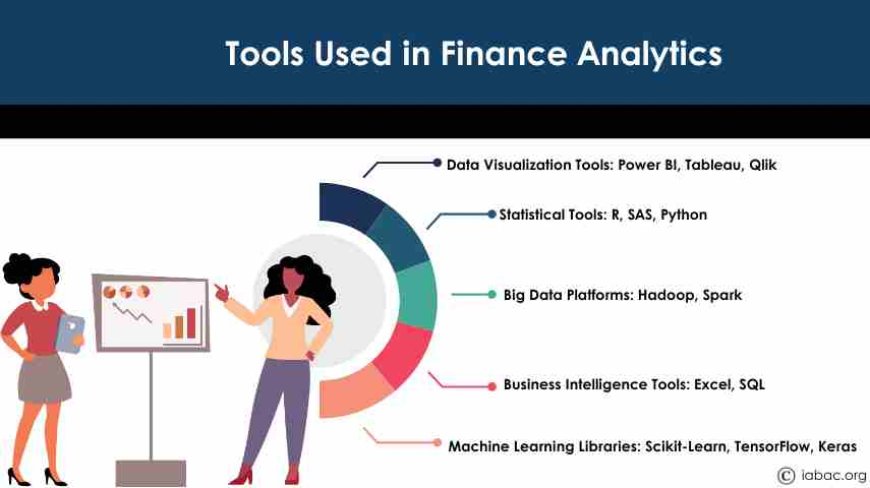
- Data Visualization Tools: Power BI, Tableau, and Qlik simplify data interpretation with visual dashboards and reports.
- Statistical Tools: R, SAS, and Python are common for building predictive models and analyzing data.
- Machine Learning Libraries: Scikit-Learn, TensorFlow, and Keras power machine learning models.
- Big Data Platforms: Hadoop and Spark support handling large data sets for real-time analysis and algorithmic trading.
- Business Intelligence Tools: Excel, SQL, and other BI tools gather and process data for comprehensive reporting.
Future of Finance Analytics and the Scope of Data Science
The future of finance analytics is full of potential, with AI and data science continuing to shape the field. Here are some trends to watch:
- Automation and AI: Routine tasks will be automated, allowing financial experts to focus on high-impact decisions.
- Blockchain for Data Transparency: Blockchain may improve the accuracy and security of financial data.
- Enhanced Predictive Models: As technology evolves, models will become more precise, helping with forecasting and risk management.
- Natural Language Processing (NLP): NLP will play a bigger role in analyzing unstructured data, like social media and customer messages, for customer service and sentiment analysis.
Benefits of a Finance Analytics Course
A finance analytics course offers valuable skills that are essential for today’s finance professionals. Here are the key benefits:
-
Better Decision-Making: Learn to analyze financial data accurately to make smarter business and investment choices.
-
Risk Management: Get tools to assess and reduce financial risks using data analysis.
-
Real-Time Insights: Use live data to quickly adapt to market changes and stay ahead.
-
Learning Key Tools: Get hands-on experience with Python, Excel, and machine learning for financial analysis.
-
Improved Forecasting: Enhance your ability to predict trends using methods like regression and time series analysis.
-
Big Data Skills: Work with large datasets to gain deeper market insights.
-
Problem-Solving: Strengthen your ability to tackle complex financial challenges with analytical thinking.
-
Comprehensive Financial Understanding: Build a solid view of a company’s financial health.
A finance analytics course helps you grow your expertise and gives you the tools to succeed in a competitive financial world.
How Can a Finance Analytics Course Bridge This Skills Gap?
As the finance industry changes, finance professionals wonder: How can I stay relevant and advance my career in such a data-focused environment?
The answer lies in investing in skills through a Finance Analytics Course. This course equips professionals with the tools and knowledge to understand data and apply analytics for more accurate financial decision-making. Whether you aim to be a Certified Data Analyst or a Certified Finance Analytics Professional, a finance analytics course prepares you to tackle modern challenges.
Why You Should Enroll in a Finance Analytics Course
A finance analytics course can help bridge the gap between traditional finance roles and the growing need for data-driven skills in today’s finance world. Here’s how it can benefit you:
Build Key Skills
A finance analytics course equips you with essential skills in data analytics, financial modeling, and forecasting. You’ll learn how to gather insights from financial data, use machine learning to create predictive models and improve decision-making accuracy. This is especially valuable if you are aiming for certifications like Certified Machine Learning Associate or Certified AI Expert.
Better Career Prospects
As companies seek professionals who can analyze and interpret financial data, completing a finance analytics course can significantly improve your job opportunities. It also complements certifications like Certified Finance Analytics Professional, helping you stand out in a competitive job market.
Practical Use of Machine Learning and AI
The course typically covers how to use machine learning and AI to predict financial trends and solve real-world problems. Some programs even offer certifications in AI or machine learning alongside finance analytics, boosting your qualifications further.
Internationally Recognized Certification
Enrolling in an IABAC-authorized finance analytics course ensures you get training that meets global standards. IABAC’s certifications, recognized worldwide, give you an extra edge in your career.
By enrolling in a finance analytics course, you’ll gain valuable skills, improve your career opportunities, and make smarter decisions backed by data.

Key Certifications to Complement Your Finance Analytics Course
Enrolling in a finance analytics course is a great start, but pairing it with certifications can elevate your expertise. Some valuable certifications include:
- Certified Data Analyst: This certification focuses on essential data analytics skills, preparing you to manage and interpret data effectively, which is vital for success in finance analytics.
- Certified Finance Analytics Professional: A specialized certification for finance professionals that dives deeply into finance-specific data analytics, helping you analyze financial statements, identify trends, and create predictive models.
- Certified Machine Learning Associate: For those interested in applying machine learning algorithms in finance, this certification ensures you have the practical skills to implement machine learning models in financial decision-making.
- Certified Artificial Intelligence Expert: AI is transforming industries, including finance. This certification teaches you how to apply AI in areas like risk management, fraud detection, and financial forecasting.
- Certified Healthcare Analytics Professional: Although it may seem unrelated to finance, healthcare professionals often handle large datasets and predictive modeling, skills that can easily transfer to financial analytics.
Top Finance Analytics Courses for Aspiring Finance Analysts
If you want to become a successful finance analyst, picking the right finance analytics course is key. These courses help you learn important skills like financial modeling, data analysis, risk management, and using tools such as Excel, Python, and SQL. Here are some of the best options:
- CFA® Program: A well-known certification focused on investment analysis and portfolio management.
- FMVA® by CFI: Perfect for learning financial modeling and valuation with real-world case studies.
- Financial Analytics Specialization: Combines finance with big data and advanced analytics.
- Wharton’s Business and Financial Modeling Specialization: Covers financial modeling and forecasting.
- Business Analytics Nanodegree: Good for beginners to learn data-driven decision-making.
- Business Analytics: Focuses on data analytics for business and financial strategy.
Pick a course that matches your career goals and current skills to grow your finance analytics expertise.
For those seeking reliable and thorough training, the IABAC Authorized Training Provider (ATP) program offers world-class instruction aligned with international standards. Taking advantage of these educational opportunities can lead to significant career growth, making you an essential asset in today’s finance sector.