
























































What Does a Data Scientist Do
Learn what a Data Scientist does daily—analyzing complex data, creating predictive models, and transforming insights into practical business strategies.


Every time someone watches a movie recommendation, gets a product suggestion online, or sees a fraud alert on a bank transaction, something important has already happened behind the scenes. A Data Scientist has worked with information to make that outcome possible.
But the real question is simple: What does a Data Scientist Do in real life, beyond the fancy job title?
This blog explains it in a simple, practical way, with real examples, basic diagrams, and a clear career path for anyone interested in a data science career.
Who Is a Data Scientist?
A Data Scientist is someone who works with large amounts of information to find patterns, solve problems, and help organizations make better decisions.
Instead of guessing what might happen, they use information to answer questions like:
- What will customers buy next?
- Why are users leaving an app?
- How can sales be improved?
- Where is fraud happening?
They work at the intersection of:
- Mathematics
- Programming
- Business understanding
- Problem solving
What Exactly Does a Data Scientist Do
The role of a Data Scientist is more important than ever. Businesses across all sectors are using data to make better decisions, predict customer behavior, and streamline their operations.
Certifications such as Data Science Foundation Certification, Data Science Developer Certification, and Data Scientist Certification are becoming increasingly popular among professionals in this field. But despite the growing interest, many people are still unsure about what a Data Scientist actually does day-to-day.
Data Scientists may hold various titles, such as Certified Data Scientist, Certified Data Scientist Operations, or more specialized roles, such as Certified Data Scientist Finance, Certified Data Scientist HR, and Certified Data Scientist Marketing. Their work can also overlap with areas like Machine Learning Expert Certification, Certified MLOps Engineer, and management positions like Data Science Certified Manager.
Given the wide range of skills and responsibilities, it’s important to understand what a Data Scientist’s job entails. So, what exactly does a Data Scientist do
Misunderstanding the Role of a Data Scientist: Common Challenges
Many people misunderstand what a Data Scientist does, leading to unrealistic expectations and failed projects. Some think that a Data Scientist’s job is only about coding and working with algorithms, not realizing that their role also involves making strategic decisions based on data. This misunderstanding can result in hiring the wrong people or wasting resources, which hurts the effectiveness of data projects. To get the most out of a Data Scientist’s skills, organizations need to understand that their role includes both analyzing data and helping shape business strategies.
- Misconception: Data Scientists only code.
- Overlooked Role: Making strategic decisions.
- Impact: Wrong hires and wasted resources.
- Solution: Recognize the full role of a Data Scientist.
What Is the Main Role of a Data Scientist?
A data scientist is crucial for analyzing and understanding complex data to help businesses make smart decisions. As more industries rely on data to guide their strategies, the role of a data scientist has become increasingly important. So, what does a data scientist actually do?
Key Responsibilities of a Data Scientist
- Collecting and Preparing Data:
- Data scientists gather large amounts of data from various sources. They clean, process, and organize this data to ensure it is accurate and ready for analysis.
- Getting certifications like the Certified Data Engineer or Certified MLOps Engineer can improve a data scientist’s skills in managing and preparing data.
- Analyzing and Interpreting Data:
- Once the data is prepared, data scientists use statistical tools and algorithms to analyze it. This helps them find patterns, trends, and insights that might not be obvious at first.
- Specialized certifications such as the Data Science Developer Certification and Certified Data Scientist are important for mastering these analysis techniques.
- Building Models and Using Machine Learning:
- A big part of a data scientist’s job is to create predictive models with machine learning algorithms. These models help forecast future trends, automate decision-making, and improve business operations.
- Earning a Machine Learning Expert Certification is very helpful for data scientists involved in developing these models.
- Communicating Findings:
- Data scientists need to explain their insights in a way that’s easy for others to understand. This requires good communication skills and the ability to present data clearly.
- Certifications like the Certified Data Scientist Operations and Certified Data Scientist Finance can help data scientists present their findings effectively.
- Specializing in Different Areas:
- Data scientists often focus on specific industries like finance, marketing, HR, or operations. Their role can vary based on what’s needed in each industry.
- For example, a Certified Data Scientist Marketing works on analyzing customer data to improve marketing strategies, while a Certified Data Scientist HR might use data to enhance employee hiring and retention.
- Continuous Learning and Certification:
- Data science is a field that keeps changing with new tools and methods. Data scientists need to keep learning and earning certifications to stay current.
- Certifications such as the Data Science Foundation Certification, Data Scientist Certification, and Certified MLOps Engineer help data scientists stay updated and skilled.
Simple Workflow of a Data Scientist
Data Collection → Cleaning → Analysis → Model Building → Insights → Decision Making
This is the basic flow of how a data scientist works every day.
What Skills Does a Data Scientist Need?
To understand the data science career, we need to look at skills required.
1. Programming Skills
Common languages:
- Python
- SQL
- R
These help in handling and processing information.
2. Statistics and Math
Used for:
- Finding averages
- Probability
- Pattern detection
3. Machine Learning
Used to:
- Build prediction systems
- Improve accuracy over time
4. Data Visualization
Tools like:
- Charts
- Graphs
- Dashboards
Help explain results clearly.
5. Communication
A model is useless if no one understands it. So explaining results is important.
Data Scientist vs Data Analyst (Simple Difference)
|
Data Analyst |
Data Scientist |
|
Works with cleaned data |
Works with raw + cleaned data |
|
Creates reports |
Builds prediction models |
|
Focus on past data |
Focus on future predictions |
A data scientist usually has deeper technical responsibilities.
Salary of a Data Scientist
The data scientist salary depends on experience, skills, and location.
Average trend (global view):
- Entry level: moderate income
- Mid-level: strong growth
- Senior level: high earning potential
In many countries, demand is increasing because companies rely heavily on data for decisions.
Growth metric:
The demand for roles in this area is expected to grow significantly between 2025–2030 due to increasing use of automation and AI systems.
Simple Math Example Used by Data Scientists
A basic probability example:
If:
- 200 customers buy a product
- 50 of them return within a month
Then:
Return rate = 50 / 200 = 0.25 = 25%
This simple calculation helps companies understand customer behavior.
How Data Becomes Insight
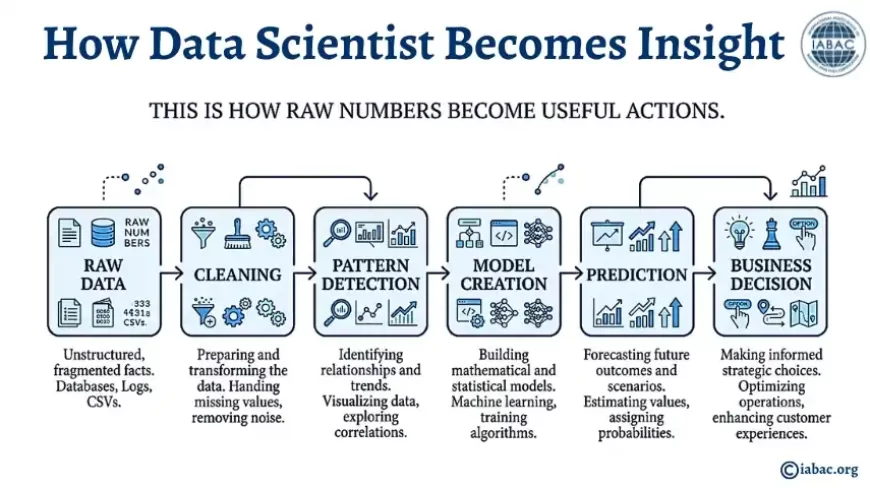
Raw Data → Cleaning → Pattern Detection → Model Creation → Prediction → Business Decision
This is how raw numbers become useful actions.
What Qualifications Are Needed?
Many people ask about data science qualifications.
Common paths include:
- Data science degree (computer science, math, statistics)
- Online training programs
- Certification programs
But in reality, skills matter more than just degrees.
Role of Certifications in Data Science
A data science certificate helps build structured learning.
Certifications cover:
- Data handling
- Machine learning
- Programming
- Real-world projects
Example programs:
These help learners understand real-world systems used in companies.
Data Scientist Career Path
A typical data science career path looks like this:
- Learn basics of programming
- Understand statistics
- Work on small projects
- Start with entry-level analytics role
- Move into data science role
- Specialize in AI or machine learning
Common job titles:
- Data Analyst
- Junior Data Scientist
- Data Scientist
- Senior Data Scientist
- AI Specialist
What Makes Data Scientists Important?
Companies depend on data scientists because they:
- Reduce guesswork
- Improve decision-making
- Increase efficiency
- Find hidden opportunities
Without them, companies would rely only on assumptions.
A Day in the Life of a Data Scientist
A normal day may include:
- Checking data quality
- Writing code
- Testing models
- Fixing errors
- Discussing results with teams
- Updating reports
It is a mix of logic, problem-solving, and creativity.
Common Tools Used by Data Scientists
- Python
- SQL
- Excel
- Tableau
- Power BI
- Machine learning libraries
These tools help convert raw data into insights.
Challenges in the Role
Even though it sounds exciting, there are challenges:
- Messy data
- Slow systems
- Unclear business questions
- Model errors
- Communication gaps
But solving these problems is part of the job.
Why Data Science Is Growing
The world produces huge amounts of information every second:
- Social media posts
- Online transactions
- App usage
- Sensors and devices
Companies need experts who can understand this flow. That is why the demand for data scientists is increasing.
Connection with Data Science Certifications
Structured learning programs like those offered by IABAC certifications help build:
- Practical skills
- Industry understanding
- Project experience
This is important for building a strong data science career foundation.
The Importance of Certification for Data Scientists
Certifications are very important for data scientists. They not only prove the skills and knowledge needed for the job but also offer opportunities to specialize in different areas. Whether you want to become a Certified Data Scientist or a Certified Data Engineer, these certifications show your expertise and dedication.
A data scientist’s main job is to collect, analyze, and interpret data to provide useful insights that help businesses succeed. With the right certifications, like the Data Science Developer Certification, Machine Learning Expert Certification, and Certified MLOps Engineer, you can improve your skills and become a valuable asset in the field of data science. Whether you are interested in finance, HR, marketing, or operations, there’s a certification path that can help you excel in your career as a data scientist.
The Importance of What Data Scientists Do
- Data Collection and Cleaning: They gather and clean data to make sure it’s accurate and ready for use.
- Data Analysis: They study data to spot trends and patterns that guide decision-making.
- Predictive Modeling: They create models to predict future trends and behaviors.
- Data Visualization: They design charts and dashboards to clearly present their findings.
- Strategy Development: They use insights from data to help shape business strategies.
- Automation: They develop systems to automate data processes, making them more efficient.
- Problem Solving: They tackle complex business challenges by using data.
Benefits for Modern Businesses
- Better Decision Making: Data insights lead to smarter and more effective decisions.
- Competitive Advantage: Understanding market trends helps businesses stay ahead of the competition.
- Improved Customer Experience: Using data to shape strategies leads to happier customers.
- Increased Efficiency: Streamlined processes save money and boost productivity.
- Risk Management: Predictive analytics help businesses identify and reduce potential risks.
- Innovation: Data helps discover new opportunities for growth and new products.
- Effective Marketing: Analyzing campaign data leads to better marketing results and a higher return on investment.
Is Data Scientist a Stressful Job?
While being a Data Scientist can be very rewarding, it also comes with challenges:
- High Pressure: Meeting deadlines and delivering precise results can be stressful.
- Complex Problems: Solving tough data issues and creating predictive models can be mentally demanding.
- Continuous Learning: Keeping up with new technologies and methods requires ongoing learning.
Which Institute is Best for Data Science in India?
If you're looking for the best place to study Data Science in India, IABAC (International Association for Business Analytics Certification) is a great choice. IABAC is known for its thorough courses and experienced teachers. They offer hands-on training that helps you build the skills needed to become a successful Data Scientist. Check out their website to learn more about their programs and take the first step toward a career in Data Science.
Data Scientists are crucial in using data to guide smart decisions, boost efficiency, and encourage innovation. While the job can be challenging, it offers great rewards and opportunities for those who are passionate about data.