




















































What is AI and machine learning?
Learn what AI and machine learning are, how they work, key differences, and real-world uses explained in simple, clear language.


If you’ve ever asked Siri for directions, let Netflix suggest your next movie, or used Google Maps to avoid traffic, you’ve already experienced AI and machine learning in action.
These two terms pop up everywhere — in news, tech talks, and even business pitches. But they’re often used so loosely that it’s easy to get confused. Are they the same thing? If not, how are they different? And why do they matter so much right now?
What Is Artificial Intelligence (AI)?
Artificial intelligence, or AI, is when machines are designed to act “smart.” Instead of just following step-by-step instructions, AI systems can analyze data, solve problems, and even make decisions in ways that look similar to human intelligence.
AI can take many forms:
-
Understanding language (chatbots, translators).
-
Seeing and recognizing images (facial recognition, medical scans).
-
Decision-making (recommendations, risk assessments).
-
Physical tasks (robots, drones).
Examples you already know:
-
Siri, Alexa, or Google Assistant.
-
Netflix and Spotify suggesting what to watch or listen to.
-
Google Maps rerouting you when traffic builds up.
-
Spam filters sorting your email inbox.
So, AI is the bigger picture — the idea of machines being able to think and act smartly.
What Is Machine Learning (ML)?
Machine learning is one part of AI — and it’s the part that makes AI so powerful today.
Instead of being programmed with fixed rules, machine learning allows systems to learn from data. The more data they get, the better they become at spotting patterns, making predictions, and improving over time.
For example:
-
A spam filter studies thousands of past emails labeled as spam or safe.
-
Over time, it learns to predict whether a new email belongs in the junk folder.
How it works in four simple steps:
-
Data Collection: Gather large sets of examples.
-
Training: Feed the data to algorithms so they can find patterns.
-
Testing: Try out the model on new data to check accuracy.
-
Prediction: Use it in the real world to make decisions.
Everyday examples of ML:
-
Fraud detection in banking.
-
Product recommendations on Amazon.
-
Predictive text on your phone.
-
Image recognition on Facebook tagging photos.
So, while AI is about creating “intelligent” machines, ML is one of the main tools that makes AI possible.
AI vs Machine Learning: What’s the Difference?
The two terms are related but not identical.
-
AI is the broad concept — making machines capable of smart behavior.
-
ML is a specific method — using data and algorithms to help machines learn.
Quick Analogy:
-
AI is like the goal of building a self-driving car.
-
ML is the method that lets the car learn from millions of hours of driving data.
Side-by-Side Comparison
|
Feature |
Artificial Intelligence (AI) |
Machine Learning (ML) |
|
Definition |
Broad field of making smart machines |
Subset of AI focused on learning from data |
|
Purpose |
Simulate human intelligence |
Identify patterns and make predictions |
|
Techniques |
Logic, reasoning, learning |
Algorithms, data training |
|
Examples |
Robots, NLP, expert systems |
Spam filters, product recommendations |
Types of Machine Learning
Machine learning isn’t one-size-fits-all. It’s usually divided into three main types:
-
Learns from labeled data (e.g., emails marked spam/not spam).
-
Good for prediction tasks.
-
Works with unlabeled data, grouping things by similarity.
-
Example: Grouping customers with similar shopping habits.
-
Learns by trial and error, with rewards for correct actions.
-
Example: A robot learning to walk, or an AI mastering a video game.
How Do AI and ML Work Together?
AI and ML aren’t competing concepts — they work hand in hand.
-
AI sets the goal → machines acting smart.
-
ML is one of the key tools → helping those machines learn and adapt.
For instance:
-
An AI chatbot uses ML to get better at answering new kinds of questions.
-
An AI healthcare system uses ML to find patterns in thousands of medical images.
-
A self-driving car uses ML to recognize road signs and adjust driving behavior.
Without ML, AI would be stuck with rigid rules. With ML, AI systems can continuously improve.
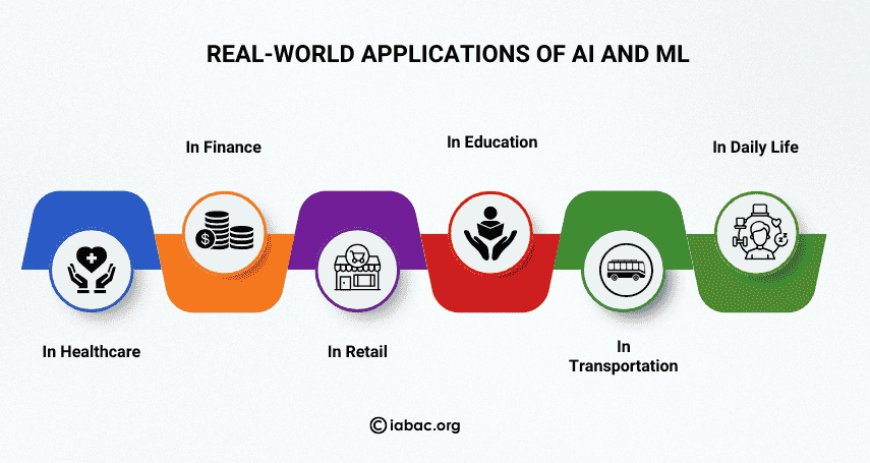
Real-World Applications of AI and ML
These technologies aren’t just futuristic buzzwords — they’re already part of our lives.
In Healthcare
-
Detecting diseases from scans.
-
Predicting patient risks.
-
Chatbots giving basic medical advice.
In Finance
-
Detecting fraud in real time.
-
Automating credit scoring.
-
Using algorithms for stock trading.
In Retail
-
Personalized product recommendations.
-
Chatbots helping customers shop.
-
Managing stock more efficiently.
In Education
-
AI tutors offering personalized support.
-
Automated grading.
-
Interactive learning assistants.
In Transportation
-
Self-driving cars learning road conditions.
-
AI systems reducing traffic congestion.
-
Predictive maintenance for vehicles.
In Daily Life
-
Smart home devices (thermostats, lights).
-
Voice assistants like Alexa and Google.
-
Social media algorithms deciding what appears in your feed.
Benefits of AI and ML
Why are companies so eager to adopt these technologies? Some of the biggest advantages are:
-
Faster processes – Handle tasks instantly.
-
Cost savings – Automate repetitive work.
-
Scalability – Serve millions of users at once.
-
Better accuracy – Fewer mistakes in predictions.
-
Personalization – Tailored recommendations and services.
Challenges and Limitations
Of course, AI and ML are not perfect. Some of the common challenges include:
-
Need for lots of data: Systems perform poorly without large, clean datasets.
-
Bias in models: If the data is biased, the results can also be biased.
-
Privacy concerns: Handling sensitive information is a big responsibility.
-
High costs: Building and maintaining AI systems is expensive.
-
Impact on jobs: Automation may reduce demand for certain roles.
The Future of AI and Machine Learning
Where are these technologies heading? Here are some trends:
-
Generative AI: Creating content like text, images, and videos.
-
Explainable AI: Making AI decisions easier to understand.
-
Ethical AI: Designing systems that are fair and transparent.
-
Integration with other tech: Combining AI with IoT, robotics, AR/VR.
-
Industry transformation: More adoption in healthcare, education, finance, and beyond.
The bottom line: AI and ML will continue to grow, but success will depend on building systems that are reliable, fair, and secure.
Artificial intelligence and machine learning are no longer just tech buzzwords. They’re practical tools shaping how we live, work, and interact with the world.
-
AI is the big idea — making machines act intelligently.
-
ML is one of the strongest tools to achieve it — by learning from data.
From healthcare and finance to education and daily apps, these technologies are everywhere. They bring faster services, more personalization, and new possibilities. At the same time, they raise questions about privacy, fairness, and the future of jobs.
The key is balance: embracing AI and ML for their benefits while using them responsibly. The future isn’t about replacing humans — it’s about building systems that help us work smarter, make better decisions, and open up new opportunities.
So the next time your phone predicts your next word, your bank flags a suspicious transaction, or your favorite app recommends the perfect show — you’ll know it’s not magic. It’s AI and machine learning at work.