


























































What Is MLL? Learn It in 5 Minutes
MLL stands for Machine Learning Lifecycle. Learn its stages, benefits, real-world applications, and how it helps build successful AI models in just 5 minutes.


MLL stands for Machine Learning Lifecycle — the end-to-end process of building, deploying, and maintaining machine learning models. It includes data collection, data preparation, model training, evaluation, deployment, and continuous monitoring.
In simple terms, MLL is the roadmap that helps organizations transform raw data into intelligent AI systems. If you're learning AI, data science, or machine learning, understanding MLL is essential because every successful AI project follows this lifecycle.
What Does MLL Stand For?
MLL stands for Machine Learning Lifecycle. It refers to the structured, repeatable process that data scientists, machine learning engineers, and AI teams follow to take a business problem from raw data all the way to a working, production-ready model — and keep it performing well over time.
Think of it like a software development lifecycle (SDLC), but purpose-built for AI. Just as you wouldn't build an app without a plan, you can't build a reliable machine learning model without following a lifecycle.
The machine learning lifecycle isn't a one-time journey. It's a continuous loop. Models degrade over time as real-world data changes, so the lifecycle keeps repeating — collect, prepare, train, evaluate, deploy, monitor, and improve.
Why Is MLL Important in AI?
Understanding the ML lifecycle isn't just academic. It has direct, measurable impact on AI project outcomes.
Reduces Project Failures A large percentage of AI projects never make it to production. The leading causes? Poor data quality, undefined objectives, and skipping evaluation steps. Following the machine learning lifecycle forces teams to address these issues early, dramatically improving success rates.
Improves Model Performance The MLL creates checkpoints — moments where you validate data quality, test model accuracy, and benchmark against business goals. Without this structure, teams often rush to deployment with models that perform poorly in the real world.
Supports Scalability A well-managed AI lifecycle makes it easier to scale models, onboard new team members, and replicate success across projects. It turns one-off experiments into repeatable, enterprise-grade AI development workflows.
If you're pursuing an AI Certification or a Machine Learning Certification, the MLL will be one of the first frameworks you study — and for good reason.
The 7 Stages of the Machine Learning Lifecycle
Here is a breakdown of each stage in the machine learning process, what happens at each step, and why it matters.
1. Business Understanding
Every machine learning project starts with a business question, not a dataset. At this stage, teams define the problem they're solving, the success metrics, the stakeholders involved, and the constraints (time, budget, data availability).
Skipping this step is one of the top reasons AI projects fail. Without a clear goal, data scientists end up building models that are technically impressive but commercially useless.
Key questions: What problem are we solving? How will success be measured? What data do we have access to?
2. Data Collection
Once the problem is defined, the next step in the machine learning pipeline is gathering the right data. This might involve pulling from internal databases, third-party APIs, web scraping, sensors, user logs, or purchasing licensed datasets.
Data volume matters, but data relevance matters more. Collecting irrelevant data wastes time and can actually hurt model performance by introducing noise. This stage also involves thinking about data privacy, compliance (GDPR, HIPAA), and ethical considerations around bias.
3. Data Preparation
Raw data is almost never ready for model training. Data preparation — also called data preprocessing or feature engineering — is typically the most time-consuming stage of the AI development lifecycle, often consuming 60–80% of a project's total time.
This stage includes:
-
Cleaning: Removing duplicates, handling missing values, correcting errors
-
Transformation: Normalizing or standardizing numerical values
-
Feature Engineering: Creating new variables that better represent the underlying patterns
-
Splitting: Dividing data into training, validation, and test sets
Getting this stage right is critical. Garbage in, garbage out — no amount of model sophistication can fix fundamentally bad data.
4. Model Training
This is the stage most people associate with machine learning. During model training, the algorithm learns patterns from the prepared training data. Depending on the problem, this could involve supervised learning, unsupervised learning, or reinforcement learning.
The machine learning engineer selects an appropriate algorithm (linear regression, decision trees, neural networks, etc.), configures hyperparameters, and runs the training process. On large datasets, this stage can take hours or even days, especially for deep learning models.
Multiple models are often trained and compared at this stage before moving forward.
5. Model Evaluation
Training a model and having a good model are two different things. The evaluation stage tests how well the model performs on data it hasn't seen before — the test set.
Common evaluation metrics include accuracy, precision, recall, F1-score, and AUC-ROC, depending on the type of problem. Teams also check for overfitting (the model memorizes training data but fails on new data) and bias (the model performs unevenly across demographic groups).
If the model doesn't meet the defined success criteria from Stage 1, the team loops back to adjust data, features, or model architecture.
6. Deployment
A model that lives in a notebook helps no one. Deployment is the process of integrating the trained model into a production environment where it can serve real users or automated systems.
This might mean deploying via a REST API, embedding the model into a mobile app, or integrating it into an enterprise platform. The AI model lifecycle at this stage also involves setting up infrastructure for scalability, latency requirements, and failover.
Deployment is where MLOps practices become critical. What is MLOps? — it's the set of practices that bridge the gap between model development and reliable production deployment.
7. Monitoring & Improvement
The machine learning workflow doesn't end at deployment. Models decay over time as real-world data drifts away from the patterns the model learned during training. A fraud detection model trained in 2023 may underperform by 2025 because fraud tactics have evolved.
Monitoring involves tracking model performance metrics, detecting data drift, and logging prediction errors. When performance drops below a threshold, the model enters a retraining cycle — feeding new data back into earlier stages of the lifecycle.
This continuous loop is what separates a one-time ML experiment from a sustainable, production-grade AI system.
Real-World Examples of MLL in Action
The machine learning lifecycle isn't theoretical. It powers some of the most widely-used AI systems in the world.
Netflix Recommendations Netflix uses the ML lifecycle to continually train and retrain recommendation models. As user behavior changes, new shows are added, and tastes evolve, their models are monitored and updated to maintain relevance. Without continuous monitoring and improvement (Stage 7), their recommendation engine would quickly become stale.
Fraud Detection in Banking Financial institutions use predictive models to flag suspicious transactions in real time. The lifecycle here is especially critical — fraud patterns change constantly, so models must be retrained frequently. A model deployed six months ago might miss entirely new fraud schemes discovered last week.
Chatbots and Conversational AI AI-powered chatbots like customer service assistants follow the full machine learning pipeline — from collecting conversation data, to training language models, to deploying via APIs, to monitoring user satisfaction and response accuracy. What is Machine Learning? provides deeper context on the underlying techniques that power these systems.
MLL vs MLOps
These two terms are closely related but serve different purposes. Here's a simple comparison:
|
Aspect |
MLL (Machine Learning Lifecycle) |
MLOps |
|
What it is |
The end-to-end process of building ML models |
Practices and tools for operationalizing ML |
|
Focus |
What steps to follow |
How to automate and scale those steps |
|
Scope |
Strategy and process |
Engineering and infrastructure |
|
Who uses it |
Data scientists, project managers |
ML engineers, DevOps teams |
|
Goal |
Deliver a working model |
Keep models running reliably in production |
|
Includes |
Data collection through monitoring |
CI/CD for ML, model registries, monitoring tools |
Think of MLL as the blueprint and MLOps as the construction crew. You need the blueprint to know what to build, and you need the crew to build it efficiently at scale. Many professionals pursuing a Data Science Certification or an AI Engineer Program study both frameworks together.
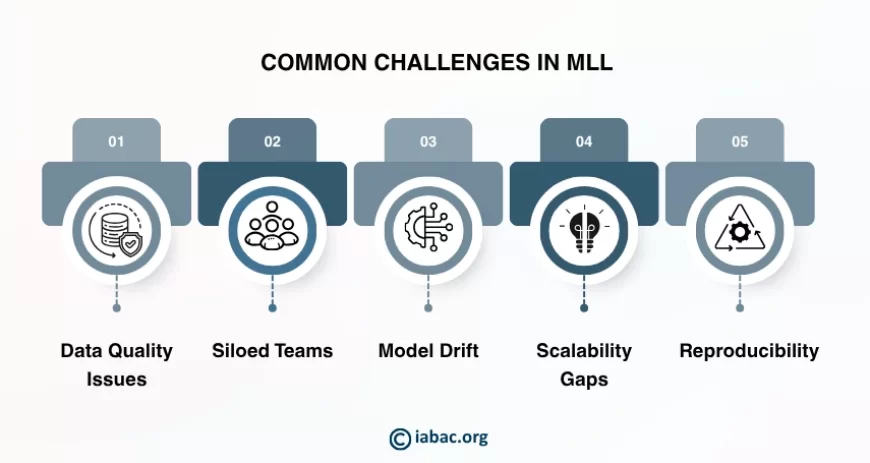
Common Challenges in MLL
Even with a clear framework, the AI lifecycle comes with real-world friction:
-
Data Quality Issues — Incomplete, biased, or poorly labeled data is the #1 cause of poor model performance. Data preparation always takes longer than expected.
-
Siloed Teams — When data engineers, data scientists, and software engineers don't communicate, models get built in isolation and fail at deployment.
-
Model Drift — Real-world data changes. A model that performs perfectly today may degrade significantly within months without proper monitoring.
-
Scalability Gaps — A model that works on a sample of 10,000 rows may not scale to 10 million. Infrastructure planning is often an afterthought.
-
Reproducibility — Without proper version control for data, code, and models, it's hard to recreate results or debug failures.
Best Practices for Managing MLL
To get the most out of the machine learning lifecycle, follow these proven practices:
Define success metrics before touching data. Business objectives must come first. Agree on what "good" looks like before the first line of code is written.
Invest heavily in data preparation. The return on time spent cleaning and engineering features is higher than any other stage. Don't rush it.
Version everything. Use tools like Git for code, DVC for datasets, and MLflow for model versions. Reproducibility is non-negotiable in production AI.
Automate monitoring. Set up automated alerts for performance degradation and data drift. Don't wait for users to report problems.
Build retraining pipelines early. Design your deployment with retraining in mind. A model that can't be updated efficiently will become a liability.
Treat ML as a team sport. Align business stakeholders, data engineers, data scientists, and ML engineers from Stage 1. Isolated work leads to integration failures.
For a deeper dive into career paths that require mastering the AI development lifecycle, see the Machine Learning Engineer Roadmap and explore Top AI Certifications to validate your skills.
The Machine Learning Lifecycle (MLL) is the backbone of every successful AI project. It provides a repeatable, structured framework that takes a business problem through data collection, preparation, model training, evaluation, deployment, and ongoing monitoring.
Without it, AI projects become expensive experiments. With it, organizations can build scalable, reliable, and continuously improving AI systems — from Netflix recommendations to real-time fraud detection to intelligent chatbots.
Whether you're just starting your journey in data science or preparing for a senior ML engineering role, mastering the MLL is non-negotiable. It's the difference between building a model and building a system that actually works.
Ready to take the next step? Explore our AI Certification and Machine Learning Certification programs to build structured, job-ready skills across the full machine learning lifecycle.