
























































Tips for Artificial Intelligence Interview Success
Ace your AI job interview with these expert tips—covering common questions, technical tests, and how to showcase your AI skills and experience.


Artificial Intelligence (AI) is one of the most exciting and fast-growing fields in today's job market. Whether you're aiming to become a Certified Machine Learning Associate, a Certified Artificial Intelligence Expert, or an Artificial Intelligence Certified Executive, doing well in AI job interviews is key to getting a great position. With companies using AI more and more to drive innovation, there's a big demand for professionals who hold AI certifications or specialize in areas like natural language processing or computer vision.
To make a strong impression in an interview, it's not just about having technical knowledge. How you explain and communicate your understanding of key AI concepts is equally important. A solid background through programs like the Artificial Intelligence Foundation can set you apart, while more advanced certifications like Certified Natural Language Processing Expert or Certified Computer Vision Expert show that you have deep expertise in sought-after areas.
The Growing Demand for AI Jobs: Key Certifications to Consider
- Rising Demand for AI Professionals: The rapid growth in artificial intelligence (AI) technology is creating many job opportunities. Companies in various sectors are on the lookout for skilled professionals to help them use AI for innovation and efficiency.
- Certified Artificial Intelligence Expert: This certification proves your knowledge in AI technologies, such as machine learning and neural networks. It’s a valuable qualification for those who want to design and implement AI systems effectively.
- Certified Natural Language Processing Expert: With natural language processing (NLP) being important for applications like chatbots and translation services, this certification shows you’re skilled in NLP techniques and algorithms. It can make you a highly sought-after candidate in the AI field.
- Artificial Intelligence Certified Executive: This certification is aimed at senior professionals and focuses on leading AI projects and managing AI strategies. It helps executives drive growth and innovation using AI.
- Certified Computer Vision Expert: With advancements in computer vision technology, this certification highlights your ability to develop and use computer vision applications. It’s crucial for jobs involving image recognition, self-driving cars, and video analysis.
The demand for AI jobs is increasing, and getting relevant certifications can greatly boost your career prospects in this exciting field. If you're interested in data-related roles, consider getting a Data Analytics Certification, as it's one of the best certifications for those looking to excel in data analysis.
How to Prepare for AI Technical Interview Questions
Preparing for AI technical interview questions involves a few key steps. Start by reviewing basic concepts like machine learning algorithms (e.g., decision trees, SVMs, and neural networks), statistics, and data structures. Make sure to practice coding often, especially in Python, and try to write AI algorithms from scratch. This shows you understand how they work. Websites like LeetCode, HackerRank, and Kaggle are excellent for practicing problem-solving. It’s also important to stay current with trends in AI, such as deep learning, reinforcement learning, and natural language processing (NLP). Reading research papers can help with this. Working through real-world AI problems and case studies will improve your ability to explain your solutions during an interview.
Preparing for an AI technical interview can feel challenging, but with the right steps, you can do well. Here’s a simple guide to help you get ready:
1. Learn Key AI Concepts
- Machine Learning Algorithms: Understand methods like linear regression, decision trees, k-means, and support vector machines (SVM).
- Deep Learning: Study neural networks, CNNs, RNNs, and transfer learning.
- Natural Language Processing (NLP): Learn about tokenization, sentiment analysis, and models like BERT or GPT.
These topics are often asked in interviews, so make sure you're comfortable with them.
2. Focus on Math and Statistics
- Linear Algebra: Know about matrices, vectors, and eigenvalues.
- Probability & Statistics: Understand conditional probability, Bayes’ Theorem, and distributions.
- Optimization: Learn about gradient descent and cost functions used in model training.
3. Practice Coding
- Data Structures & Algorithms: Work on arrays, linked lists, dynamic programming, and graphs.
- Machine Learning Code: Practice writing algorithms from scratch or using libraries like TensorFlow, PyTorch, and Scikit-learn.
Common AI Interview Questions and Simple Answers
1. What is Artificial Intelligence (AI)?
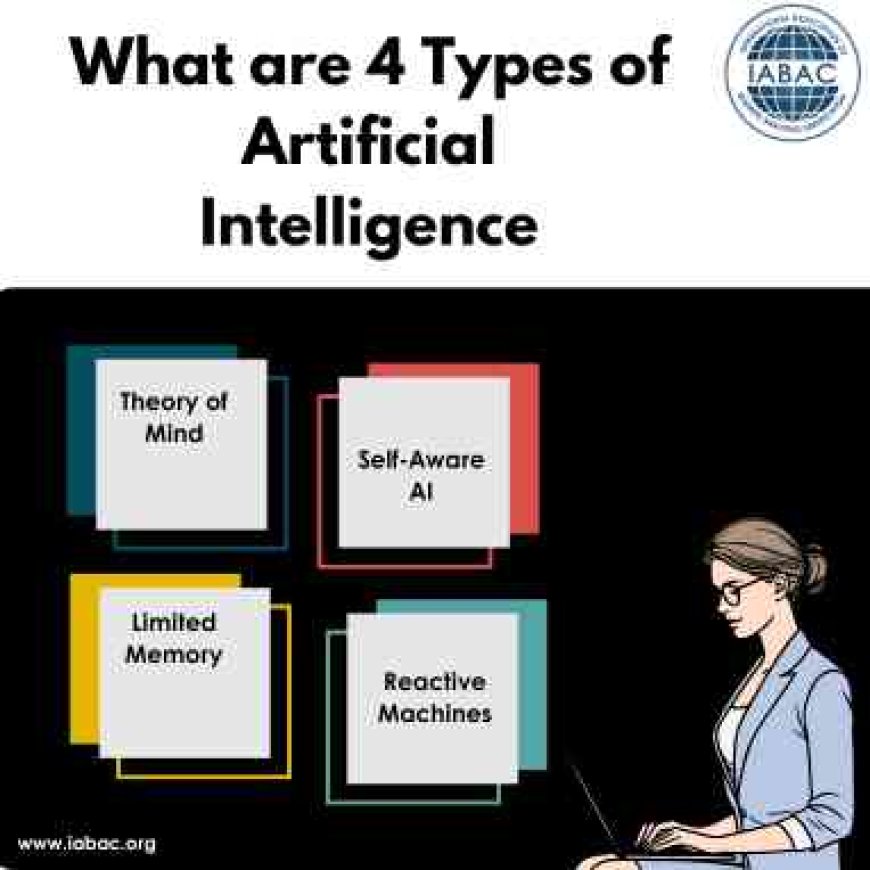
Artificial Intelligence (AI) refers to machines or computers doing tasks that normally require human intelligence. These tasks include things like learning, reasoning, and problem-solving. AI has several key parts:
- Machine Learning (ML): This allows machines to learn from data and get better over time.
- Natural Language Processing (NLP): This helps computers understand and work with human language.
- Computer Vision: Machines can see and understand images or videos.
- Robotics: Machines use AI to do physical tasks automatically.
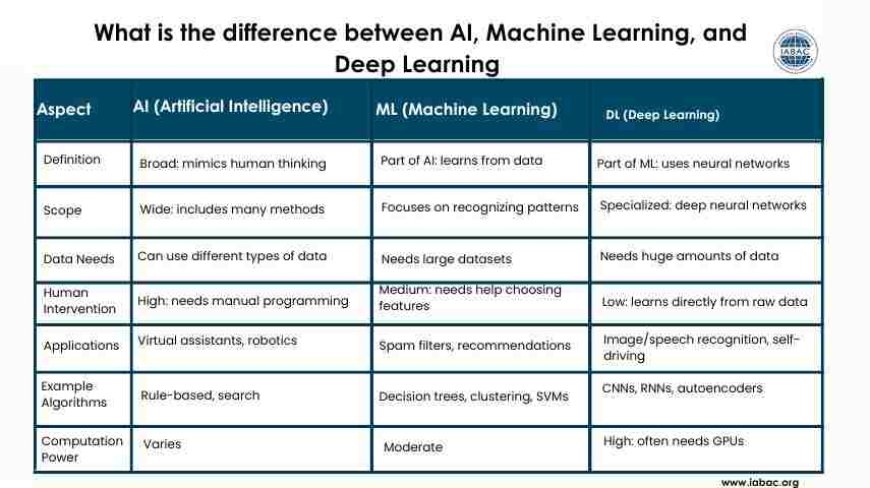
2. What is the difference between AI, Machine Learning, and Deep Learning?
- Artificial Intelligence (AI): AI is a broad idea where machines act in ways we think are intelligent.
- Machine Learning (ML): A part of AI, ML is about machines learning from data and improving over time.
- Deep Learning (DL): A type of ML that uses deep neural networks. It's especially good at tasks like recognizing images and understanding speech.
3. What is supervised learning and how does it differ from unsupervised learning?
- Supervised Learning: In this method, you train the algorithm using labeled data, where both inputs and outputs are given. The machine learns to predict the output from the input.
- Unsupervised Learning: Here, the data is not labeled, and the machine tries to find patterns or groupings on its own.
4. What is overfitting in machine learning, and how can it be prevented?
Overfitting happens when a model works really well on the training data but does poorly on new data because it has learned the noise in the training set. To avoid overfitting:
- Cross-Validation: This tests the model on different parts of the data to ensure it works well.
- Regularization: Adds penalties to the model for being too complex.
- Pruning: In decision trees, remove unnecessary parts to simplify the model.
- Dropout: In neural networks, randomly ignore some neurons during training to make the model more general.
5. What is a confusion matrix, and why is it important in classification tasks?
A confusion matrix is a table that helps evaluate how well a classification model works. It breaks down predictions into four categories:
- True Positives (TP): Correctly identified positives.
- True Negatives (TN): Correctly identified negatives.
- False Positives (FP): Incorrectly identified as positive.
- False Negatives (FN): Incorrectly identified as negative.
This helps measure things like accuracy, precision, and recall.
6. What is reinforcement learning, and can you provide a real-world example?
Reinforcement Learning (RL) is a type of learning where a machine (called an agent) learns by interacting with an environment and receiving rewards or punishments. The goal is to maximize rewards over time.
Example: Self-driving cars use RL to learn how to navigate roads, avoid accidents, and follow traffic rules.
7. What is a neural network, and how does it function?
A neural network is a computer system modeled after the human brain. It has:
- Input Layer: Takes in the data.
- Hidden Layers: Processes the data in steps through connected neurons (nodes).
- Output Layer: Gives the final prediction or result.
Neurons are connected by weights, and each neuron applies an activation function (like ReLU or Sigmoid) to decide the output.
8. What is Natural Language Processing (NLP)?
Natural Language Processing (NLP) helps computers understand and work with human language. It's used in many everyday applications:
- Sentiment Analysis: Finding out if a text is positive, negative, or neutral.
- Machine Translation: Converting text from one language to another.
- Speech Recognition: Converting spoken words into text.
- Chatbots: Programs that can talk to people, answering questions and helping with tasks.
9. What is a generative model? Give an example.
A generative model creates new data that looks like the data it was trained on. It learns the patterns and distributions in the data.
Example: Generative Adversarial Networks (GANs) create realistic images from random inputs. These models are used to create art, fake images, and videos.
10. What are the ethical concerns surrounding AI?
Some ethical issues in AI include:
- Bias: AI can learn biased behavior from data, leading to unfair decisions, like in hiring or legal systems.
- Transparency: Many AI systems are hard to understand, making it unclear how decisions are made.
- Privacy: AI systems can collect and use personal data without people knowing, leading to privacy concerns.
- Job Loss: AI can replace jobs that involve repetitive tasks, affecting employment in certain industries.
- Accountability: It's hard to determine who's responsible when an AI system makes a wrong decision.
If you're preparing for an AI interview or seeking to boost your knowledge, having a Data Analytics Certification can give you an edge. You can also look into the Best Data Analytics Certifications to enhance your understanding of data handling and AI systems!
Getting ready for an artificial intelligence interview can be both exciting and a bit nerve-wracking. To set yourself up for success, focus on grasping basic concepts, showing off your practical experience, and keeping up with the latest developments in AI. Practice solving problems and coding challenges, explain your thought process clearly, and be prepared to talk about your past projects and their results. By following these tips, you'll be well-prepared to impress your interviewers and move closer to securing that desired AI position.