


















































Learn 80% of AI Agent Builders in Just 30 Minutes
Learn 80% of AI Agent Builders in 30 minutes. Explore AI agents, top frameworks, use cases, skills, and career paths for beginners.

The Pareto principle says that 80% of outcomes come from 20% of inputs. In the world of AI agent building, this is remarkably true. Dozens of frameworks, platforms, and tools compete for your attention — but the underlying mental models that govern all of them can be mastered in a single focused session.
This guide gives you exactly that. Whether you are a business analyst who wants to automate workflows without writing code, a developer evaluating frameworks for a production deployment, or a professional looking to formalise your AI skills with a globally recognised certification, this article covers the essential 20% of knowledge that unlocks 80% of competency in AI agent building.
By the end, you will understand what AI agents actually are, the six types that power nearly every real-world application, how to categorise every major builder on the market, and how to choose the right tool for your specific profile and goals.
What Is an AI Agent? The 3-Minute Version
An AI agent is a software system that perceives its environment, makes decisions autonomously, and takes actions to achieve a defined goal — without requiring step-by-step human instructions for every move it makes. Unlike a traditional chatbot that only responds to direct prompts, an AI agent can plan, use external tools, remember past interactions, and adapt its approach based on feedback.
The simplest mental model: think of an AI agent like a newly hired employee. You give them a goal — "research these five competitors and summarise the findings in a report" — and they figure out the steps: which search tools to use, how to organise information, when to ask for clarification, and how to present the output. You don't dictate every action; you set the objective and the guardrails.
The 4 Core Pillars of Every AI Agent
|
Pillar |
What It Does |
Analogy |
|
Brain (LLM) |
Reasoning, planning, language understanding |
The employee's cognitive ability |
|
Tools |
APIs, web search, code execution, databases |
The employee's software and equipment |
|
Memory |
Short-term context + long-term knowledge storage |
The employee's notepad and experience |
|
Perception |
Reading inputs: text, files, images, data streams |
The employee's senses and observation skills |
What an AI Agent Is NOT
-
Not a chatbot — a chatbot responds; an agent acts
-
Not magic — agents follow patterns learned from data, they do not "think" like humans
-
Not infallible — agents can hallucinate, make wrong tool calls, and misinterpret ambiguous goals
-
Not always necessary — for simple, single-step queries, a direct LLM call is more efficient
Key Insight
The "agent" label applies when a system must take multiple autonomous steps to complete a task, potentially using external tools and remembering context across those steps. If it's one prompt, one response — that's a chatbot, not an agent.
The 6 Types of AI Agents (Know These, Know 80%)
Most discussions of AI agents list tools and platforms. But the real leverage is in understanding the architectural types — because every builder on the market is implementing one or more of these six patterns. Master the types, and you can evaluate any new tool in minutes.
Type 1: Simple Reflex Agents
These agents act on direct condition-action rules: "if X, then do Y." They have no memory, no planning, and no model of the world. A spam filter that automatically deletes emails containing certain keywords is a simple reflex agent. Fast and predictable, but brittle — they fail outside their predefined rules.
Type 2: Model-Based Reflex Agents
An upgrade over simple reflex: these agents maintain an internal model of the world to handle situations where the current input alone is insufficient. A self-driving car that tracks the position of vehicles it can no longer see uses a model-based approach. Useful when the environment is partially observable.
Type 3: Goal-Based Agents
These agents choose actions by evaluating which path leads to a desired goal state. They can plan multiple steps ahead. A travel booking agent that searches flights, compares prices, and selects the best option is goal-based. Most production AI agents used in business automation fall into this category.
Type 4: Utility-Based Agents
A refinement of goal-based: instead of a binary "achieved / not achieved," these agents optimise toward a utility function — a numeric measure of desirability. A recommendation engine that balances relevance, diversity, and recency scores is utility-based. These power personalisation systems across e-commerce and streaming platforms.
Type 5: Learning Agents
These agents improve their own performance over time using machine learning algorithms. They have a learning element that modifies the performance element based on feedback. Fraud detection systems that adapt to new fraud patterns are learning agents. This category underpins the most sophisticated enterprise deployments.
Type 6: Multi-Agent Systems (MAS)
Multiple agents — each with specialised roles — collaborate, negotiate, or compete to accomplish complex tasks that no single agent could handle alone. A multi-agent research system might have one agent searching the web, another evaluating source credibility, a third synthesising findings, and a fourth formatting the final output. Frameworks like CrewAI and AutoGen are built specifically for this pattern.
|
Type |
Decision Basis |
Memory |
Best For |
Example Tool |
|
Simple Reflex |
Condition-action rules |
None |
Fast, deterministic tasks |
Zapier (basic) |
|
Model-Based Reflex |
Internal world model |
Short-term |
Partially observable environments |
Custom LLM pipelines |
|
Goal-Based |
Goal state planning |
Short-term |
Multi-step business automation |
LangGraph, Copilot Studio |
|
Utility-Based |
Utility function optimisation |
Short + long-term |
Personalisation, ranking, scoring |
OpenAI Agents SDK |
|
Learning |
ML feedback loops |
Long-term |
Adaptive systems, anomaly detection |
LangChain + vector DB |
|
Multi-Agent |
Role-based collaboration |
Shared + individual |
Complex research, orchestrated workflows |
CrewAI, AutoGen |
The 3 Categories of AI Agent Builders
Every tool that calls itself an "AI agent builder" sits in one of three categories. Knowing this taxonomy ends the paralysis of choice — you no longer compare all tools against each other, only within the category that fits your profile and requirements.
Category A: No-Code Builders
Who it's for: Business users, operations managers, HR professionals, marketers — anyone who needs to deploy intelligent automation without engineering support.
How it works: Drag-and-drop interfaces, pre-built connectors, and natural-language configuration. You describe what you want the agent to do; the platform handles the underlying LLM calls, routing, and tool connections.
Representative tools: Lindy.ai, Microsoft Copilot Studio, Google Vertex AI Agent Builder, Zapier AI, Make (Integromat)
-
✅ Fastest time to first working agent (often under an hour)
-
✅ No programming knowledge required
-
❌ Limited customisation beyond what the platform allows
-
❌ Vendor lock-in is a real risk at scale
Category B: Low-Code Builders
Who it's for: Product managers, data analysts, solutions architects, automation engineers — people with some technical literacy who need flexibility without the full overhead of a developer framework.
How it works: Visual canvas with modular nodes for LLM calls, conditionals, API calls, and data transformations. You can drop in Python or JavaScript snippets where custom logic is needed.
Representative tools: n8n, Langflow, Dify, Retool
-
✅ Balance of speed and flexibility
-
✅ Visual flows make complex pipelines readable and auditable
-
❌ Some scripting knowledge needed for advanced use cases
-
❌ Monitoring and observability can require additional setup
Category C: Developer Frameworks
Who it's for: Software engineers, AI engineers, ML researchers — teams building production-grade, custom agentic applications at scale.
How it works: Code-first SDKs in Python (primarily) that give you full control over agent architecture, memory management, tool definitions, prompt templates, and evaluation pipelines.
Representative tools: LangChain, LangGraph, CrewAI, AutoGen, OpenAI Agents SDK, SmolAgents
-
✅ Maximum flexibility and control
-
✅ Production-ready, scalable, composable
-
❌ Steep learning curve for non-developers
-
❌ Longer time to prototype compared to no-code/low-code
The Decision Matrix: Which Builder Is Right for You?
|
Your Profile |
Recommended Tool(s) |
Time to First Agent |
Ceiling |
|
Non-technical business user |
Lindy.ai / Copilot Studio |
< 1 hour |
Business automation, customer-facing bots |
|
Operations / automation lead |
n8n / Langflow / Dify |
2–4 hours |
Complex multi-step workflows, API integrations |
|
Developer / AI engineer |
LangChain / LangGraph / CrewAI |
1–2 days |
Custom production agents, RAG pipelines |
|
Enterprise AI architect |
AutoGen / OpenAI Agents SDK |
1 week+ |
Multi-agent systems, enterprise-scale deployment |
|
Researcher / experimenter |
SmolAgents / AutoGPT |
Minutes (prototype) |
Experimentation, benchmarking, academic use |
Top 10 AI Agent Builders Explained (2026)
Here are the ten platforms and frameworks that dominate the AI agent builder landscape in 2026. Each entry covers what it is, who it's for, its standout feature, pricing direction, and its key limitation.
1. LangChain / LangGraph [Developer Framework]
What it is: LangChain is the most widely adopted open-source framework for building LLM-powered applications. LangGraph extends it with a graph-based architecture that makes stateful, multi-step agentic workflows explicit and controllable.
Standout feature: LangGraph's node-and-edge model lets you define conditional branching, human-in-the-loop checkpoints, and parallel execution with precision.
Pricing: Open-source; LangSmith observability platform has a free tier and paid plans.
Limitation: Verbose setup; production observability requires LangSmith integration or a third-party tool.
Key capabilities: Python, RAG, multi-step workflows
2. CrewAI [Developer Framework]
What it is: An open-source Python framework purpose-built for orchestrating teams of AI agents ("Crews") with defined roles, goals, and collaboration logic.
Standout feature: Role-based agent design — you define an Agent as a "Senior Researcher" with specific goals and backstory, which meaningfully shapes its behaviour within the crew.
Pricing: Open-source core; CrewAI Enterprise from $99/month.
Limitation: Best for structured multi-agent tasks; less flexible for single-agent, open-ended agentic loops.
Key capabilities: Multi-agent, role-based, Python
3. AutoGen (Microsoft) [Developer Framework]
What it is: Microsoft's open-source framework for building conversational multi-agent systems where agents communicate with each other through structured message passing.
Standout feature: Native human-in-the-loop support — you can insert a human agent into any conversation at a defined trigger point.
Pricing: Open-source (MIT licence).
Limitation: The conversational message-passing model can be overkill for simpler sequential pipelines.
Key capabilities: Multi-agent, human-in-loop, Microsoft ecosystem
4. n8n [Low-Code]
What it is: An open-source workflow automation platform that added AI-native capabilities, letting you connect LLM nodes to 500+ app integrations in a visual canvas.
Standout feature: Unmatched integration ecosystem combined with the ability to drop raw code nodes anywhere in the workflow — the best of both worlds for hybrid teams.
Pricing: Self-hostable free; n8n Cloud from ~$20/month.
Limitation: The agent loop internals are less sophisticated than purpose-built agent frameworks; complex reasoning chains require workarounds.
Key capabilities: Visual builder, 500+ integrations, self-hostable
5. Langflow [Low-Code]
What it is: A drag-and-drop UI built on top of LangChain that makes LLM pipeline construction visual. Each LangChain component — prompts, memory, tools, chains — becomes a draggable node.
Standout feature: Fastest path from LangChain concept to working prototype for teams that think visually; great for onboarding non-developers into LLM workflows.
Pricing: Open-source; Langflow Cloud available.
Limitation: Heavy dependency on LangChain means you inherit its constraints and versioning complexity.
Key capabilities: Visual LangChain, RAG pipelines, beginner-friendly
6. OpenAI Agents SDK [Developer Framework]
What it is: OpenAI's first-party framework for building agents using the Responses API, with built-in tools (web search, file search, code interpreter) and a managed runtime.
Standout feature: Native tool integration without custom wiring — web search and code execution are first-class citizens, not bolted-on integrations.
Pricing: Usage-based (model tokens + per-tool fees).
Limitation: Portability trade-off — you're building on OpenAI's infrastructure, which reduces flexibility for multi-model strategies.
Key capabilities: First-party tools, managed runtime, GPT-native
7. Microsoft Copilot Studio [No-Code]
What it is: Microsoft's low-to-no-code platform for building AI agents that integrate natively with Microsoft 365, Teams, SharePoint, and Dynamics 365.
Standout feature: For organisations already on Microsoft 365, Copilot Studio offers the fastest path to deploying agents that can read emails, update CRM records, and interact through Teams — no IT tickets required.
Pricing: Included in some Microsoft 365 plans; metered per-message pricing for production.
Limitation: Tightly coupled to the Microsoft ecosystem; limited utility outside it.
Key capabilities: Microsoft 365, Teams integration, Enterprise
8. Google Vertex AI Agent Builder [No-Code]
What it is: Google Cloud's enterprise agent building platform, powered by Gemini models. Supports multimodal tasks (text, image, video, code) and retrieval-augmented generation (RAG) over enterprise data.
Standout feature: Native integration with Google's data ecosystem — BigQuery, Google Drive, Google Search — and multimodal processing that no competing no-code platform matches.
Pricing: Google Cloud usage-based pricing.
Limitation: Requires Google Cloud familiarity; cost management can become complex at scale.
Key capabilities: Multimodal, RAG, Google Cloud
9. Lindy.ai [No-Code]
What it is: A no-code AI agent builder specifically designed for non-technical business teams. You create "Lindies" — AI assistants — through a conversational setup interface.
Standout feature: The fastest setup experience tested across any major platform; a sales follow-up Lindy can be configured and deployed in under 30 minutes without documentation.
Pricing: Free tier available; paid plans from ~$49/month.
Limitation: Limited customisation for complex, multi-step reasoning tasks that require conditional branching.
Key capabilities: Non-technical, sales automation, email/CRM
10. Dify [No-Code / Open-Source]
What it is: An open-source LLM application development platform that bridges the gap between no-code visual building and developer-level customisation. Supports RAG pipelines, agent workflows, and model fine-tuning.
Standout feature: Self-hostable with full data sovereignty — ideal for regulated industries (healthcare, finance, legal) that cannot send data to third-party cloud platforms.
Pricing: Open-source (self-host free); Dify Cloud has a free tier and paid plans.
Limitation: Self-hosting requires DevOps capability; the visual builder has a steeper learning curve than Langflow.
Key capabilities: Self-hostable, data sovereignty, RAG
How AI Agent Builders Actually Work: The Architecture
Behind every drag-and-drop canvas and every Python SDK is the same fundamental architecture. Understanding these layers lets you diagnose problems, evaluate platforms beyond their marketing, and design systems that hold up in production.
Architecture Overview
Input → Orchestration Layer → Tool / Memory / Eval Layers → LLM (Reasoning Core) → Output / Action
The Orchestration Layer
This is the "thinking" layer — where the agent decomposes a high-level goal into a sequence of subtasks, decides which tools to invoke at each step, and manages the loop. The most common pattern is ReAct (Reason + Act): the agent reasons about the current state, selects a tool action, observes the result, and iterates. LangGraph implements this as an explicit state machine; CrewAI implements it as role-based task delegation.
The Tool Layer
Tools are how an agent affects the world beyond text generation. Anything defined as a callable function — a web search API, a SQL query runner, a Python code executor, an email sender — becomes a tool. The quality of an agent's toolset is often the single biggest determinant of its real-world usefulness. Agent frameworks like LangChain let you wrap any Python function as a tool in three lines of code.
The Memory Layer
Memory separates agents that feel intelligent from those that feel goldfish-like. There are three tiers:
-
Short-term / working memory: the current conversation context window
-
Long-term memory: external storage (vector databases like Pinecone, Chroma, or Weaviate) that persists beyond a single session
-
Episodic memory: summaries of past interactions, enabling agents to reference what a user asked last week
Evaluation and Guardrails
Production-grade agents require a safety and quality layer: content filters, output validators, token budget monitors, and human-in-the-loop review triggers. Most beginners skip this entirely — which is one reason so many AI pilots succeed in sandbox but fail in production. LangSmith, Maxim AI, and built-in evaluation suites in OpenAI's Agents SDK address this, but require explicit configuration.
Real-World Use Cases: Where AI Agents Are Deployed Today
Abstract concepts crystallise fastest through concrete examples. Here are five high-impact deployment patterns that represent the majority of commercial AI agent use in 2026.
Human Resources: Candidate Screening Agent
An HR agent reads incoming CVs from an email inbox or ATS, extracts structured data (skills, experience, education), scores each candidate against a job description using an LLM, and drafts a personalised acknowledgement email — all without human intervention at the intake stage. A recruiter reviews a ranked shortlist, not a raw pile of 300 applications. Tool stack: n8n or Langflow + GPT-4o + ATS API.
Sales: Lead Qualification and Outreach Agent
A sales agent monitors a CRM for new inbound leads, researches each company using web search tools, scores fit against the ideal customer profile, and drafts a personalised first-touch email waiting for a human sales rep to approve and send. This cuts research time per lead from 25 minutes to under 2. Tool stack: CrewAI or Lindy.ai + web search tool + CRM connector.
Customer Support: Tier-1 Triage Agent
A support agent reads incoming tickets, classifies the issue type and urgency, retrieves relevant knowledge base articles, resolves straightforward queries automatically, and escalates complex cases to human agents with a full context summary pre-written. Deployed on top of Zendesk or Freshdesk via API. Tool stack: LangGraph + RAG over knowledge base + ticketing system API.
Finance: Invoice Processing Agent
A document analysis agent extracts line items, totals, vendor names, and due dates from uploaded invoices (PDF or image), validates against purchase orders, flags discrepancies, and pushes clean data into the accounting system. In regulated industries, it routes flagged items to a human reviewer with an audit trail. Tool stack: Dify (self-hosted for data sovereignty) + vision model + ERP API.
Education: Personalised Learning Agent
A tutoring agent tracks a student's quiz performance over time (episodic memory), identifies knowledge gaps, generates targeted practice questions at the right difficulty level, provides step-by-step explanations, and adjusts the lesson sequence dynamically. Tool stack: LangChain + long-term memory (Postgres vector store) + custom question-generation tools.
What Most Guides Won't Tell You: The 20% That Trips People Up
Every "build your first AI agent in 30 minutes" tutorial shows you a working demo in a sandbox environment. Here is what those tutorials omit — the challenges that determine whether an agent thrives or fails once it touches real data and real users.
The Hallucination Problem Is Amplified in Agents
A single LLM call that hallucinates gives you one wrong answer. An agentic loop that hallucinates can take ten wrong actions in sequence before a human notices. Guardrails — output validators, confidence thresholds, human approval gates — are not optional extras; they are core infrastructure.
1. The Observability Gap
Most beginners run agents without tracing, logging, or span-level monitoring. When something goes wrong in production (and it will), you have no visibility into which tool call failed, what the agent's reasoning state was, or why it chose a particular path. Adding an observability layer (LangSmith, Langfuse, or OpenTelemetry-compatible tracing) from day one is best practice, not an afterthought.
2. The Multi-Agent Trap
Multi-agent systems are powerful and genuinely useful for complex, parallelisable tasks. They are also significantly harder to debug, test, and maintain than single-agent pipelines. Many teams reach for CrewAI or AutoGen because they look impressive, then spend weeks untangling inter-agent communication failures that a simple sequential pipeline would have avoided entirely. Match complexity to the problem, not the other way around.
3. Production ≠ Prototype
A working prototype in a sandbox environment often fails for four reasons in production: it doesn't handle edge cases gracefully, it has no retry or fallback logic for tool failures, it doesn't respect rate limits and token budgets, and it has no mechanism for the agent to ask for clarification when ambiguous inputs arrive. Building production resilience typically takes 3–5× longer than building the initial prototype.
4. The Ethics and Governance Blind Spot
Agentic AI introduces governance challenges that static LLM deployments do not. An agent acting autonomously on behalf of a user — sending emails, making purchases, modifying databases — raises serious questions about data privacy, accountability, and auditability. Organisations deploying agents need clear policies around what actions agents can take without human approval, how decisions are logged, and how errors are reversed.
5. Token Cost Management
Agentic loops that run for many steps — especially those with large context windows, repeated tool calls, and multi-agent communication — can accumulate significant token costs that are invisible during development but alarming in production. Always instrument token usage from the start, set hard limits per task, and consider lighter models for sub-tasks that don't require frontier-model reasoning.
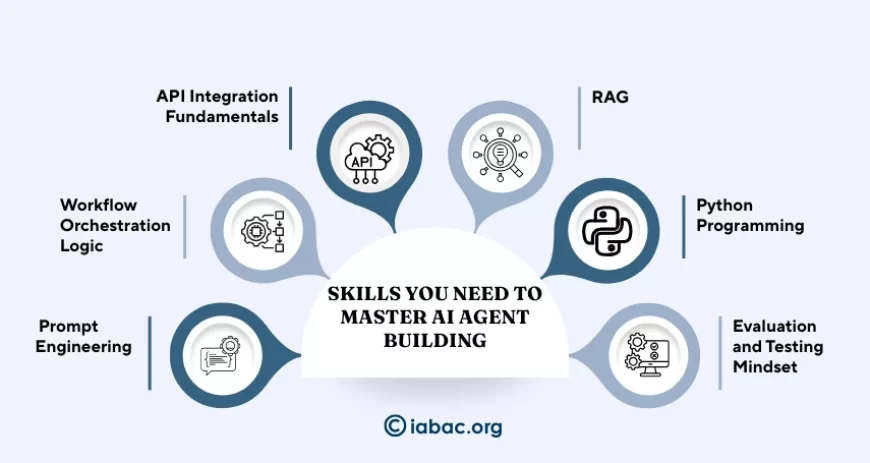
Skills You Need to Master AI Agent Building
The specific skill set depends on which category of builder you use — but these six capabilities are relevant regardless of your chosen tool stack. They represent the 20% of skills that unlock 80% of professional competency in this space.
- Prompt Engineering: System prompts, few-shot examples, and role definitions shape agent behaviour more than any other variable. Understanding how to write precise, unambiguous instructions is foundational for all three builder categories.
- Workflow Orchestration Logic: The ability to decompose a complex goal into discrete, testable subtasks — and to map dependencies, conditionals, and failure modes — is the cognitive skill that separates functional agents from fragile ones.
- API Integration Fundamentals: Even no-code platforms require you to understand how REST APIs work, what authentication means, and how to interpret JSON responses. This is the minimum technical floor for meaningful agent building.
- RAG (Retrieval-Augmented Generation) Basics: Most enterprise agents need to query an organisation's own data — documents, databases, knowledge bases — rather than relying on an LLM's training knowledge alone. Understanding embedding, chunking, and vector retrieval is critical for building grounded, accurate agents.
- Python Programming (Developer track): If you are pursuing the developer framework category, Python is non-negotiable. LangChain, CrewAI, AutoGen, and SmolAgents are all Python-first. Basic Python proficiency — functions, classes, async/await, virtual environments — is sufficient to start.
- Evaluation and Testing Mindset: The ability to write test cases for agent behaviour, define success metrics, and set up automated evaluation pipelines is the skill that separates engineers who deploy reliable agents from those who deploy impressive demos.
India Context
Demand for AI agent specialists in India is growing rapidly across Bengaluru, Hyderabad, and Pune tech hubs. Roles including AI Engineer, Automation Architect, and Prompt Engineer are now listed by major Indian IT services firms including Infosys, TCS, Wipro, and HCL Technologies — alongside a wave of AI-native startups.
How to Validate Your AI Agent Skills — The Career Angle
Learning to build AI agents is valuable. Being able to prove that you can — to a hiring manager, a client, or a promotion committee — is what converts knowledge into career momentum.
The AI agent market's growth trajectory means the window for early movers is open but closing. Professionals who establish verifiable, recognised credentials now are positioning themselves ahead of the majority of the market who are still "planning to learn AI."
The Problem with Self-Reported AI Skills
A LinkedIn profile that says "experienced in LangChain and multi-agent systems" is easy to write and nearly impossible for a hiring manager to evaluate without investing significant interview time. A globally recognised, proctored certification cuts through this ambiguity — it signals that a neutral, standards-based body has verified the claim.
The IABAC Certification Pathway for AI Agent Professionals
IABAC operates as a vendor-neutral, internationally recognised certification body aligned with the Edison Data Science Framework from the European Commission. This means your credential is valid whether your organisation uses LangChain or LangGraph, Azure ML or AWS SageMaker, Langflow or CrewAI — you are certified on principles and competencies, not on any single vendor's platform.
|
Certification |
Who It's For |
What It Validates |
|
AI Foundation Certification |
Beginners, career changers, non-technical managers |
Core AI concepts, ML fundamentals, NLP, agent basics, ethical AI |
|
AI ML Certification |
Working professionals transitioning to AI roles |
Machine learning, deep learning, model deployment, agentic workflows |
|
Certified AI Expert |
Senior engineers, architects, AI leads |
Advanced AI systems, multi-agent orchestration, governance, production deployment |
AI agent builders are transforming the way businesses and professionals use artificial intelligence. While there are dozens of tools available, understanding the core concepts behind AI agents is far more important than memorizing specific platforms.
Whether you choose a no-code tool like n8n, a low-code platform like Dify, or a developer framework like LangChain or CrewAI, the goal remains the same: building intelligent systems that can automate tasks, make decisions, and deliver real business value.
As the demand for AI skills continues to grow, learning AI agent fundamentals, workflow automation, prompt engineering, and agent development can help you stay ahead in a rapidly evolving job market. Start with the basics, build practical projects, and continue developing your expertise through structured learning and hands-on experience.
The future belongs to professionals who can not only use AI but also build and manage AI-powered solutions.