





















































Healthcare Analytics and Its Impact
Learn how healthcare analytics is transforming the industry. Improve patient outcomes, streamline operations, and enhance decision-making through data.

When I first started exploring the world of data, I had no idea how powerful Data Analytics Certifications could be in shaping my career. As someone deeply passionate about using data to solve real-world problems—especially in healthcare—I quickly realized that certifications weren’t just paper credentials. They proved my expertise, opened doors to new opportunities, and helped me build trust with clients and employers. In this blog, I’ll share my journey, tips, and insights on how to boost your certified data analytics skills. Whether you’re just starting out or looking to level up, there’s always room to grow and make an impact.
What is Healthcare Analytics?
It is the collection, processing, and interpretation of data to improve medical decision-making, patient care, and hospital administration. Healthcare workers can obtain a better understanding of patient health, medical condition management, and resource allocation by utilizing advanced statistical approaches, artificial intelligence, and machine learning.
The incorporation of analytics into healthcare has resulted in groundbreaking advances such as model predictions for disease outbreaks, individualized treatment procedures, and simplified administrative processes. The goal is to shift from reactive to proactive healthcare, reducing risks and improving outcomes with data-driven decision-making.
The Importance of Healthcare Analytics
The developing volume of healthcare data creates great opportunities for medical service improvement. Every day, clinics and hospitals produce huge amounts of data through electronic healthcare records, medical imaging, wearable devices, and clinical research. When properly evaluated,this data can assist healthcare practitioners in making more informed decisions, reducing costs, and improving the care of patients.
Some major advantages include:
- Improved Patient Outcomes: predictive analytics helps in early detection and timely intervention.
- Cost Reduction: Finding inefficiencies in hospital procedures reduces wasteful expenses.
- Better Resource Allocation: Optimizing workforce and resource distribution increases efficiency.
- Enhanced Patient Experience: Personalized treatment services lead to higher patient satisfaction and recovery rates.
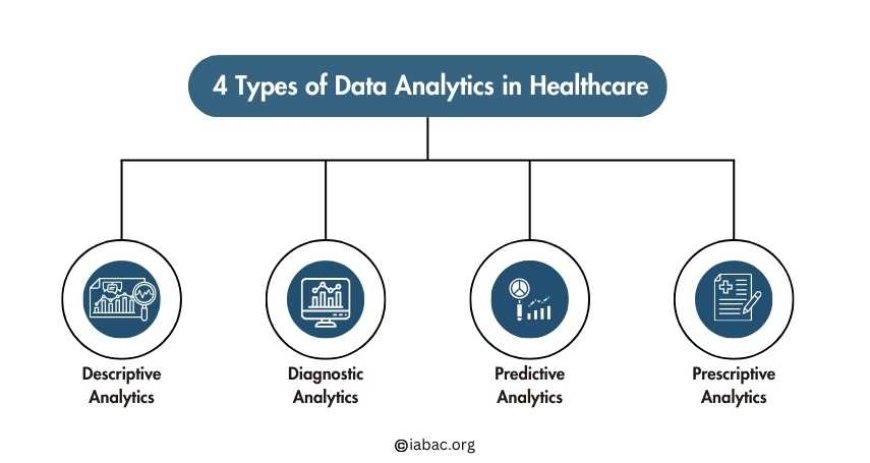
What are the 4 Types of Data Analytics in Healthcare?
Healthcare analytics can be divided into four categories, each providing a unique function in enhancing healthcare delivery:
1. Descriptive Analytics
Descriptive analytics analyzes historical data to better understand prior trends and events. This sort of analytics answers the question "What happened?" and assists healthcare providers in understanding patient demographics, disease prevalence, and hospital performance.
Examples of Descriptive Analytics in Healthcare:
- Tracking the number of hospitalizations over time.
- Infection rates are monitored in healthcare settings.
- Evaluation of the findings of a patient satisfaction survey.
2. Diagnostic Analytics
Diagnostic analytics goes beyond descriptive analytics to investigate the causes of past events. It addresses the question, "Why did it happen?" by identifying patterns and correlations in healthcare data.
Examples of Diagnostic Analytics in Healthcare:
- Identifying variables contributing to high readmission rates.
- Analyzing patient symptoms and lab results to determine disease risk factors.
- Understanding why a given treatment was less effective for some patients.
3. Predictive Analytics
Predictive analytics predicts future outcomes through statistical models, machine learning, and artificial intelligence. By analyzing data from the past and the present, predictive analytics can provide insights into potential risks and help healthcare suppliers take proactive steps.
Examples of Predictive Analytics in Healthcare:
- Predicting patient deterioration in ICU settings.
- predicting disease outbreaks using population and environmental data.
- Using patient history to predict hospital readmissions.
4. Prescriptive Analytics
Prescriptive analytics makes practical recommendations based on predictive insights. It addresses the question "What should be done?" by providing the best treatments and treatment approaches.
Examples of Prescriptive Analytics in Healthcare:
- Recommending individualized treatment strategies based on genetic information.
- Optimizing hospital workflows to reduce wait time.
- Patients with a high risk of chronic diseases should be advised to make lifestyle adjustments.
The Role of AI and Machine Learning in Healthcare Analytics
Artificial intelligence and machine learning are critical for improving healthcare analytics. Large datasets may be analyzed more quickly and effectively by AI-powered algorithms, which can also spot patterns and insights that people would find challenging.
Key AI Applications:
- Medical Imaging Analysis: Artificial intelligence can detect problems in MRIs, X-rays, and CT scans.
- Natural language processing: It involves extracting relevant information from unstructured medical records and clinical notes.
- Predictive Disease Modeling: detecting high-risk people for conditions such as diabetes and cancer.
- Drug Discovery: The process of using biochemical data to speed up the discovery of novel medicines.
Future Trends in Healthcare Analytics
As technology advances, the future of healthcare analytics appears hopeful. Some rising trends are:
Real-Time Analytics
Real-time analytics allows healthcare suppliers to make immediate decisions based on live data. This is especially useful in emergency care situations, where prompt treatments can save lives.
Personalized Medicine
Advances in genomics and AI-powered analytics are paving the way for personalized medicine, which tailors therapies to individual patients based on their genetic makeup and medical history.
Blockchain for Data Security
Blockchain technology provides a decentralized and secure method for storing and sharing healthcare data, lowering the risk of data breaches and assuring transparency.
Telehealth and Remote Monitoring
It is becoming increasingly important in remote patient monitoring as telemedicine grows, enabling physicians to monitor patient health indicators from a distance.
Through the facilitation of data-driven decision-making, enhancement of patient outcomes, and optimization of healthcare operations, It is transforming the medical industry. Prescriptive, predictive, descriptive, and diagnostic analytics are the four types of analytics that healthcare organizations can use to revolutionize the way they provide care.
Despite obstacles like as interoperability, data privacy, and implementation costs, It has a promising future. Blockchain, artificial intelligence, and real-time analytics are some of the emerging technologies that will further expand the possibilities of healthcare analytics and improve the effectiveness, efficiency, and personalization of patient care.