

















































What Is Fine-Tuning in AI and How Does It Work?
Fine-tuning in AI makes general models task-specific. Know how the process works, its real-world applications, key benefits, and common challenges to avoid.

Artificial intelligence has reached a turning point. Powerful foundation models can now understand language, analyze images, and generate content with remarkable accuracy.
Yet for most organizations, these general-purpose models don't solve their specific business problems out of the box.
A model trained on general internet text may not understand your company's internal documentation.
An image recognition system trained on everyday objects may not detect defects in your manufacturing line.
This is where fine-tuning becomes essential. It’s the process of turning a broadly capable AI model into a specialized tool for your exact use case. Rather than investing millions of dollars and months of computational time to train a model from scratch, fine-tuning allows you to build on the foundation of existing models and customize them for your unique needs.
Let's see more about fine-tuning.
What Is Fine-Tuning?
Fine-tuning is a machine learning technique that modifies a pre-trained model for specific tasks or use cases through further training on a smaller, domain-specific dataset. It is a form of transfer learning, which means it uses what the AI already knows as a starting point to learn something new
The fundamental principle behind fine-tuning is simple: it is easier and more efficient to improve an existing model that already has broad knowledge than to build a completely new model from the ground up for your specific task.
Fine-tuning helps organizations adapt pre-trained AI models to work better with their specific data and use cases, improving model performance while requiring less training data than building a model from scratch. This technique is particularly effective when you have limited training data or want to build on existing model capabilities.
When you fine-tune a large language model, you adapt its general knowledge to specific tasks such as generating code, summarizing text, creating chatbots, or performing sentiment analysis. The model already understands language patterns, grammar, and general world knowledge from its initial training. Fine-tuning teaches it to apply that knowledge in specialized ways
How Does Fine-Tuning Work?
Fine-tuning starts with an AI model that's already learned vast amounts of general knowledge from huge datasets. During fine-tuning, we show the model a smaller set of examples specific to your task, and we make careful adjustments to its internal settings so it becomes better at what you need it to do.
Here's how the process unfolds in practice:
Step 1: Get Your Data Ready
The success of fine-tuning depends heavily on your data. You need to prepare it carefully before training begins.
Gather the right data: Collect examples that match exactly what you want the model to learn. If you're building a customer service bot, gather real customer questions and appropriate responses.
Clean it up: Remove mistakes, fix formatting issues, and throw out anything that doesn't belong. Make sure everything is organized consistently.
Divide into three parts:
- Training data (what the model learns from)
- Validation data (what you use to check progress while training)
- Test data (what you use to check final results after training)
Step 2: Pick Your Method
You don't have to change the entire model. Depending on your needs and resources, you can choose how much to modify.
Change Everything (Full Fine-Tuning)
Every part of the model gets adjusted during training. Use this when you have lots of data and powerful computers, and your task is quite different from what the model originally learned.
Change Only What's Necessary (Efficient Fine-Tuning)
This smarter approach keeps most of the original model untouched and only adds small new parts that learn your specific task. It's like keeping a great cookbook and just adding a few pages of your family recipes instead of rewriting the whole book. This method is faster, cheaper, and works well even with limited data.
Common techniques include LoRA (Low-Rank Adaptation ) and QLoRA (Quantized Low-Rank Adaptation)
Step 3: Let the Model Learn
Now you actually train the model on your data.
Set the training rules: Choose how quickly the model should learn (learning rate), how many examples to process at once (batch size), and how many times to go through the data (epochs). Use a gentle learning rate so you don't undo all the good knowledge the model already has.
Start training: Feed your data to the model and watch it learn. Check the validation data regularly to see if it's getting better.
Tweak if needed: If results aren't great, try adjusting your settings or switching methods. You might need to try a few times to get it right.
Step 4: Test and Put It to Work
Before using your model with real users, make sure it actually works well.
Check the results: Test your model on data it's never seen before. Measure how accurate it is, how often it's right when it makes a prediction, and how well it catches what it should catch.
Launch it: Once it performs well, connect it to your website, app, or system so people can use it.
Keep watching it: Models don't just work forever without attention. Check how it's doing in the real world, and retrain it with new data if performance starts dropping.
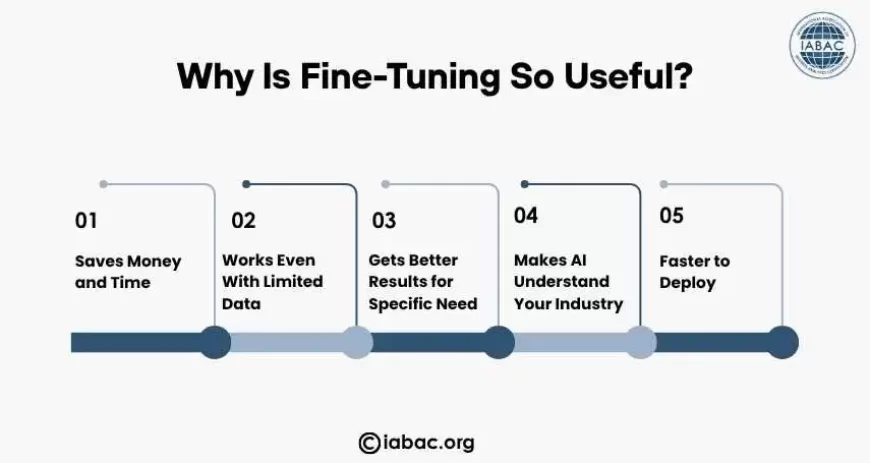
Why Is Fine-Tuning So Useful?
As AI moves from experimentation into everyday business operations, generic models are no longer enough. Organizations need AI that understands their specific data, processes, and goals, and fine-tuning is what bridges that gap.
1. Saves Money and Time
Training a powerful AI model from scratch can cost millions of dollars and take months. Fine-tuning is much cheaper and faster because you're starting with a model that's already smart. You only need to train it on a smaller, specialized dataset.
2. Works Even With Limited Data
You don't need thousands of examples to fine-tune a model. Since the model already knows general patterns, it can learn your specific task with fewer examples. This is crucial when specialized data is hard to get.
3. Gets Better Results for Your Specific Need
A general AI model is good at many things but not perfect at any one thing. Fine-tuning makes it excellent at your specific task. If you want an AI that understands legal documents, fine-tuning on legal texts makes it much better at that job than a general model.
4. Makes AI Understand Your Industry
Fine-tuning teaches the AI your industry's special language and concepts. A finely tuned medical AI understands medical terms. A financial AI understands banking jargon. A general AI doesn't know these specifics.
5. Faster to Deploy
Instead of waiting months to train a model, you can have a customized AI working for you in days or weeks. This speed matters when you need AI solutions quickly.
Real-World Examples: Where Fine-Tuning Is Used
Fine-tuning shows up in more places than most people realize, and the use cases span nearly every major industry.
Customer Service Chatbots
Companies fine-tune language models to create chatbots that understand their products, policies, and common customer questions. Instead of a generic chatbot, you get one that knows your business inside out.
Klarna has deployed a fine-tuned AI assistant that now handles the workload equivalent of 700 full-time agents, cutting average customer query resolution time from 11 minutes to under 2 minutes and driving an estimated $40 million in profit improvement in 2024.
Medical Image Analysis
Hospitals fine-tune image-recognition models to detect specific diseases from X-rays or MRIs. A model that recognizes general images becomes specialized at spotting tumors or fractures.
UCLA researchers proved this with SLIViT (SLice Integration by Vision Transformer), a fine-tuned model that started by learning from eye scan images and was then fine-tuned on liver MRI scans two completely different organs and imaging types. The model still performed accurately, showing that core visual patterns learned in one medical context can carry over to another, making high-quality diagnoses possible without needing thousands of manually labeled scans to start from scratch.
Financial Advisory
Morgan Stanley fine-tuned an AI assistant on its internal library of financial research and client data. The result was a system that went from being able to answer 7,000 questions to effectively answering any question from a corpus of 100,000 documents, giving financial advisors instant access to the firm's entire knowledge base during client interactions.
Investment Banking and Internal Operations
Goldman Sachs found that off-the-shelf AI models were not sufficient for its needs. The firm fine-tuned large language models with its internal codebases to improve relevance and accuracy for finance-specific use cases, rolling the system out across functions ranging from investment banking to trading and asset management.
What Are the Challenges?
Fine-tuning comes with real trade-offs, and knowing them upfront helps you plan smarter and avoid costly mistakes.
1. You Need Good Data
Bad data = bad results. The data you use for fine-tuning must be accurate, clean, and representative of what you want the AI to do. If you train on biased or wrong information, the AI will learn those problems.
2. Still Needs Computer Power
While fine-tuning is cheaper than training from scratch, it still needs powerful computers (especially GPUs) to run. Small businesses might need to use cloud services.
3. Risk of "Forgetting" General Knowledge
If you train too aggressively or on too narrow data, the AI might lose some of its general knowledge. It becomes great at your task but forgets everything else. Using the right techniques prevents this.
4. Possibility of Overfitting
Overfitting means the AI memorizes your training data too well and can't handle new, slightly different examples. It's like a student who memorizes practice test answers but fails when questions are phrased differently.
5. Need Technical Knowledge
Fine-tuning requires understanding concepts like learning rates, layers, and evaluation metrics. You need someone with AI knowledge or access to experts.
What's Next for Fine-Tuning?
The field is evolving quickly, and the direction is clear: fine-tuning is becoming faster, cheaper, and more accessible than ever.
Easier Tools for Everyone
Tools are becoming simpler so non-experts can fine-tune models easily. Microsoft made fine-tuning available for regular business teams to use with their company information.
Learning From Real Feedback
Advanced systems can now learn from real-world user feedback and improve over time, as humans do. The AI gets smarter the more it's used.
More Specialized Starting Models
More pre-trained models are available for specific industries (healthcare, law, finance), making fine-tuning even more effective.
More Efficient Methods
Research is making fine-tuning require less computing power, making it accessible to smaller organizations.
Why Fine-Tuning Matters
Fine-tuning is now a fundamental technique in AI, especially for the powerful models used in generative AI. It's the practical way to make AI work for your specific needs.
Here's what you need to remember:
- Fine-tuning takes an already-smart AI and makes it excellent at your specific task
- It's much cheaper and faster than building AI from scratch
- It works well even when you don't have tons of data
- It makes AI understand your industry's special language and needs
- It's used everywhere: customer service, healthcare, law, finance, content creation
Whether you want a chatbot that understands your products, an AI that reads medical records, or a system that writes content in your brand voice, fine-tuning is the practical path to making powerful AI work for you
For any organization wanting to use AI effectively, understanding fine-tuning is essential. It's how you get AI that truly understands your business, your data, and your unique requirements without spending millions training models from scratch.
If you want to go deeper into these concepts and apply them with confidence, building structured knowledge in AI is the right move.
An AI certification can help you build the skill set organizations are actively hiring for and give you the credibility to work with these technologies professionally.
As AI becomes more common in business, fine-tuning will be the key to making AI solutions that deliver real value for your specific needs. It's not just a technical trick; it's the practical way to bring AI power to real-world problems.