





























































What is the starting salary for Data Scientists in India
Learn about the starting salary for Data Scientists in India, including factors influencing pay and career growth opportunities in the tech industry.


When I started learning about data science in India, one of the biggest things I wanted to know was how much data scientists earn when they start. The answer isn’t simple, but it’s interesting! Over time, I’ve noticed that factors like skills, experience, and even Data Science Certifications have a big impact on a fresher’s salary. Since companies are always looking for experts to make sense of large amounts of data, the need for data scientists has grown a lot. Based on what I’ve learned and researched, I want to share some insights about salary trends in this field.
Understanding the Role of a Data Scientist
Data is one of the most valuable resources for businesses and organizations. However, raw data is not useful unless it is analyzed and turned into meaningful information. This is where data scientists play a key role. They help make sense of large and complex data sets, guiding companies in making better decisions, identifying trends, and even predicting future outcomes.
Who Is a Data Scientist?
A data scientist is a skilled professional who combines knowledge of statistics, computer science, and a specific industry to find useful insights from data. They work like detectives, using data to solve problems. Their job is not just to analyze information but also to create models and algorithms that can learn from past data to predict future events.
Data scientists work in many fields, such as finance, healthcare, technology, retail, marketing, and transportation. Their role helps companies make decisions based on facts rather than guesswork.
Key Responsibilities of a Data Scientist
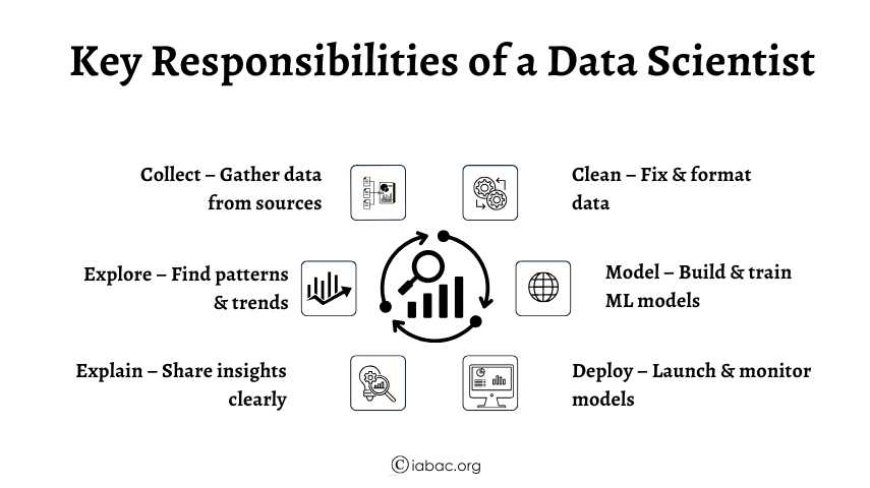
Data scientists follow a step-by-step process to work with data:
-
Data Collection
-
Gather data from different sources such as databases, cloud storage, or web scraping.
-
Understand the formats and possible issues with the data.
-
Data Cleaning and Preparation
-
Fix missing or incorrect data.
-
Organize the data into a structured format for analysis.
-
Perform tasks like scaling, encoding, and normalizing data.
-
Exploratory Data Analysis (EDA)
-
Use statistics and visuals to understand data patterns.
-
Identify relationships, trends, and unusual data points.
-
Develop ideas about what might be influencing the data.
-
Building Models and Machine Learning
-
Choose the right machine learning techniques (e.g., regression, classification, clustering).
-
Train models using past data and check their accuracy.
-
Improve models by adjusting settings and validating results.
-
Interpreting Data and Finding Insights
-
Turn model results into useful business insights.
-
Use charts and reports to explain findings to non-technical people.
-
Deploying and Monitoring Models
-
Integrate predictive models into business applications.
-
Track model performance and update them as needed.
Essential Skills for a Data Scientist A good data scientist needs a mix of technical, analytical, and communication skills:
Technical Skills
-
Programming: Python, R, and SQL are common languages used in data science. Python is popular because of its libraries like Pandas, NumPy, and Scikit-learn.
-
Data Handling: Experience with tools like Pandas for structured data and NumPy for calculations.
-
Machine Learning: Understanding of different methods like regression, decision trees, and neural networks.
-
Big Data Technologies: Familiarity with tools like Hadoop, Spark, and cloud platforms such as AWS, Azure, or Google Cloud.
-
Data Visualization: Skills in tools like Matplotlib, Seaborn, Plotly, Tableau, and Power BI for creating clear visuals.
Mathematics and Statistics
-
Strong foundation in probability, linear algebra, calculus, and statistical modeling.
-
Ability to check if results are meaningful and accurate.
Industry Knowledge
-
Understanding of the business field where data science is applied.
-
Ability to ask the right questions and align data work with business needs.
Communication and Storytelling
-
Ability to present findings clearly through reports, dashboards, and presentations.
-
Skills in explaining technical details simply and understandably.
Common Tools Used by Data Scientists
|
Category |
Tools & Technologies |
|
Programming |
Python, R, SQL |
|
Data Handling |
Pandas, NumPy, Excel, Spark |
|
Machine Learning |
Scikit-learn, XGBoost, TensorFlow, Keras |
|
Visualization |
Matplotlib, Seaborn, Plotly, Tableau, Power BI |
|
Databases |
MySQL, PostgreSQL, MongoDB, SQLite |
|
Cloud Platforms |
AWS, Google Cloud, Azure |
|
Version Control |
Git, GitHub |
|
Notebooks & IDEs |
Jupyter, Google Colab, VS Code |
Why Are Data Scientists Important? Data scientists help companies turn uncertainty into clear answers. Businesses often need to understand:
-
Why are customers leaving?
-
What products should we introduce next?
-
How can we lower costs or prevent fraud?
By analyzing data, data scientists help companies:
-
Make better decisions: Insights from data guide business strategies.
-
Improve customer experience: Personalized recommendations increase customer satisfaction.
-
Increase efficiency: Data helps identify and fix inefficiencies.
-
Encourage innovation: Predictions from data can help businesses explore new opportunities.
Career Options in Data Science Data science offers different career paths. Some common roles include:
-
Data Analyst: Focuses on analyzing and reporting data insights.
-
Machine Learning Engineer: Designs and applies machine learning models.
-
Data Engineer: Builds systems for managing and processing data.
-
Business Intelligence (BI) Analyst: Works with business teams to interpret data.
-
Research Scientist: Develops new models and algorithms.
What Is the Starting Salary for Data Scientists in India?
According to the International Association of Business Analytics Certifications (IABAC), entry-level data scientists in India can earn between ₹5,00,000 to ₹8,00,000 per year. With experience, salaries increase:
-
3 to 5 years: ₹8,00,000 to ₹15,00,000 per year.
-
6+ years: ₹15,00,000 to ₹25,00,000 or more annually.
Earnings depend on education, skills, industry, and location. Keeping up with new tools and methods in data science can further increase salary potential.
How much can a data scientist earn in India?
Data Scientists in India earn competitive salaries based on experience, skills, location, and industry. Beginners with 0–2 years of experience earn between ₹3,00,000 and ₹10,00,000 per year, with an average of ₹6,00,000. Those with a technical or analytical background often start at the higher end.
Mid-level professionals with 3–5 years of experience earn ₹8,00,000 to ₹20,00,000 per year, averaging around ₹12,00,000. At this stage, they work with real data, build models, and provide business insights. Senior Data Scientists with 6+ years of experience earn ₹15,00,000 to ₹30,00,000 per year, with an average of ₹20,00,000. They lead teams, manage data strategies, and apply advanced techniques.
Salaries depend on experience, technical skills like Python, R, SQL, and big data tools, and location. Cities like Bengaluru, Mumbai, and Hyderabad offer higher salaries. Industries such as finance, technology, healthcare, and e-commerce also pay more.With the right skills and continuous learning, Data Scientists can expect strong salary growth and better career opportunities.