






















































Essential Business Analytics Skills Every Professional Should Master
Master essential business analytics skills, including Excel, data visualization, critical thinking, and decision-making to advance your career.

Imagine you're in a meeting where sales have declined for three consecutive quarters. Different departments have different opinions about the cause. Marketing believes customer engagement is the issue, operations point to supply chain delays, and finance is focused on rising costs. The leadership team needs more than assumptions—they need evidence.
This is where business analytics makes a difference. Instead of relying on instinct alone, organizations use data to understand what is happening, identify the underlying causes, and determine the most effective course of action. Over the years, one pattern I've noticed across industries is that the organizations making consistent, informed decisions aren't necessarily collecting more data—they're asking better questions and developing the skills to interpret that data effectively.
Whether you're a student preparing for your first role, a manager leading a team, a business leader shaping strategy, or a professional looking to change careers, developing strong business analytics skills can help you make more informed decisions, communicate insights clearly, and contribute greater value to your organization.
As professionals build these capabilities, many choose to complement practical experience with structured learning and industry-recognized certifications. Certifications can help validate practical knowledge, establish a common understanding of accepted business analysis practices, and encourage continuous professional development. They also provide a structured framework for learning concepts that professionals may not encounter in day-to-day work alone. Organizations such as IABAC, along with several other professional certification bodies, offer programs that focus on business analytics and related disciplines. While certifications do not replace real-world experience, many employers view them as one indicator of a professional's commitment to continuous learning and industry best practices.
How Business Analytics Works
Successful analytics process usually follows a structured workflow:
- Define the business problem.
- Collect relevant data from reliable sources.
- Clean and prepare the data.
- Analyse the information using appropriate techniques.
- Interpret the findings in a business context.
- Recommend actions based on the evidence.
- Monitor outcomes and refine future decisions.
A common mistake teams make is focusing on the analysis before clearly defining the business question. Even sophisticated analytical models can produce limited value if they are solving the wrong problem.
Common Misconceptions About Business Analytics
Several misconceptions continue to create confusion around business analytics.
|
Myth |
Reality |
|
Business analytics is only for data scientists. |
Professionals across marketing, HR, finance, healthcare, operations, and sales use analytics to improve decisions. |
|
Analytics is just creating reports. |
Reporting is one component. Analytics also identifies patterns, predicts outcomes, and recommends actions. |
|
More data automatically leads to better decisions. |
High-quality, relevant data is often more valuable than simply having large volumes of information. |
|
Analytics eliminates human judgment. |
Effective analytics complements business experience rather than replacing it. |
|
Only large enterprises benefit from analytics. |
Small and medium-sized businesses also use analytics to improve efficiency and customer experience. |
Why Is Business Analytics Important?
Organizations increasingly compete on how effectively they use information rather than how much information they collect. Data alone does not create value—its interpretation and application do.
Research and guidance from respected organizations such as the World Economic Forum, LinkedIn, Deloitte, IBM, Microsoft, and McKinsey consistently highlight analytical thinking, data literacy, and evidence-based decision-making as essential workplace capabilities across industries.
As digital transformation continues, professionals are expected to combine business understanding with analytical skills to solve increasingly complex challenges.
Better Decision-Making
Strong decision-making skills are one of the most valuable outcomes of business analytics.
Instead of relying solely on experience or intuition, decision-makers can evaluate multiple scenarios using data, identify potential risks, and make informed choices supported by measurable evidence.
For example, a retailer deciding whether to expand into a new region can analyse customer demographics, purchasing behaviour, logistics costs, and competitor activity before making a significant investment.
Improving Business Performance
Business analytics enables organizations to measure key performance indicators (KPIs), identify operational inefficiencies, and continuously improve processes.
Manufacturers may analyse production downtime.
Banks may evaluate fraud detection patterns.
Healthcare organizations may optimize patient scheduling.
Retailers may improve inventory planning.
Although each industry uses different datasets, the underlying objective remains the same: improve performance through informed decisions.
Supporting Career Growth
One pattern I've observed across hiring trends is that employers increasingly seek professionals who can translate data into business outcomes rather than simply produce reports.
These capabilities are valuable in roles such as:
- Business Analyst
- Data Analyst
- Product Manager
- Operations Manager
- Marketing Analyst
- Financial Analyst
- Project Manager
- HR Analyst
- Business Intelligence Analyst
- Strategy Consultant
Professionals who combine analytical thinking with communication and business knowledge often find themselves contributing to strategic discussions earlier in their careers.
Building a Data-Driven Culture
Analytics is not only about technology—it also influences organizational culture.
When teams consistently use evidence to support decisions, organizations often become more transparent, collaborative, and responsive to change.
Leaders gain greater visibility into performance.
Managers can prioritize improvements based on measurable outcomes.
Employees develop greater confidence in the decisions they make because they understand the reasoning behind them.
Real-World Applications of Business Analytics
Business analytics creates value across virtually every industry because every organization generates data that can inform better decisions. The specific challenges vary, but the underlying approach remains remarkably consistent: identify the problem, analyse relevant information, and take evidence-based action.
1. Retail: Improving Inventory Management
Situation: A national retail chain experiences frequent stock shortages for popular products while excess inventory accumulates in other categories.
Challenge: Balancing customer demand with inventory costs.
Application: Analysts examine historical sales data, seasonal purchasing patterns, regional demand, supplier lead times, and promotional activity.
Outcome: Inventory allocation becomes more accurate, reducing stockouts while minimizing excess inventory and storage costs.
2. Healthcare: Optimizing Patient Scheduling
Situation: A hospital struggles with long patient wait times despite having sufficient clinical staff.
Challenge: Inefficient appointment scheduling and uneven resource utilization.
Application: Business analytics identifies peak demand periods, appointment cancellation trends, and physician availability patterns.
Outcome: Improved scheduling helps reduce patient waiting times and increases operational efficiency without requiring additional staff.
3. Financial Services: Detecting Fraud
Situation: A financial institution processes millions of daily transactions.
Challenge: Identifying suspicious activity without delaying legitimate customer transactions.
Application: Analytical models compare transaction behaviour with historical customer patterns to identify unusual activity.
Outcome: Fraud investigations become more targeted while reducing unnecessary alerts for genuine customers.
4. Manufacturing: Reducing Equipment Downtime
Situation: Unexpected machine failures interrupt production schedules.
Challenge: High maintenance costs and delayed customer deliveries.
Application: Operational data from production equipment is analysed to identify patterns that indicate potential failures before they occur.
Outcome: Maintenance teams can schedule repairs proactively, helping reduce costly downtime and improve production reliability.
5. Marketing: Improving Campaign Performance
Situation: A company invests in multiple digital marketing campaigns but struggles to identify which channels deliver the highest return.
Challenge: Allocating marketing budgets effectively.
Application: Analysts evaluate campaign performance, customer acquisition costs, conversion rates, and customer lifetime value.
Outcome: Marketing teams focus investment on higher-performing channels, improving overall return on marketing spend.
6. A Realistic Business Scenario
Consider a mid-sized software company experiencing a steady increase in customer churn. Initial assumptions point to pricing, but analytics reveals a different story.
Customer support records show recurring technical issues during onboarding. Product usage data indicates that many customers stop using key features within the first month. Survey responses highlight a lack of training resources rather than dissatisfaction with pricing.
Instead of reducing subscription fees—a costly decision that may not have solved the problem—the company redesigns its onboarding process, introduces guided tutorials, and strengthens customer success support.
Within the following months, customer retention improves because the organization addressed the actual cause of churn rather than the most obvious assumption.
This is where business analytics delivers its greatest value. It helps organizations move beyond opinions and make decisions grounded in evidence.
Essential Business Analytics Skills Every Professional Should Master
While technology continues to evolve, the most effective business analysts share a common foundation of technical knowledge, business understanding, and interpersonal abilities. In real projects, organizations rarely struggle because they lack data—they struggle because they lack professionals who can interpret that data and translate it into meaningful business actions.
Below are the core skills that consistently add value across industries.
1. Analytical and Critical Thinking Skills
One of the most important essential business analytics skills is the ability to think analytically. This means breaking complex business problems into manageable parts, identifying patterns, and evaluating possible solutions objectively.
Closely related are critical thinking skills, which help professionals question assumptions, validate evidence, and avoid drawing conclusions too quickly.
For example, if customer satisfaction scores decline, an analyst should investigate multiple contributing factors rather than assuming a single cause. Looking at support response times, product quality, customer demographics, and recent operational changes often provides a more complete picture.
Professionals with strong analytical thinking are able to:
- Recognize trends and anomalies
- Evaluate data quality
- Distinguish correlation from causation
- Ask meaningful business questions
- Present balanced recommendations
2. Problem-Solving Skills
Business analytics ultimately exists to solve business problems.
Strong problem-solving skills allow professionals to move beyond identifying issues and develop practical, evidence-based solutions.
A common mistake teams make is jumping directly into data analysis before clearly defining the problem. Successful analysts spend time understanding business objectives, stakeholder expectations, and operational constraints before selecting analytical methods.
Effective problem-solving generally involves:
- Defining the business challenge
- Identifying available data
- Testing possible explanations
- Evaluating alternative solutions
- Measuring outcomes after implementation
This structured approach often leads to better long-term decisions than relying solely on intuition.
3. Decision-Making Skills
Data becomes valuable only when it supports action.
Strong decision-making skills enable professionals to weigh risks, compare alternatives, and recommend solutions aligned with organizational goals.
For example, when evaluating whether to launch a new product, decision-makers may analyse:
- Market demand
- Customer preferences
- Production costs
- Competitive positioning
- Financial forecasts
- Operational capacity
Business analytics provides the evidence needed to evaluate these factors, but professionals must still apply business judgment when making recommendations.
Technical expertise alone rarely leads to impactful analysis.
Business acumen helps analysts understand how different functions—such as finance, marketing, operations, sales, and customer service—work together to achieve organizational objectives.
Professionals who understand revenue models, customer behaviour, operational processes, and industry dynamics are better equipped to interpret analytical findings within the broader business context.
This combination of analytical ability and business understanding often distinguishes experienced professionals from those who focus only on technical outputs.
5. Data Visualization and Storytelling
Decision-makers rarely have time to interpret large spreadsheets or complex statistical outputs.
One pattern I've noticed is that even excellent analysis can be overlooked if it is presented poorly.
Data visualization helps transform analytical findings into charts, dashboards, and reports that stakeholders can quickly understand.
Equally important is storytelling with data. Rather than simply presenting numbers, analysts explain:
- What happened
- Why it happened
- Why it matters
- What action should be taken
Clear communication increases the likelihood that analytical insights will influence business decisions.
6. Communication and Collaboration
Business analytics is rarely an individual activity.
Professionals regularly collaborate with:
- Business leaders
- Department managers
- IT teams
- Data engineers
- Product teams
- Finance professionals
- Marketing specialists
Strong communication skills help analysts translate technical findings into language that different stakeholders can understand.
In many organizations, success depends as much on collaboration as on technical expertise.
7. Statistical and Quantitative Knowledge
Not every analyst needs to become a statistician, but understanding fundamental statistical concepts helps professionals interpret data more accurately.
Useful concepts include:
- Mean, median, and mode
- Standard deviation
- Probability
- Correlation
- Regression
- Sampling
- Hypothesis testing
These techniques support more reliable decision-making and reduce the risk of drawing misleading conclusions from data.
Business Analytics Tools Every Professional Should Know
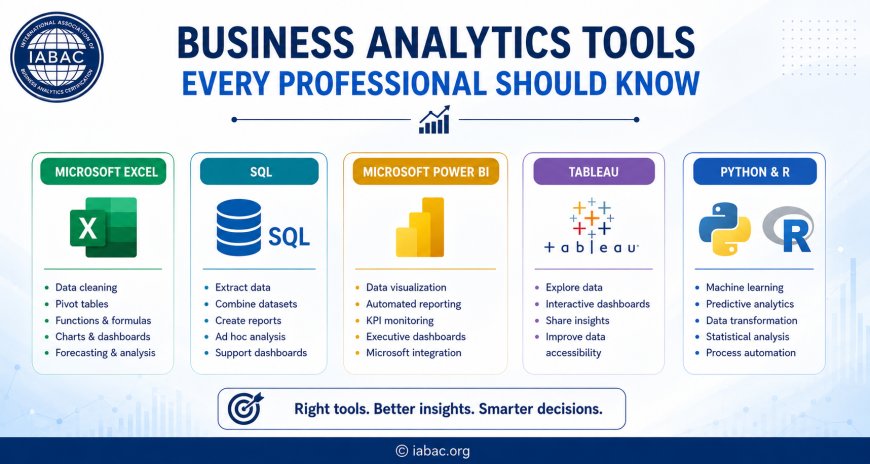
Selecting the right business analytics tools depends on the business problem, data sources, and organizational requirements. While new platforms continue to emerge, several tools remain widely used because of their versatility and industry adoption.
Microsoft Excel
Despite the growth of advanced analytics platforms, Excel for business analytics remains one of the most widely used tools.
Excel supports:
- Data cleaning
- Pivot tables
- Lookup functions
- Conditional formatting
- Charts and dashboards
- Basic forecasting
- What-if analysis
Many professionals begin their analytics journey with Excel before progressing to more advanced platforms.
SQL
Structured Query Language (SQL) enables analysts to retrieve, filter, and organize data stored in relational databases.
Typical uses include:
- Extracting business data
- Combining multiple datasets
- Creating reports
- Performing ad hoc analysis
- Supporting dashboard development
SQL is considered a foundational skill for many analytics roles.
Microsoft Power BI
Power BI helps organizations create interactive dashboards that provide real-time visibility into business performance.
Its strengths include:
- Data visualization
- Automated reporting
- KPI monitoring
- Executive dashboards
- Integration with Microsoft products
Tableau
Tableau is widely recognized for its interactive visual analytics capabilities.
Organizations often use Tableau to:
- Explore large datasets
- Build executive dashboards
- Share insights across departments
- Improve data accessibility
Python and R
For advanced analytics, automation, and predictive modelling, programming languages such as Python and R are increasingly valuable.
Common applications include:
- Machine learning
- Predictive analytics
- Data transformation
- Statistical analysis
- Process automation
Not every business analyst requires advanced programming knowledge, but familiarity with these tools can broaden career opportunities.
Common Business Analytics Techniques
Effective analysis depends on selecting the right technique for the business question. Some of the most commonly used business analytics techniques include:
Descriptive Analytics
Summarizes historical data to explain what has already happened.
Examples include monthly sales reports, operational dashboards, and performance scorecards.
Diagnostic Analytics
Investigates why an event occurred by examining relationships, trends, and contributing factors.
Example:
Identifying the reasons behind declining customer retention.
Predictive Analytics
Uses historical patterns and statistical models to estimate future outcomes.
Organizations frequently apply predictive analytics to:
- Sales forecasting
- Demand planning
- Customer churn prediction
- Risk assessment
Prescriptive Analytics
Recommends actions based on analytical findings.
Examples include:
- Inventory optimization
- Pricing recommendations
- Workforce scheduling
- Supply chain planning
What Business Analytics Professionals Actually Do
Many people assume analysts spend most of their day creating reports. In practice, their responsibilities are far more diverse.
A typical business analytics professional may:
- Meet with stakeholders to understand business challenges
- Define analytical objectives
- Collect and validate data
- Clean and prepare datasets
- Perform exploratory analysis
- Build dashboards and reports
- Present findings to leadership
- Recommend practical business actions
- Monitor results after implementation
- Refine analytical models based on business outcomes
Successful professionals also balance technical work with business communication, ensuring that insights lead to informed decisions rather than remaining unused in reports.
Core Components of Business Analytics
Business analytics combines several interconnected disciplines. Understanding these core components provides a clearer picture of how successful analytics initiatives are built.
- Business Understanding – Defines organizational objectives and identifies the problems that analytics should address.
- Data Collection – Gathers relevant information from internal systems, external sources, and operational processes.
- Data Quality Management – Ensures information is accurate, complete, and consistent before analysis begins.
- Data Preparation – Cleans, transforms, and organizes raw data into a usable format.
- Exploratory Data Analysis – Identifies trends, relationships, and anomalies that may require deeper investigation.
- Statistical Analysis – Applies quantitative methods to validate findings and support decision-making.
- Data Visualization – Presents analytical insights through charts, dashboards, and reports that stakeholders can easily interpret.
- Business Interpretation – Connects analytical findings to operational and strategic objectives.
- Decision Support – Helps leaders evaluate options using objective evidence.
- Performance Monitoring – Tracks outcomes using key performance indicators (KPIs) and other business metrics.
- Continuous Improvement – Uses feedback and new data to refine processes, models, and decision-making over time.
Key Benefits of Business Analytics
Supports Better Business Decisions
Business analytics provides structured evidence that helps leaders evaluate opportunities, assess risks, and prioritize initiatives. While experience remains valuable, combining it with reliable data often leads to more balanced decisions.
Improves Operational Efficiency
By identifying bottlenecks, process variations, and resource constraints, analytics helps organizations streamline workflows, reduce waste, and improve productivity over time.
Enhances Customer Understanding
Analysing customer behaviour, purchasing patterns, feedback, and engagement data enables organizations to tailor products, services, and communication more effectively.
Strengthens Strategic Planning
Forecasting, scenario analysis, and performance measurement allow leadership teams to align business strategies with measurable objectives rather than assumptions alone.
Creates Stronger Career Opportunities
Professionals with a combination of analytical thinking, technical proficiency, communication skills, and business knowledge are increasingly sought after across industries. As organizations continue investing in data-driven decision-making, these capabilities can open opportunities in leadership, consulting, operations, finance, marketing, and technology-related roles.
Comparison: Traditional Decision-Making vs. Data-Driven Decision-Making
|
Traditional Approach |
Business Analytics Approach |
|
Relies heavily on intuition and past experience |
Combines experience with evidence from reliable data |
|
Decisions may vary between individuals |
Decisions follow a structured analytical process |
|
Limited visibility into trends |
Uses historical and real-time data to identify patterns |
|
Problems often addressed after they occur |
Predictive techniques help identify potential issues earlier |
|
Reporting focuses on past performance |
Analytics supports forecasting and future planning |
|
Improvements may be difficult to measure |
Outcomes can be tracked using KPIs and measurable business metrics |
Business analytics does not replace professional judgment. Instead, it provides the context and evidence needed to make decisions with greater confidence and transparency.
Emerging Trends in Business Analytics
Business analytics continues to evolve as organizations adopt new technologies and respond to changing business needs. While the fundamentals of asking the right questions and interpreting data remain unchanged, several trends are shaping how analytics is applied today.
1. Artificial Intelligence and Augmented Analytics
Artificial intelligence (AI) is helping analysts automate repetitive tasks such as data preparation, anomaly detection, and predictive modelling. Rather than replacing professionals, AI often enables them to spend more time interpreting insights and advising stakeholders.
Organizations such as Microsoft and IBM continue to expand AI-powered analytics capabilities, making advanced analytical tools more accessible to business users.
2. Self-Service Analytics
Business users increasingly expect to explore data without relying on technical teams for every report. Self-service platforms such as Power BI and Tableau enable managers and department leaders to access dashboards, filter information, and answer operational questions independently.
This trend encourages faster decision-making while placing greater emphasis on data governance and data literacy.
3. Stronger Focus on Data Governance
As organizations collect more information, maintaining data quality, privacy, and compliance has become a strategic priority.
Frameworks developed by organizations such as the National Institute of Standards and Technology (NIST) help organizations establish reliable practices for managing data, reducing risk, and supporting trustworthy analytics.
4. Analytics Embedded in Everyday Workflows
Rather than existing as standalone reports, analytics is increasingly integrated into CRM systems, ERP platforms, HR software, and customer service applications. This allows professionals to access insights within the tools they already use, reducing delays between analysis and action.
5. Growing Demand for Data Literacy
Analytics is no longer limited to specialized roles. Finance teams, HR professionals, marketers, operations managers, and business leaders are all expected to understand data well enough to make informed decisions.
Reports from organizations such as the World Economic Forum and LinkedIn continue to highlight analytical thinking, problem-solving, and data literacy among the capabilities employers value across a wide range of industries.
How the Business Analytics Process Works
Although projects differ across organizations, successful analytics initiatives generally follow a structured process.
Step 1 – Define the Business Problem
Clarify the business objective, identify stakeholders, and determine what decisions the analysis should support.
Step 2 – Collect Relevant Data
Gather information from internal systems, customer interactions, financial records, operational databases, or trusted external sources.
Step 3 – Prepare and Validate the Data
Clean duplicate records, address missing values, standardize formats, and verify data accuracy before beginning analysis.
Step 4 – Analyse the Data
Apply appropriate analytical methods, statistical techniques, or visualization tools to identify trends, relationships, and opportunities.
Step 5 – Present Insights
Translate findings into clear recommendations using dashboards, reports, and visualizations that align with business objectives.
Step 6 – Monitor and Improve
Measure business outcomes, evaluate whether recommendations achieved the desired results, and refine future analyses using new data and stakeholder feedback.
One lesson many experienced analysts learn early is that analytics is rarely a one-time activity. Continuous monitoring often reveals new insights that support ongoing improvement.
Expert Insights from Industry Leaders
Several respected organizations consistently emphasize the growing importance of analytical capabilities in modern workplaces.
- World Economic Forum (WEF): Analytical thinking remains one of the most important workplace skills as organizations adapt to technological and economic change.
- LinkedIn: Workforce insights consistently show sustained demand for professionals with analytics, business intelligence, and data visualization skills across industries including healthcare, finance, retail, manufacturing, and technology.
- McKinsey & Company: Organizations that integrate data into decision-making processes are often better positioned to improve operational performance and identify new growth opportunities.
- Deloitte: Successful analytics initiatives combine technology, skilled professionals, and strong organizational processes rather than relying on tools alone.
- Microsoft: Democratizing access to data enables more employees to contribute to informed decision-making throughout the organization.
A common message across these organizations is that business analytics is most effective when it becomes part of everyday decision-making rather than a function performed only by specialized teams.
Future Outlook
Business analytics is expected to remain an essential capability as organizations continue investing in digital transformation, automation, and artificial intelligence.
At the same time, technology will not eliminate the need for human expertise. Professionals who can interpret results, evaluate business context, communicate recommendations, and collaborate across departments will continue to play an important role.
Future opportunities are likely to expand in areas such as:
- AI-assisted decision support
- Predictive and prescriptive analytics
- Responsible AI and data governance
- Customer experience analytics
- Supply chain optimization
- Sustainability and ESG reporting
- Healthcare and financial analytics
Preparing for these changes means developing both technical knowledge and broader business capabilities such as communication, collaboration, and strategic thinking.
Frequently Asked Questions
1. What are the most essential business analytics skills?
The most important skills include analytical thinking, critical thinking, problem-solving, decision-making, business acumen, data visualization, communication, and proficiency with tools such as Excel, SQL, Power BI, and Tableau.
The exact combination depends on your role, but successful professionals typically balance technical expertise with a strong understanding of business objectives.
2. Is Excel still useful for business analytics?
Yes. Despite the availability of advanced analytics platforms, Excel remains one of the most widely used tools for data preparation, reporting, financial analysis, forecasting, and dashboard creation.
Many organizations continue to use Excel alongside platforms such as Power BI and SQL rather than replacing it entirely.
3. Which industries use business analytics?
Business analytics is applied across nearly every industry, including healthcare, banking, insurance, retail, manufacturing, logistics, education, telecommunications, government, and technology.
Any organization that collects and uses data to improve decisions can benefit from business analytics.
4. Do I need programming skills to become a business analyst?
Not always. Many entry-level and business-focused roles rely primarily on Excel, SQL, and visualization tools.
However, learning programming languages such as Python or R can expand your opportunities, particularly in predictive analytics and data science.
5. How long does it take to learn business analytics?
Learning timelines vary depending on your background and goals.
Many professionals develop foundational skills within a few months of structured study and practical projects, while building advanced expertise is an ongoing process supported by continuous learning and workplace experience.
6. Are business analytics certifications worth pursuing?
Certifications can help professionals demonstrate foundational knowledge, learn established frameworks, and support career development, particularly when combined with practical experience.
Their value often depends on factors such as the certification content, employer expectations, industry requirements, and how effectively professionals apply what they learn in real-world situations.
Business Analytics is no longer a niche capability reserved for specialists. It has become an essential discipline that helps organizations make informed decisions, improve operational performance, understand customer behaviour, and respond more effectively to changing market conditions.
The most successful professionals combine technical knowledge with analytical thinking, communication, business understanding, and practical problem-solving. They recognize that dashboards and reports are only valuable when they lead to informed decisions and measurable business outcomes.
Whether you're beginning your analytics journey or building on existing experience, investing time in developing these essential business analytics skills can strengthen your ability to contribute across a wide range of industries and roles.
Continuous learning is an important part of long-term success in business analytics. Practical experience, mentoring, exposure to industry frameworks, and professional certifications can all contribute to building deeper expertise over time. Professionals may explore certification options from organizations such as IABAC, as well as other recognized certification providers, depending on their career goals, preferred learning approach, and industry expectations. Ultimately, the strongest business analytics professionals are those who combine structured learning with real-world application, adapting their skills as business needs, technologies, and data practices continue to evolve.