



























































What is a Financial Data Scientist?
Learn what a financial data scientist does, their roles & responsibilities. Find the skills required to analyze financial data and drive business decisions.


A financial data scientist does more than just work with numbers. They explore financial data, such as stock prices, market trends, or customer transactions, to identify patterns that can assist businesses in making better decisions. In my experience helping startups and mentoring professionals, I’ve noticed how this position connects technical skills with business strategy.
It involves utilizing tools like machine learning and statistical analysis to not only understand the past but also predict the future, manage risks, and discover opportunities that might otherwise be overlooked.
What Does a Financial Data Scientist Do?
A financial data scientist's responsibilities can change based on the company. However, a few common tasks are:
1. Analyzing Financial Data
Large amounts of financial data are collected and analyzed by them. Economic indicators, trading histories, transaction records, and stock prices are a few examples of this data. They find patterns, trends, and anomalies by applying machine learning and advanced statistical approaches.
To determine which stocks are most likely to increase in value, they can, for example, analyze market trends. Alternatively, they may look at credit card transactions to find unusual spending patterns that might point to fraud.
2. Building Predictive Models
Developing models to predict future financial results is one of the main duties. These models estimate stock prices, credit risks, or investment returns based on past data. In this procedure, machine learning algorithms are important.
For example, create a model to predict a borrower's probability of loan default. These predictions can help banks make more informed loan choices.
3. Risk Management
Risks that financial organizations must deal with include fraud and market fluctuation. They assist in risk management by spotting potential risks and offering evidence-based solutions.
Data scientists, for example, are used by insurance companies to identify customers who are most likely to file claims. They are also used by investment businesses to safeguard portfolios and predict market downturns.
4. Fraud Detection
One of the biggest issues facing the banking industry is fraud. Data analytics is used by them to identify anomalous or suspicious activity. They create algorithms that automatically identify possible fraud, assisting businesses in avoiding losses.
5. Supporting Business Decisions
They help executives in making strategic decisions about more than just numbers and models. They help businesses make smart investments, establish competitive prices, and streamline operations by offering data-driven insights.
Skills Required to Become a Financial Data Scientist
It takes a combination of technical, analytical, and business abilities to become one of them. These are the essential skills required:
1. Statistical and Analytical Skills
Data analysis, probability, and statistics are all necessary for them. They must feel at ease handling huge datasets and understanding complex financial patterns.
2. Programming Skills
Building models and working with data require programming. Python, R, SQL, and sometimes Java or C++ are among the programming languages frequently used in financial data research.
3. Knowledge of Finance
It is important to have a solid knowledge of economics and finance. Every day work involves concepts like as market behaviour, financial statements, investment strategies, and risk management.
4. Machine Learning and AI
They can identify patterns and make predictions with the help of machine learning algorithms. It's important to be knowledgeable about algorithms such as neural networks, classification, regression, and clustering.
5. Communication Skills
Simply analyzing data is insufficient. To stakeholders, managers, and executives who might not be technical experts, they have to clearly explain their findings.
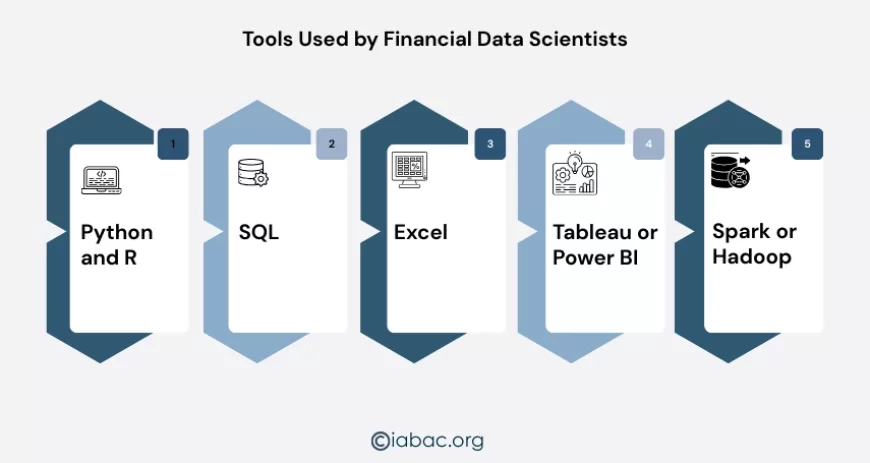
Tools Used by Financial Data Scientists
They collect, analyze, and present data using a variety of tools. Some of the most widely used tools are:
-
Python and R: Popular computer languages used for data analysis and machine learning.
-
SQL: For large-scale database administration and querying.
-
Excel: Still a popular tool for financial modeling and simple data analysis.
-
Tableau or Power BI: For making dashboards and reports that are visually appealing.
-
Spark or Hadoop: For handling large data management.
They can quickly process huge amounts of data and get valuable insights with the help of these tools.
Applications of Financial Data Science
There are many practical uses for financial data science, including:
1. Stock Market Predictions
To predict stock prices and trends, financial data scientists examine past market data. These predictions help investors make well-informed choices.
2. Credit Scoring
Used by banks to assess borrowers' creditworthiness. They determine credit scores that inform lending decisions by looking at income, repayment history, and other variables.
3. Fraud Prevention
By identifying questionable activity, fraud detection systems that use data science algorithms can help customers and banks reduce losses.
4. Risk Assessment
Data scientists are employed by investment businesses to evaluate market conditions and portfolio risks. Predictive models help in maximizing profits and reducing losses.
5. Customer Insights
In order to provide individualized services, financial institutions additionally study consumer behaviour. This could involve customized investment recommendations, loan offers, or marketing campaigns.
How to Get into Financial Data Science?
Anyone interested in finance and data can become a financial data scientist, even though it may seem difficult at first. The most important steps are as follows:
1. Build a Strong Educational Foundation
A degree in computer science, finance, economics, mathematics, or statistics should be your first choice. It is important to have a strong background in data analysis and finance.
2. Learn Data Science Skills
Learn SQL for database administration, become proficient in programming languages like Python or R, and research AI and machine learning ideas. You can develop these skills through boot camps, tutorials, and online courses.
3. Gain Finance Knowledge
Expand your knowledge of risk management, investing methods, and financial markets. It is beneficial to have a practical understanding of how financial institutions function.
4. Work on Projects
Practical experience is important. To show your skills, work with real-world datasets, develop prediction models, or design dashboards. Taking part in contests such as Kaggle can also be beneficial.
5. Get Certified
Employers view certifications as proof of your experience. For example, the Data Scientist Certification can increase your credibility as a data scientist and is acknowledged in the business.
6. Build a Professional Network
Make connections with data science and finance experts. Attend conferences, webinars, and seminars to keep updated on opportunities and trends.
7. Apply for Entry-Level Roles
Start with positions such as junior data scientist, financial analyst, or data analyst. These jobs give you practical knowledge and help with the transition to financial data science professions.
A financial data scientist is a special kind of professional who combines data science and finance. They manage risk, create predictive models, evaluate huge datasets, and use data-driven insights to inform business choices.
In the current financial environment, where businesses depend on data to make quicker and more informed decisions, this position is important. Anyone can become a financial data scientist with the correct set of data science abilities, finance knowledge, and real-world experience.
Consider improving your profile with the Data Scientist Certification if you're interested in pursuing this career path. It can provide you with the credibility and knowledge required to be successful in this expanding industry.