



























































What Is Applied Artificial Intelligence?
Learn what Applied Artificial Intelligence is, how it works in real-world applications, and why it’s essential for businesses and everyday life.


These days, applied artificial intelligence is no longer just a theoretical idea; it actively influences enterprises, industries, and everyday life. My hands-on experience advising businesses and entrepreneurs has shown me how applied AI transforms research ideas into practical solutions that increase productivity, reduce costs, and foster innovation.
Applied AI emphasizes creating systems with measurable impacts, unlike traditional AI research, which often stays within laboratories. The importance, relevance, and uses of applied AI today are explained clearly and simply for professionals, students, and curious readers.
What Do We Mean by “Applied AI”?
When people mention AI, they often mean robots that replicate human intellect – learning, reasoning, perception, and so on. However, a lot of AI concepts are still in theory, prototypes, or research laboratories. The area of artificial intelligence known as "applied AI" takes such concepts and makes them function in actual settings, such as companies, consumer apps, and industries.
In other words:
-
It is about taking action and creating reliable, functional systems.
-
It is contextual, conforming to safety, performance, ethics, and domain restrictions.
-
It finds value by improving user experience, accuracy, cost, or productivity.
In summary: applied AI = AI principles + real context + actual systems.
Why Is Applied AI Important?
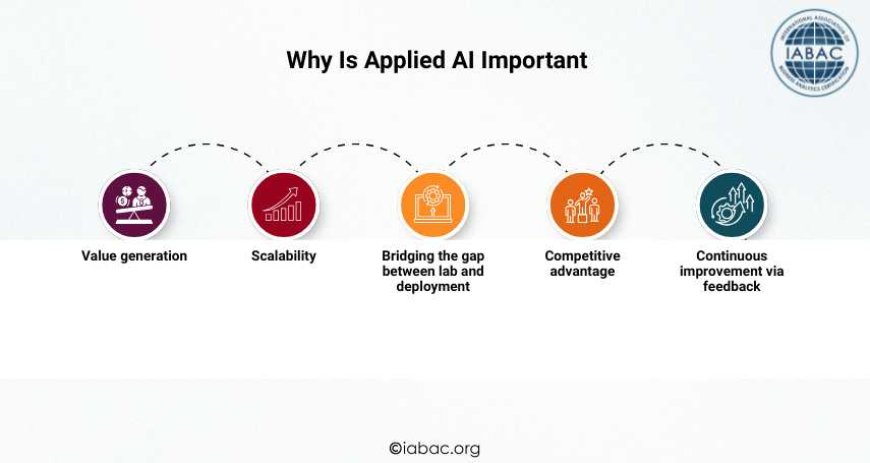
Why should we focus on applied AI instead of theory? The following are some main reasons:
-
Value generation
Although theory is excellent, systems only provide value when they truly address issues. Businesses may eliminate errors, automate processes, make better decisions, and develop new services with the help of applied AI. -
Scalability
Systems must handle edge cases, changing conditions, and noisy data in real-world settings. In order for AI to scale, applied AI connects theory with implementation. -
Bridging the gap between lab and deployment
A large number of research models are not "out of the box." Work on applied AI guarantees that AI is reliable, maintainable, intelligible, and compliant with non-technical limitations (such as privacy and regulations). -
Competitive advantage
Businesses that successfully implement AI frequently see improvements in productivity, creativity, customer satisfaction, and cost effectiveness. -
Continuous improvement via feedback
Real input is received by deployed systems. Models can be improved over time and adjusted to drift with the use of such feedback.
Applied AI vs. Basic AI Research
To make things clearer, let's compare applied AI with basic AI, also known as theoretical AI:
|
Aspect |
Basic / Research AI |
Applied AI |
|
Focus |
Novel algorithms, theory, and models |
Applying algorithms in practical settings |
|
Goal |
Publish new findings, push boundaries |
Solve domain problems, deliver value |
|
Environment |
Controlled datasets, synthetic settings |
Real data, real constraints, real users |
|
Performance metrics |
Benchmarks, accuracy, and new architectures |
Reliability, latency, maintainability, usability |
|
Constraints |
Fewer real-world constraints |
Must deal with missing data, noise, regulation, and integration |
|
Longevity |
Proof-of-concept prototypes |
Production systems, ongoing maintenance |
Applied AI complements research: good applied work frequently draws on research advances, but it also requires engineering, domain knowledge, system design, and, in many cases, cross-disciplinary collaboration.
Technologies, Techniques, and Building Blocks
Many of the methods used in general AI and machine learning are also used in applied AI, but with a focus on practical concerns. Here are some fundamental components that you will often see.
One of the fundamental AI techniques is machine learning. Instead of being explicitly coded with rules, it allows computers to learn from data.
Applied AI systems frequently create ML models such as:
-
Supervised learning (predict labels)
-
Unsupervised learning (cluster, find structure)
-
Reinforcement learning (learn via feedback)
-
Deep learning (neural networks, especially for images, text, etc.)
Data Engineering & Infrastructure
Many applications of applied AI deal with data, including gathering, cleaning, storing, and setting up pipelines to provide high-quality data for AI models to access. A poor data infrastructure can cause the best models to fail.
Feature Engineering & Feature Store
It's important to transform unstructured data into useful inputs or features. One way to manage and reuse features across models and apps is with a feature store.
Model Training, Tuning & Validation
One set of data is used to train the model, another is used for validation, hyperparameters are adjusted, and overfitting is checked. You also need to retrain and keep an eye on drift, which is the degradation of models over time, under applied settings.
Deployment & Serving
Models should be deployed into production as soon as they are prepared, by way of being incorporated into pre-existing systems, exposed as APIs, or embedded in apps. Think about versioning, scalability, and latency.
Monitoring & Feedback Loops
Monitoring of model accuracy over time, error rates, biases, and performance is necessary while implementing AI. Feedback loops help in the model's improvement and adaptation.
Explainability & Interpretability
Explainable AI judgments are required by users or authorities in many real-world systems. To explain "black box" models, methods like SHAP, LIME, and counterfactuals are employed.
Integration, Constraint Handling & Safety
Constraints that applied AI must manage include corporate standards, security, privacy, safety, and fairness. It needs to interface with databases, user interfaces, other software, and human workflows.
Edge AI, On-device AI & Hybrid Systems
AI models sometimes operate on mobile phones and Internet of Things devices with constrained memory, processing power, or connectivity. Models must be optimized using applied AI to function within those limitations.
Steps to Build an Applied AI System
This is a simplified road map for creating an applied AI solution:
-
Problem Definition & Domain Understanding
First, describe the problem, metrics, limitations, risks, and user impact in collaboration with domain experts. -
Data Collection & Exploration
Collect unprocessed data, identify patterns, clean it up, and preprocess it. -
Feature Engineering & Selection
Convert unstructured data into valuable features by eliminating noise and selecting relevant features. -
Model Selection & Training
Select, train, validate, and refine candidate models (such as neural nets and decision trees). -
Evaluation & Validation
Assess using pertinent metrics (accuracy, ROC, precision/recall, etc.) after testing on held-out data. -
Explainability & Safety Checks
Verify model behavior in edge situations, develop justifications, and assess bias and fairness. -
Deployment & Integration
Integrate the model with systems or user interfaces, and wrap it into a service or application. -
Monitoring & Feedback
Integrate the model with systems or user interfaces, and wrap it into a service or application. -
Maintenance & Continuous Improvement
Over time, iterate, improve, add features, or broaden the scope.
You can improve your chances of having a strong, practical, applied AI system by following these guidelines and best practices.
Tips for Beginners & Learners in Applied AI
-
Start small and with well-defined challenges. Focus on use cases that have quantifiable effects or a clear return on investment.
-
Collaborate with experts in the field. Making educated choices on features, constraints, and edge cases can be helped by domain knowledge.
-
Don’t skip engineering. Good software engineering, data pipelines, and modular architecture matter a lot.
-
Invest in monitoring & feedback. Deployed models must adapt; “set and forget” rarely works.
-
Learn MLOps & ML lifecycle management. Tools like versioning, experiment tracking, and automated pipelines help a lot.
-
Focus on interpretability, fairness, and ethics. These are essential for real adoption.
-
Stay updated with research & industry. Applied AI draws heavily on research advances.
-
Build a portfolio of projects. Implement end-to-end systems (data → model → deployment → monitoring) to gain experience.
When artificial intelligence's magic meets real-world needs, it's called applied artificial intelligence. Applied AI, as opposed to theory or prototype models, is concerned with resolving practical issues, integrating with systems, managing complex data, scaling, and long-term maintenance. In addition to model-building skills, it requires knowledge of the topic, software engineering, data infrastructure, ethics, and teamwork.
You may also think about getting a professional certification like the Artificial Intelligence Certification, which is widely accepted and can help confirm your knowledge in the subject, improve your applied AI skills and acquire industry trust.