



















































What is the Use of Artificial Intelligence?
The uses of Artificial Intelligence in everyday life, business, and technology, and how it drives efficiency and innovation.


Artificial Intelligence (AI) isn’t just a futuristic idea anymore—it’s all around us, quietly making life easier. From helping doctors spot health issues faster to recommending your next favorite movie, AI can do tasks that usually need human thinking, like learning, solving problems, and understanding language. Today, AI touches almost every part of our lives—at work, at school, on the road, and even in our homes.
Understanding AI
Before we look at how AI is used, it helps to know the main types of AI:
-
Narrow AI: AI that does one specific task, like chatbots or recommendation engines. This is the most common type today.
-
General AI: A type of AI that can do any task a human can do. This is still mostly theoretical.
-
Superintelligent AI: AI that is smarter than humans. This is a future idea and does not exist yet.
Most of the AI we see in daily life is narrow AI, which focuses on specific tasks to make work faster and smarter.
Automation and Efficiency
One of the main uses of AI is automation. It can take over repetitive tasks and help companies and people save time.
Repetitive Tasks
Many jobs include routine tasks that take time but do not need much thinking. AI can do these tasks, such as checking documents, transcribing calls, and answering common customer questions. For example, customer service chatbots use AI to give instant answers, which frees up human employees for more difficult tasks.
Process Optimization
AI also helps make processes more efficient. In healthcare, it can organize patient schedules and track treatments. In factories, AI can manage assembly lines and inventory. Banks use AI to process transactions quickly and find mistakes. Overall, AI helps reduce errors, saves time, and makes work run more smoothly.
Data Analysis and Insights
Companies and organizations create a huge amount of data every day. AI is good at looking at all this data, finding patterns, and giving useful information.
Large-Scale Data Processing
AI can quickly study complex data that humans might take days or months to understand. This is important for finance, marketing, healthcare, and other fields where decisions depend on accurate information. AI helps identify trends and make sense of large amounts of data.
Predictive Analytics
AI can also predict future events based on past data. In healthcare, AI can predict which patients might get sick or need extra care. In finance, AI can forecast market trends, evaluate risks, and detect fraud. Predictive analytics helps people and organizations make better decisions before problems happen.
Personalization and User Experience
AI improves how people interact with technology by customizing experiences to individual needs.
Customized Recommendations
Recommendation systems are a common example of AI. Websites and apps like Netflix, YouTube, and Amazon use AI to suggest movies, videos, or products based on what you like. This saves time for users and helps companies keep people engaged.
Intelligent Assistants
Virtual assistants like Siri, Alexa, and Google Assistant use AI to understand human language. They can manage tasks, give information, and help with daily routines. AI assistants make life easier and help people be more productive.
Communication and Collaboration
AI also enhances workplace communication and productivity:
-
Email filters and grammar tools improve writing quality.
-
AI-generated summaries, transcriptions, and reports save time for teams and enable more focused decision-making.
Problem-Solving and Decision-Making
AI also helps with problem-solving and decision-making by analyzing data and showing possible outcomes.
Medical Applications
In healthcare, AI helps doctors diagnose diseases, suggest treatments, and assist in surgeries. AI can find issues in X-rays, MRIs, and CT scans, supporting human expertise. It can also analyze patient data to create personalized care plans and predict possible complications, improving patient outcomes.
Safety and Risk Management
AI is used to detect risks in many areas. Banks use AI to spot unusual transactions and prevent fraud. Industries like construction and mining use AI to monitor dangerous areas, reducing the risk of accidents. These applications help keep humans safe and improve reliability.
Other Key Applications
Transportation
-
Self-Driving Vehicles: Autonomous and semi-autonomous cars use AI to navigate, detect obstacles, and make real-time driving decisions. Features like lane-keeping and adaptive cruise control enhance safety.
-
Edge AI and IoT Devices: Smart devices, wearables, and industrial sensors use AI to process data locally, making systems faster and less dependent on cloud computing.
Scientific Discovery
AI accelerates research and helps solve global challenges:
-
Research Applications: AI assists scientists by analyzing massive datasets, modeling scenarios, and testing hypotheses. This is crucial for drug discovery, climate research, and technology innovation.
-
Sustainability: AI helps optimize energy consumption, predict natural disasters, and manage resources efficiently, supporting environmental and conservation efforts.
Economic and Social Implications
AI affects not just work and technology but also society and the economy.
-
Job Changes: AI can replace some routine tasks but also creates new jobs in AI development, data analysis, and digital services.
-
Global Competitiveness: Countries and companies using AI efficiently can become more innovative and productive.
-
Accessibility: AI tools are now available to small businesses and individuals, making technology more widely usable.
These impacts show that AI is important not just for businesses but for society as a whole.
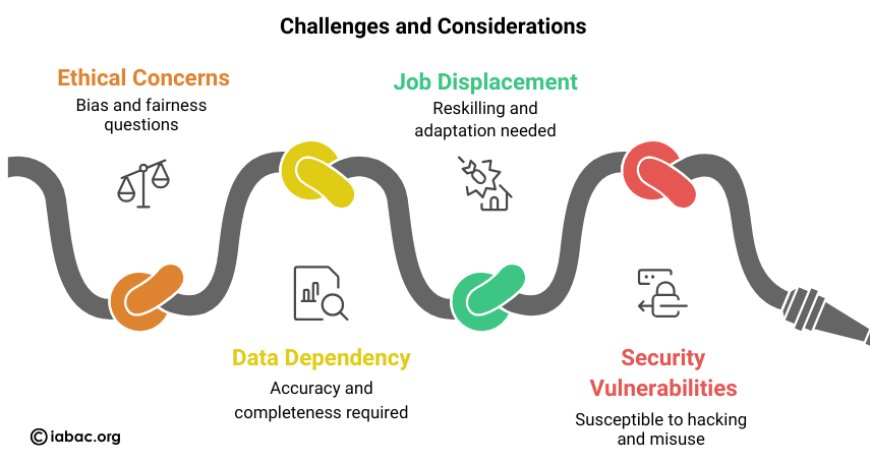
Challenges and Considerations
AI is powerful, but it also comes with challenges:
-
Ethical Issues: AI can inherit biases from its data or programs, which raises fairness and accountability questions.
-
Data Dependence: AI works well only if the data it uses is accurate and complete.
-
Job Displacement: Automation can reduce some jobs, making reskilling necessary.
-
Security Risks: AI systems can be vulnerable to hacking or misuse if not properly secured.
Understanding these challenges is key to using AI responsibly.
How to Leverage AI
Businesses and individuals can start using AI in practical ways without big investments:
-
Businesses: Automate repetitive tasks, use AI to analyze data, and offer personalized experiences to customers.
-
Individuals: Use AI for productivity tools, learning apps, and personal organization.
Starting small helps people and organizations understand the benefits of AI and expand its use gradually.
AI is evolving, and its future use will continue to grow:
-
Creative Work: AI is used in writing, art, music, and design.
-
Cybersecurity: AI helps detect and stop cyber threats faster.
-
Regulations and Ethics: Governments and companies are working to ensure AI is fair, transparent, and accountable.
These trends show that AI will continue to shape industries, daily life, and innovation in meaningful ways.