






















































How AI Agents Actually Work and Make Decisions
How AI agents think, make decisions, use memory, reasoning, and automation to complete complex tasks intelligently.

It is 2 a.m. No one is in the office. No one is clicking, typing, or making decisions.
And yet, somewhere inside a company's cloud infrastructure, an AI agent is quietly doing all three.
It has already scanned 400 customer support tickets, flagged the three most urgent ones, drafted personalized responses, escalated two edge cases to the right human teams, and updated the CRM — all while the building sat dark and empty.
This is not a futuristic pilot programme. It is happening right now, at companies across industries, at a scale that is growing faster than most people realize.
But here is what almost nobody talks about: how does an AI agent actually know what to do?
Not in a vague, hand-wavy sense. Specifically — how does it read a situation, weigh its options, pick an action, recover when something goes wrong, and keep moving toward a goal it was given hours ago by a human who is now asleep?
That question sits at the intersection of computer science, cognitive architecture, and something that starts to feel — if you look at it long enough — uncomfortably close to thinking.
This article answers it. We will pull back the curtain on how AI agents actually work and make decisions: the memory systems that give them context, the reasoning loops that guide their choices, the tools they wield, and the architectures that hold it all together. Whether you are building with AI, managing teams that use it, or simply trying to understand what is reshaping the world of work — this is the piece that connects the dots.
By the end, you will not just know what an AI agent is. You will understand why it does what it does. And that understanding is becoming one of the most valuable things a professional can have.
What Are AI Agents?
At its simplest, an AI agent is a software system that perceives its environment, processes information, makes decisions, and takes actions — all in pursuit of a defined goal.
Think of it like a chess player. A chess player looks at the board (perception), thinks through possible moves (reasoning), picks the best one (decision), and moves the piece (action). An AI agent follows the same loop — except its "board" could be a database, a browser, a codebase, or an enterprise workflow.
Unlike traditional automation — which follows rigid, rule-based scripts — autonomous AI agents are adaptive. They can handle new situations, course-correct when something goes wrong, and even break large goals into smaller sub-tasks without being explicitly told how.
The term "AI agent" gained significant traction with the rise of large language models (LLMs) like GPT-4 and Claude. These models gave agents powerful language understanding and generation capabilities, turning them from simple task-runners into genuine reasoning systems.
Core Components of AI Agents
Before understanding how an AI agent makes decisions, it helps to understand what it is built from. Every functional AI agent has four core components working in concert.
1. Perception Module
This is how the agent senses its environment. Inputs can include text, files, images, API data, web content, or user messages. The perception module converts raw inputs into structured information the agent can process.
2. Memory Systems
AI agents use multiple layers of memory:
|
Memory Type |
Description |
Example |
|
Short-term (context) |
Active information in the current session |
Current conversation history |
|
Long-term (external) |
Stored knowledge retrieved as needed |
Vector databases, user preferences |
|
Episodic memory |
Record of past actions and outcomes |
Prior task results |
|
Semantic memory |
General world knowledge |
Trained model weights |
Without effective memory systems, agents would restart every task from scratch — like waking up with amnesia each morning.
3. Reasoning and Planning Engine
This is the agent's brain. Using chain-of-thought reasoning, the agent works through multi-step logic: "To accomplish goal X, I need to do A, then B, then C. If B fails, I will try D." Modern LLM agents can break complex goals into structured sub-plans, much like a project manager breaking a launch into sprints.
4. Action Module (Tool Use)
Agents do not just think — they act. The action module allows agents to:
-
Call external APIs
-
Search the web
-
Write and execute code
-
Read and modify files
-
Trigger other agents or workflows
This is called tool calling, and it is what separates AI agents from passive chatbots.
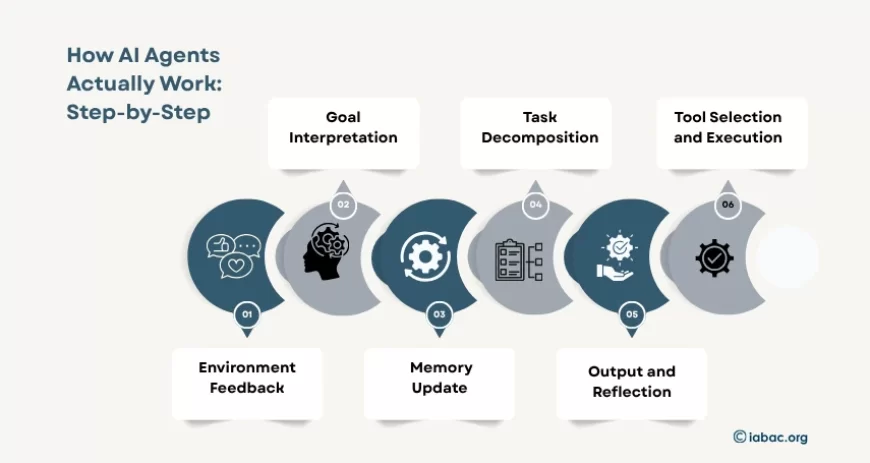
How AI Agents Actually Work: Step-by-Step
Here is a concrete walkthrough of how an AI agent processes a task from start to finish. Let us use a real-world example: "Research the top five competitors in our market and draft a summary report."
Step 1: Goal Interpretation
The agent receives the instruction and parses it into a clear objective. It identifies what success looks like: five competitors identified, information gathered, report written.
Step 2: Task Decomposition (Planning)
Using planning algorithms, the agent breaks the goal into actionable steps:
-
Search the web for relevant competitors
-
Visit each competitor's website and extract key information
-
Compare features, pricing, and positioning
-
Organize findings into a structured summary
-
Draft the report
Step 3: Tool Selection and Execution
For each sub-task, the agent selects the right tool. Web search for step one. A browser automation tool for step two. A text editor or template for step five. Crucially, the agent decides which tool to use and when — not a human programmer.
Step 4: Environment Feedback
After each action, the agent receives feedback from its environment. Did the search return useful results? Did the website load correctly? Based on this feedback, it adjusts its next step. This is the perception-reasoning-action loop in motion.
Step 5: Memory Update
Key findings are stored in the agent's contextual memory. As the task progresses, earlier research informs later decisions — the agent does not forget that competitor A uses a freemium model when comparing it to competitor C later.
Step 6: Output and Reflection
Once the sub-tasks are complete, the agent assembles the final report. More advanced agents also include a self-reflection step — reviewing their output for gaps or errors before delivering it.
This entire workflow can happen in minutes, autonomously, without human intervention at each step.
How AI Agents Make Decisions
This is where things get intellectually interesting. AI decision-making is not a single mechanism — it is a layered process involving several cognitive strategies.
Chain-of-Thought Reasoning
Modern LLM agents use chain-of-thought (CoT) prompting to reason step-by-step rather than jumping to conclusions. Instead of answering "What should I do next?" directly, the agent generates an internal monologue: "The user wants X. I currently know Y. The gap is Z. To close that gap, I should do..."
This technique dramatically improves the accuracy and coherence of complex decisions.
Goal-Based and Utility-Based Decision Making
Some agents operate on goal-based logic: they evaluate each possible action by asking "does this bring me closer to the goal?" Others use utility-based logic, assigning a numerical value to different outcomes and choosing the action with the highest expected value.
Enterprise-grade AI agents often blend both approaches, especially in multi-step workflows where some actions carry higher risk or cost.
Reinforcement Learning and Feedback Loops
Agents designed for repeated tasks can improve over time using reinforcement learning principles. They receive positive or negative signals based on outcomes and adjust future decisions accordingly. Think of this as the agent developing intuition — not from biology, but from accumulated feedback.
Uncertainty and Fallback Logic
What happens when an agent does not know what to do? Good agentic design includes fallback strategies: request clarification, escalate to a human, try an alternative path, or stop gracefully. This uncertainty management is a hallmark of mature AI reasoning engines.
Types of AI Agents
Not all AI agents are built the same. Understanding the taxonomy helps contextualize how different agents are deployed.
|
Agent Type |
How It Works |
Best For |
|
Reactive Agents |
Respond to current inputs only; no memory |
Simple, real-time tasks |
|
Deliberative Agents |
Maintain an internal model and plan ahead |
Complex, multi-step workflows |
|
Goal-Based Agents |
Evaluate actions against a defined goal |
Research, strategy tasks |
|
Learning Agents |
Improve through experience and feedback |
Adaptive, iterative systems |
|
Multi-Agent Systems |
Multiple agents collaborating or competing |
Enterprise orchestration |
Multi-agent systems deserve special attention. In these architectures, one "orchestrator" agent manages a team of specialized sub-agents — a researcher agent, a writer agent, a coder agent — each handling its area of expertise. This mirrors how human teams operate and is rapidly becoming the standard for enterprise AI workflow automation.
AI Agent Architecture Explained
A complete AI agent architecture is best understood in layers.
[ User / Environment ]
↓
[ Perception Layer ] ← Reads inputs, senses environment
↓
[ Memory Layer ] ← Stores context, history, knowledge
↓
[ Reasoning / Planning ] ← Breaks goals into steps, selects strategies
↓
[ Action Layer ] ← Calls tools, executes tasks, triggers outputs
↓
[ Reflection Layer ] ← Reviews outputs, updates memory, loops back
This architecture is sometimes called a cognitive architecture because it mirrors how human cognition moves from perception to action. The reflection layer — unique to more advanced agentic AI — is what enables self-correction and continuous improvement.
Popular frameworks for building this kind of architecture include LangChain, AutoGen, CrewAI, and LlamaIndex. Each provides scaffolding for connecting LLMs to tools, memory stores, and orchestration logic.
Real-World Applications of AI Agents
Theory only goes so far. Here is where agentic AI is actively delivering value today.
Customer Support and Resolution
AI agents in customer support do more than answer FAQs. They access account databases, process refunds, update records, and escalate unresolved cases — all within a single conversation. Companies like Intercom and Zendesk have integrated agentic layers that dramatically reduce average handling time.
Software Development
AI copilots like GitHub Copilot go beyond autocomplete. Agentic development tools can write entire modules, run tests, identify bugs, and suggest fixes — reducing time-to-deployment significantly. Developers using these tools report handling more complex projects with smaller teams.
Financial Analysis and Reporting
Investment firms deploy LLM agents that monitor news, scrape financial filings, run sentiment analysis, and generate daily briefings — tasks that would require a small analyst team. The agent does not replace judgment; it compresses the research cycle.
Healthcare Administration
AI agents handle appointment scheduling, insurance pre-authorization, patient intake, and clinical documentation — freeing medical staff for direct patient care. Some agents assist in literature review for diagnostic support.
Enterprise Workflow Automation
Arguably the highest-growth area. An AI agent can connect to a company's CRM, email, calendar, and project management tools and orchestrate complex workflows — like processing a new client onboarding — without human coordination at each step.
Challenges and Risks of Agentic AI
Honest analysis requires acknowledging where AI agents fall short or introduce new risks.
Hallucination and Factual Errors
LLMs can generate plausible-sounding but incorrect outputs. In an agentic context, a single hallucination early in a workflow can cascade into compounding errors — especially without human checkpoints.
Security and Prompt Injection
Agents that browse the web or read external documents are vulnerable to prompt injection attacks — where malicious content in the environment hijacks the agent's instructions. This is an active area of AI security research.
Over-Autonomy and Misalignment
Giving agents too much authority without oversight creates risks when their interpretation of a goal diverges from human intent. The field of AI governance is developing frameworks for human-in-the-loop checkpoints, especially for high-stakes decisions.
Cost and Latency
Complex agentic workflows can require dozens of LLM calls, tool invocations, and external API requests. Computational cost and response latency remain engineering challenges, particularly at enterprise scale.
Auditability and Explainability
When an agent makes a decision, can it explain why? Regulatory environments — especially in finance, healthcare, and legal — increasingly require explainable AI. Many current LLM agents lack robust audit trails.
Future of Agentic AI
The trajectory is steep and the pace is accelerating.
Multi-agent collaboration will become the norm. Rather than single powerful agents, enterprises will deploy ecosystems of specialized agents that communicate, delegate, and cross-check each other — forming what some researchers call "AI organizations."
Memory and personalization will deepen. Future agents will maintain rich, structured memories of individual users, their preferences, past interactions, and organizational context — enabling truly personalized intelligent automation.
Proactive agents will emerge — systems that do not wait for instructions but monitor their environment and act when conditions are met. Imagine an agent that detects a spike in customer complaints, investigates the root cause, drafts a response strategy, and alerts the team — all before a human notices the trend.
AI governance and standards will formalize. As agents gain more autonomy, regulatory bodies and industry organizations will establish standards for transparency, accountability, and safety. Professionals who understand both AI capability and governance will be disproportionately valuable.
Embodied and physical agents — robots and autonomous vehicles guided by LLM-style reasoning — will bring agentic AI into the physical world, merging digital decision-making with physical action at scale.
Why AI Agent Skills Matter for Professionals
The rise of agentic AI is not just a technology story — it is a workforce story.
Professionals who understand how AI agents work, how to design agentic workflows, and how to govern autonomous systems are becoming indispensable. This spans roles across engineering, product management, operations, legal, and strategy.
The skills most in demand include:
-
Prompt engineering and agent design — structuring instructions that produce reliable, goal-directed agent behavior
-
Workflow orchestration — designing multi-step, multi-tool pipelines that an agent can execute reliably
-
AI evaluation and testing — knowing how to assess whether an agent is performing correctly and safely
-
AI governance — understanding the ethical, legal, and organizational frameworks for deploying autonomous systems
Organizations that invest in upskilling their teams in these areas are moving faster, deploying smarter, and building competitive advantages that are hard to replicate.
How AI Agents Actually Work — and Why It Matters for You
Understanding how AI agents actually work and make decisions is no longer a niche technical interest. It is a fundamental literacy for the era we are entering.
AI agents represent a qualitative shift in what software can do — from executing fixed instructions to pursuing open-ended goals, adapting to changing conditions, and operating with meaningful autonomy. That shift has enormous implications for how businesses are organized, how work is designed, and what skills professionals need.
As organizations move from experimenting with AI to deploying it at scale, the gap between those who understand agentic systems and those who do not will widen rapidly. Practical expertise in AI architecture, decision-making frameworks, and intelligent automation will be core to leadership at every level.
For professionals looking to build structured, industry-relevant expertise in this space, programs like those offered by IABAC (International Association of Business Analytics Certifications) provide a pathway to recognized credentials in Artificial Intelligence, automation, and data-driven decision-making. As agentic AI moves from pilot projects to enterprise infrastructure, having verified skills in these areas can meaningfully accelerate career growth.
The agents are already working. The question is whether you understand them well enough to work with them — and lead the teams that build them.