

























































How to Become a Data Scientist in India
Become a data scientist in India with this practical roadmap, skills, salary, step-by-step guide, and tips to land your first data science job faster.

If you had asked me five years ago what it takes to break into data science in India, I would have told you to get a master's degree, learn Python, and hope for the best. That advice was incomplete then, and it is dangerously incomplete now.
The market has shifted. India currently contributes around 11.6% of global data science job openings and sits among the top countries hiring data professionals. Companies from Swiggy and Zepto to Goldman Sachs and Google are building serious data science teams here. The demand is real. But so is the competition.
What Does a Data Scientist in India Actually Do?
A data scientist's core job is to turn messy, incomplete, sometimes contradictory data into decisions that businesses can act on. That sounds straightforward until you are three weeks into a project, the data pipeline is broken, the business team keeps changing requirements, and your model is performing beautifully in notebooks but failing in production.
What the role looks like
In an Indian company context, this often means working across multiple roles simultaneously. At a startup, a data scientist might own everything from data cleaning to model deployment to presenting results to the CXO. At an MNC like Infosys or TCS, the role is more structured, with dedicated data engineers and analysts supporting the workflow.
Core responsibilities
-
Data wrangling
-
Exploratory analysis
-
Building machine learning models
-
Working with business stakeholders
-
Communicating results clearly
The technical skills matter, but so does your ability to translate numbers into plain business language.
The Data Scientist Job Market in India Right Now

India's data science job market went through a correction phase in 2023, with some companies trimming analytics teams. But by 2026, hiring has picked up significantly, driven by three major forces.
Digital transformation across sectors: Banking, healthcare, retail, and logistics are all generating more data than they know what to do with. Companies are actively investing in people who can make sense of it.
Government-backed AI momentum: Initiatives like Digital India and the National AI Mission are creating real infrastructure for data-driven industries, which in turn create more data science roles.
GenAI integration: With generative AI becoming part of enterprise workflows, data scientists who understand large language models, prompt engineering, and AI-assisted analytics are in exceptional demand right now.
Major hiring cities remain Bengaluru, Hyderabad, Mumbai, Pune, and Delhi-NCR. Hyderabad deserves special mention because global giants like Google, Microsoft, Amazon, and Facebook have set up significant operations there, creating high-quality roles outside of Bengaluru's saturated market.
Data Scientist Salary in India: What to Actually Expect
If you're planning to become a data scientist in India, understanding salary expectations early helps set realistic goals.
According to Glassdoor data, the average data scientist salary in India sits at approximately ₹15.5 LPA, with the typical pay range between ₹10 LPA (25th percentile) and ₹22.78 LPA (75th percentile).
Here is how it breaks down across career stages:
Fresher / Entry-level (0 to 2 years): Entry-level roles typically pay ₹6 to ₹14 LPA, though IIT and NIT graduates joining top product companies often command ₹12 to ₹20 LPA. Most people start in the ₹6 to ₹9 LPA range at good analytics or IT companies.
Mid-level (3 to 6 years): Professionals with three to five years of experience command salaries ranging from ₹10 to ₹15 LPA, with employers valuing their ability to manage complex datasets, build predictive models, and implement actionable insights.
Senior-level (6+ years): Senior data scientists can reach ₹20 to ₹30 LPA or higher, and in leadership roles at MNCs or product companies, compensation can exceed ₹1 crore annually when factoring in ESOPs and bonuses.
One thing that salary tables rarely capture is the role of specialisation. A data scientist with strong skills in GenAI, MLOps, or NLP commands a premium that the average figures simply do not reflect. Domain expertise in finance or healthcare adds another layer of leverage.
What Skills Do You Need to Become a Data Scientist in India?
Here is where most roadmaps go wrong. They list every tool and library known to humanity and leave you paralysed. Let me give you the practical hierarchy instead.
The Foundation Skills (Non-Negotiable)
Python: There is no debate here. Python is the primary language of data science in India and globally.
Focus on core libraries: Pandas for data manipulation, NumPy for numerical computing, Matplotlib and Seaborn for visualisation, and Scikit-learn for machine learning. You should be comfortable writing clean, reusable code, not just notebooks that only you can understand.
SQL: Almost every data science job in India requires solid SQL skills. You will use it to pull data, write complex joins, create aggregations, and sometimes build analytical features. If you cannot write a window function query confidently, keep practising.
Statistics and Probability: This is the foundation that separates data scientists from people who run machine learning code without understanding it. Hypothesis testing, regression, probability distributions, Bayesian thinking — these are the mental models behind every model you build.
Machine Learning Fundamentals: Supervised learning (regression, classification), unsupervised learning (clustering, dimensionality reduction), model evaluation, and cross-validation. Understanding when to use which algorithm matters far more than memorising every algorithm.
Strong foundations separate long-term growth from surface-level learning. To build a solid base in data science, consider the Data Science Foundation certification. We focus on strengthening your profile through a structured syllabus, a hands-on approach, real project experience, and guidance from experienced data scientists.
The Next Layer (Builds Your Edge)
Data Visualisation: Tableau and Power BI are widely used in Indian companies for business reporting. Knowing how to present your analysis visually is as important as the analysis itself.
Cloud Platforms: AWS, Google Cloud, or Azure. Most production data science workloads in India run on cloud infrastructure. Even a strong foundational certification signals seriousness to recruiters.
Version Control: Git is mandatory. If your projects are not on GitHub, they effectively do not exist for most interviewers.
Deep Learning Basics: TensorFlow or PyTorch. You do not need to be an expert, but understanding neural network architectures, training pipelines, and common applications (image classification, text analysis) opens a significantly larger set of job opportunities.
Big Data Tools: Spark, Hadoop, and similar frameworks are relevant for companies dealing with very large datasets. This matters more for data engineering adjacent roles.
The Soft Skills Nobody Talks About Enough
Communication is genuinely the skill that holds back otherwise excellent data scientists.
If you can build a churn prediction model but cannot explain its implications to a product manager in plain language, you will be stuck in a corner.
Practice writing clear summaries of your analyses. Practice presenting to non-technical audiences.
Business acumen follows closely. Understanding what the company is trying to achieve, what success looks like, and how your model connects to revenue or cost.
Educational Paths Into Data Science in India
There is no single path, and that is actually good news.
Traditional Degrees
A bachelor's degree in Computer Science, Mathematics, Statistics, or Engineering provides a solid foundation. Many working data scientists in India hold B.Tech degrees from NITs or state engineering colleges, supplemented by self-learning and certifications.
Research shows that while 65% of data scientists in India hold master's degrees, employers are increasingly willing to waive formal degree requirements in favour of relevant skills and real-world project experience. This shift is significant.
Professional Certifications
Globally recognised certifications from IABAC, Google, IBM, and DeepLearning.AI carry real weight in the Indian job market when backed by strong portfolio projects.
Bootcamps
Intensive bootcamps from credible providers can compress a learning timeline significantly. The good ones offer mentorship, real projects, and placement support. The trap to avoid is paying for a bootcamp and treating it like college — passive attendance will not prepare you for interviews.
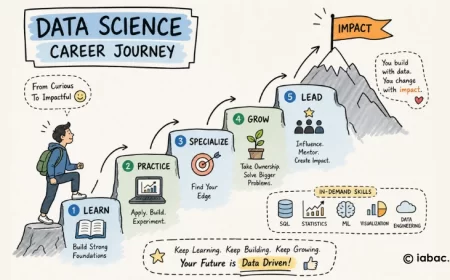
The Step-by-Step Data Science Roadmap for India
Step 1: Build Your Technical Foundation (3–6 months)
Start with Python and SQL together. Don’t overthink it—pick one beginner-friendly Python course and complete it fully.
Once you understand the basics, start solving small data problems:
-
Clean a dataset
-
Analyze trends
-
Answer simple business questions
Platforms like Kaggle are great for this. Their short courses and practice exercises help you apply what you learn immediately.
Step 2: Learn Machine Learning the Right Way (2–4 months)
Take your time here—this is where most people rush and struggle later.
Start with simple datasets like:
-
Titanic survival
-
Iris classification
-
Housing price prediction
Use tools like Scikit-learn to build basic models.
Then slowly move to messy, real-world datasets.
Also, focus on how to evaluate models properly:
-
Accuracy is not enough
-
Learn precision, recall, F1 score, and ROC-AUC
-
Understand when to use each metric
These concepts are asked in almost every interview.
Step 3: Build a Portfolio That Proves Your Skills
Your portfolio is what gets you shortlisted—especially if you don’t have experience.
Aim for 3–5 complete projects on GitHub.
Each project should clearly explain:
-
The problem
-
Your approach
-
Key results
-
Business impact
Make sure:
-
One project uses messy, real-world data
-
One shows strong data visualisation
Good project ideas for India:
-
Customer churn prediction (telecom)
-
Crop yield prediction (agriculture)
-
Credit risk analysis (finance)
-
Demand forecasting (e-commerce)
Also, write 2–3 short posts on LinkedIn or Medium explaining your work.
This shows you can communicate—not just code.
Step 4: Get Real Experience Before Your First Job
Don’t wait for a full-time job to gain experience.
Start with:
-
Internships
-
Freelance work
-
Small real-world projects
Apply actively on:
-
LinkedIn
-
Naukri
-
AngelList (Wellfound)
-
Company career pages
Kaggle competitions help—but treat them as practice, not shortcuts.
If you’re already working (in tech, analytics, or business), try moving into data-related work within your current company. Internal transitions are often easier.
Step 5: Prepare for Interviews the Smart Way
Most data science interviews in India include:
-
SQL and basic coding
-
Machine learning concepts
-
Probability and statistics
-
Case study or project discussion
The case study round is very important.
You’ll be asked things like:
-
How would you solve this business problem?
-
What data would you use?
-
What model would you choose?
-
How would you measure success?
Practice explaining your thinking clearly.
For preparation:
-
Use LeetCode or StrataScratch for SQL
-
Revise ML concepts regularly
-
Try teaching concepts—it helps you find gaps
Step 6: Land Your First Job and Grow Smartly
Your first job is about learning, not just salary.
Choose roles where:
-
You work on real data
-
You get mentorship
-
You solve real business problems
Even if the pay is slightly lower, the experience matters more early on.
After 2–3 years, you can specialise in areas like:
-
Machine Learning Engineering
-
NLP (Natural Language Processing)
-
MLOps
-
Data Science Leadership
Think about your direction before your second job switch—it will shape your long-term growth.
What Most People Get Wrong

After years of seeing talented people struggle to land data science roles they were technically qualified for, a few patterns keep appearing.
Certifications for Projects: Certifications signal structured learning and industry alignment, while projects prove real-world ability. Interviewers evaluate both. Build projects alongside a certification from globally recognised certification bodies, so your learning stays practical and aligned with what companies actually expect.
Ignoring business context: Every project you build should have a "so what." Why does this prediction matter? What would a company do differently because of it? Train yourself to answer this before you close the notebook.
Skipping the deployment piece entirely: You do not need to be a software engineer. But knowing how to put a model behind a simple API using Flask or FastAPI, containerise it with Docker, and deploy it on a cloud platform separates you from most of the data science candidates in India.
Only targeting "Data Scientist" roles: Data Analyst, Junior ML Engineer, Business Intelligence Analyst, and Analytics Engineer roles are legitimate entry points that lead to data science. Do not be rigid about the title when you are starting.
Neglecting communication skills: Write about your projects. Post on LinkedIn. Explain technical topics in simple language. The data scientists who advance fastest are almost always the ones who can speak both languages, technical and business.
FAQs
Q1. Can I become a data scientist in India without a degree in computer science or statistics?
Yes, this is increasingly common. Many come from engineering, economics, finance, or even non-technical backgrounds. Employers prioritise skills, projects, and interview performance—but you must build strong foundations in statistics and programming.
Q2. How long does it take to become a data scientist in India from scratch?
Typically, 12 to 18 months of focused learning and projects is enough to become job-ready. The key is to learn and apply simultaneously, and start applying before you feel fully ready.
Q3. Is data science a good career in India for the next 10 years?
Yes, but it is evolving. Routine tasks are being automated, while demand is rising for skills in business understanding, GenAI, and MLOps. Continuous upskilling is essential.
Q4. Which city in India is best for a data science career?
Bengaluru leads in opportunities, followed by Hyderabad. Mumbai is strong for finance roles. For freshers, Bengaluru and Hyderabad offer the best exposure and job volume.
Q5. Do I need to know deep learning to get a data science job in India?
Not necessarily. Most entry-level roles require strong machine learning fundamentals. Deep learning is needed for specialised roles, but basic familiarity gives you an edge.
Becoming a data scientist in India is achievable across diverse backgrounds. The market is strong, salaries are competitive, and the work is intellectually rewarding. But success goes beyond courses; it requires real projects, clear communication, and a long-term mindset. Focus on depth in learning, build practical projects, and practice explaining concepts simply. Apply early, even if you feel unready, and learn from rejections.
The first job is just the beginning. In data science, consistency, curiosity, and the ability to learn from experience matter far more than brilliance alone.
If you still have doubts or confusion about starting your data science career, connect with the IABAC team to get clarity on your next steps. Our certified experts can help you define a clear roadmap, identify skill gaps, and move from learning to job-ready with confidence.
The path to becoming a data scientist in India is not linear, but it becomes clearer with the right skills, consistent execution, and expert guidance.